This Tree Dedicated to the Future Generations of Americans
1638 — 1938
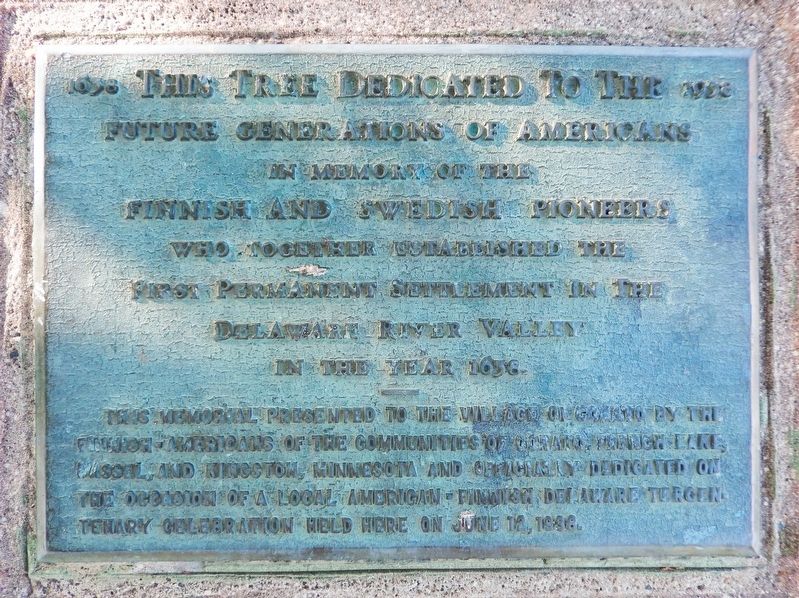
In memory of the Finnish and Swedish pioneers who together established the First Permanent Settlement in the Delaware River Valley in the year 1638.
Erected 1938.
Topics. This historical marker is listed in these topic lists: Immigration • Settlements & Settlers. A significant historical year for this entry is 1638.
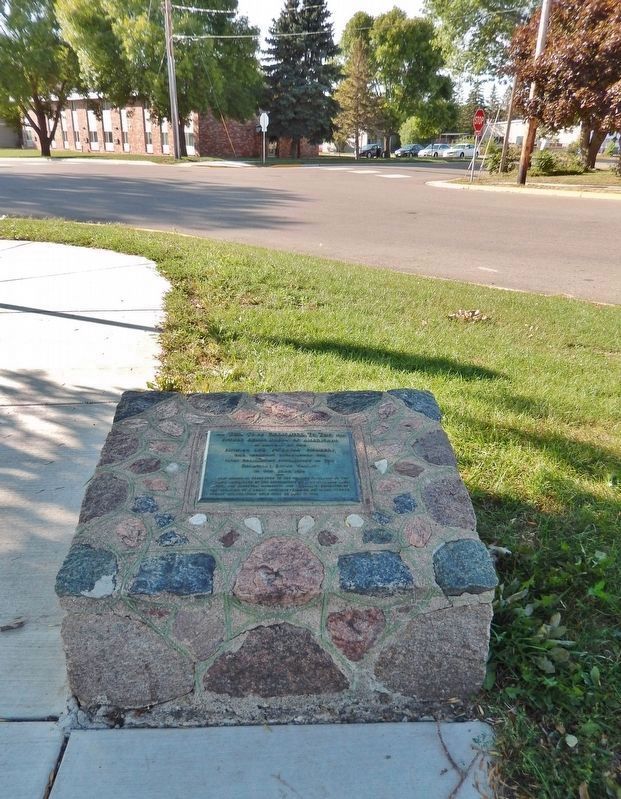
Location. 45° 4.506′ N, 94° 11.496′ W. Marker is in Cokato, Minnesota, in Wright County. It is at the intersection of 4th Street Southwest and Jenks Avenue Southwest, on the left when traveling west on 4th Street Southwest. The marker beside the sidewalk near the northwest corner of Peterson Park. Touch for map. Marker is at or near this postal address: 655 Broadway Avenue South, Cokato MN 55321, United States of America. Touch for directions.

Regionally, this marker is in the Twin Cities Metropolitan Area. It is also
this page online
Other nearby markers. At least 8 other markers are within 6 miles of this marker, measured as the crow flies: Mill Stones (within shouting distance of this marker); Veterans Memorial (about 300 feet away, measured in a direct line); Unity Park (about 600 feet away); The Dustin Massacre (approx. 4.4 miles away); Wright County Centennial Elm Tree (approx. 5.6 miles away); Dassel Area Veterans Memorial (approx. 5.6 miles away); West End Elevator (approx. 5.8 miles away); Howard Lake City Hall (approx. 6 miles away). Touch for a list and map of all markers in Cokato.
Related markers. Click here for a list of markers that are related to this marker.
Also see . . .
1. The Tercentenary Celebration in Cokato (Delano Herald Journal).
(by Jennifer Kotila, July 18, 2011) Excerpt: The Cokato Enterprise in(Submitted on August 30, 2026, by Cosmos Mariner of Cape Canaveral, Florida.)1938 reported that “the (tercentenary) celebration will commemorate the day 300 years ago when a ship landed at the mouth of the Delaware River, bringing the first Swedish and Finnish settlers to America.” The marker, and the celebration around it June 12, 1938, was a very big affair in Cokato, taking place from noon and lasting well into the evening.Photographed by Cosmos Mariner, September 7, 20232. This Tree Dedicated to the Future Generations of Americans MarkerLooking northwest through the northwest corner of Peterson Park across 4th Street Southwest. Jenks Avenue Southwest crosses in the background.“Several thousand persons thronged Cokato Sunday to attend the fete commemorating the 300th anniversary,” reported the Enterprise newspaper. Celebrations were held throughout the US, coinciding with the Swedish celebration of the tercentenary. A National Finnish Delaware Tercentenary committee was formed, along with a local committee with members from Cokato, Annandale, Dassel, and Kingston, reported the Enterprise.
Several prominent people came to speak at the celebration, including Governor Elmer Benson, as chairman of the state legislative committee for the Delaware Tercentenary committee. Benson dedicated the memorial, which was presented by William Onkka of Cokato as a representative of the Finnish Tercentenary Committee. R.M. Peterson accepted the memorial on behalf of the park committee
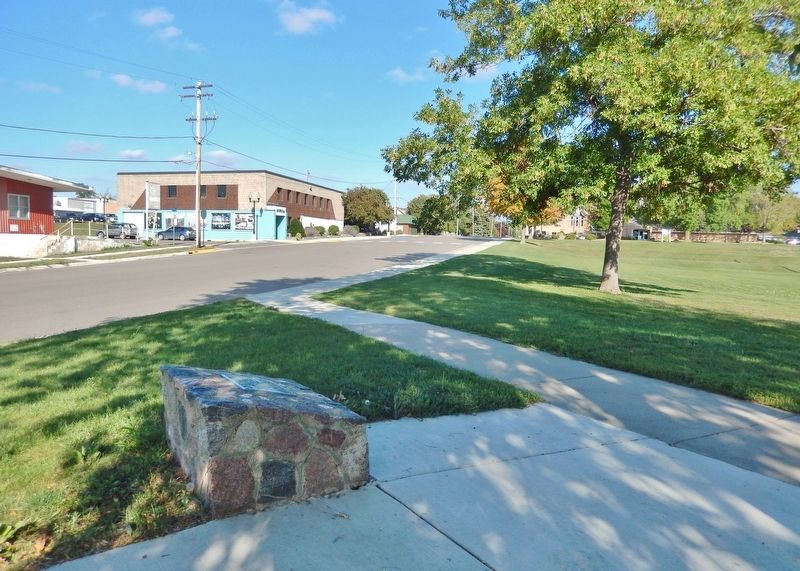
and the village of Cokato.Photographed by Cosmos Mariner, September 7, 20233. This Tree Dedicated to the Future Generations of Americans MarkerLooking east along 4th Street Southwest. The north end of Peterson Park is in the right background.
2. Fort Christina (Wikipedia).
Excerpt: Fort Christina, also called Fort Altena, was the first Swedish settlement in North America and the principal settlement of the New Sweden colony. Built in 1638 and named after Christina, Queen of Sweden, it was located just east of present-day downtown Wilmington, Delaware, at the confluence of the Brandywine River and the Christina River, approximately 2 mi upstream from the mouth of the Christina on the Delaware River.(Submitted on August 30, 2026, by Cosmos Mariner of Cape Canaveral, Florida.)In 1938, to celebrate the 300th anniversary of the Swedish colonization of the area, the state of Delaware created a park which contained the Rocks and the site of the former forts. The dedication was attended by U.S. President Franklin D. Roosevelt, Crown Prince Gustav Adolf, Crown Princess Louise, and Prince Bertil.
3. Cokato History (City of Cokato).
Excerpt: The first settlers arrived in Cokato in 1858, settling just south of Sucker Creek. Cokato and Stockholm Townships were established in July 1868. The first settlers were people from states like New York, New Hampshire, and Maine. They came to speculate (buy and re-sell) land and establish businesses. Soon, waves of immigrants from Europe began to arrive. They were mostly from Sweden and Finland, but also included Norwegians, Germans, Poles, and Bohemians. Today, Cokato is still known as a Swedish and Finnish community.(Submitted on August 30, 2026, by Cosmos Mariner of Cape Canaveral, Florida.)
Credits. This page was last revised on August 30, 2026. It was originally submitted on August 27, 2026, by Cosmos Mariner of Cape Canaveral, Florida. This page has been viewed 13 times since then. Photos: 1, 2, 3. submitted on August 30, 2026, by Cosmos Mariner of Cape Canaveral, Florida.
