Hilton Beach in Algoma District, Ontario — Central Canada (North America)
Black Hole or Flogging/Le trou noir, ou le fouet?
| — | Fort Saint Joseph National Historic Site | — |
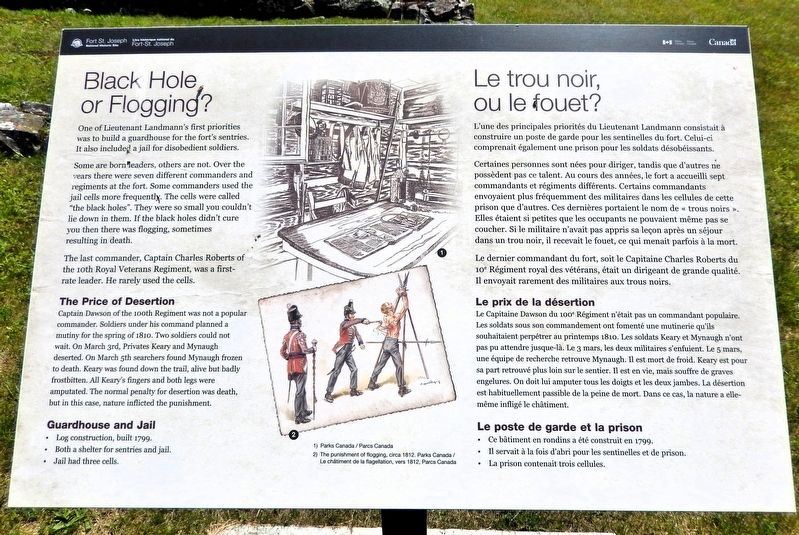
Photographed by Cosmos Mariner, June 10, 2024
1. Black Hole or Flogging/Le trou noir, ou le fouet? Marker

One of Lieutenant Landmann's first priorities was to build a guardhouse for the fort's sentries. It also included a jail for disobedient soldiers.
Some are born leaders, others are not. Over the years there were seven different commanders and regiments at the fort. Some commanders used the jail cells more frequently. The cells were called “the black holes.” They were so small you couldn't lie down in them. If the black holes didn't cure you then there was flogging, sometimes resulting in death.
The last commander, Captain Charles Roberts of the 10th Royal Veterans Regiment, was a first-rate leader. He rarely used the cells.
The Price of Desertion
Captain Dawson of the 100th Regiment was not a popular commander. Soldiers under his command planned a mutiny for the spring of 1810. Two soldiers could not wait. On March 3rd, Privates Keary and Mynaugh deserted. On March 5th searchers found Mynaugh frozen to death. Keary was found down the trail, alive but badly frostbitten. All Keary's fingers and both legs were amputated. The normal penalty for desertion was death, but in this case, nature
this page online
Guardhouse and Jail
• Log construction, built 1799.
• Both a shelter for sentries and jail.
• Jail had three cells.
[image captions]
• The punishment of flogging, circa 1812. [Parks Canada]
L'une des principales priorités du Lieutenant Landmann consistait à construire un poste de garde pour les sentinelles du fort. Celui-ci comprenait également une prison pour les soldats désobéissants.
Certaines personnes sont nées pour diriger, tandis que d'autres ne possèdent pas ce talent. Au cours des années, le fort a accueilli sept commandants et régiments différents. Certains commandants envoyaient plus fréquemment des militaires dans les cellules de cette prison que d'autres. Ces dernières portaient le nom de « trous noirs ». Elles étaient si petites que les occupants ne pouvaient même pas se coucher. Si le militaire n'avait pas appris sa leçon après un séjour dans un trou noir, il recevait le fouet, ce qui menait parfois à la mort.
Le dernier commandant du fort, soit le Capitaine Charles Roberts du 10e Régiment royal des vétérans, était un dirigeant de grande qualité. Il envoyait

Photographed by Cosmos Mariner, June 10, 2024
2. Black Hole or Flogging/Le trou noir, ou le fouet? Marker
Looking south across the Fort Saint Joseph National Historic Site. The Guardhouse and Jail (1799) foundation is beside the marker.
Le prix de la désertion
Le Capitaine Dawson du 100e Régiment n'était pas un commandant populaire. Les soldats sous son commandement ont fomenté une mutinerie qu'ils souhaitaient perpétrer au printemps 1810. Les soldats Keary et Mynaugh n'ont pas pu attendre jusque-là. Le 3 mars, les deux militaires s'enfuient. Le 5 mars, une équipe de recherche retrouve Mynaugh. Il est mort de froid. Keary est pour sa part retrouvé plus loin sur le sentier. Il est en vie, mais souffre de graves engelures. On doit lui amputer tous les doigts et les deux jambes. La désertion est habituellement passible de la peine de mort. Dans ce cas, la nature a elle-même infligé le châtiment.
Le poste de garde et la prison
• Ce bâtiment en rondins a été construit en 1799.
• Il servait à la fois d'abri pour les sentinelles et de prison.
• La prison contenait trois cellules.
[légendes d'images]
• Le châtiment de la flagellation, vers 1812 [Parcs Canada]
Erected by Parks Canada / Parcs Canada.
Topics. This historical marker is listed in these topic lists: Forts and Castles • Law Enforcement. A significant historical year for this entry is 1799.
Location. 46° 3.776′ N, 83° 56.788′ W. Marker is in Hilton Beach, Ontario, in Algoma District. It can be reached from Fort Road 4.8 kilometers west of A Line Road. The marker is on the Fort St. Joseph National Historic Site interpretive trail. Touch for map. Marker is at or near this postal address: 185 Fort Road, Hilton Beach ON P0R 1G0, Canada. Touch for directions.

Regionally, this marker is in the Sault Ste. Marie and Algoma Area and in Northern Ontario. It is also in Central Canada. Globally, it is in North America, in the Great North Woods, on the Great Lakes, on Lake Superior’s North Shore, in the Western Hemisphere, in the Western World, and in the Anglosphere. Historically, it finds itself in what was once a British colony, the Viceroyalty of New France, the Haudenosaunee (Iroquois) Confederacy, and Rupert’s Land.
Other nearby markers. At least 8 other markers are within walking distance of this marker: What's the Story?/Histoire de la cheminée (a few steps from this marker); The Importance of Friends/L'importance des amis (a few steps from this marker); Making Do/Se débrouiller avec les moyens du bord (within shouting distance of this marker); Want to be a Soldier?/Vous voulez être un soldat? (within shouting distance of this marker); Land of Little Comfort / Un Territoire offrant peu de confort (within shouting distance of this marker); Inside the Walls/À l'intérieur des remparts (within shouting distance of this marker); Build it Better/Une construction améliorée (within shouting distance of this marker); Major Intersection/Une intersection importante (within shouting distance of this marker). Touch for a list and map of all markers in Hilton Beach.
Related markers. Click here for a list of markers that are related to this marker. Fort Saint Joseph National Historic Site
Also see . . . Fort St. Joseph National Historic Site (Parks Canada).
Excerpt: Explore the ruins of Fort St. Joseph National Historic Site and feel the rich War of 1812 history that lingers – a history that saw a powerful alliance struck between the British and the First Nations People of the western Great Lakes region.(Submitted on September 1, 2026, by Cosmos Mariner of Cape Canaveral, Florida.)
Credits. This page was last revised on September 1, 2026. It was originally submitted on August 30, 2026, by Cosmos Mariner of Cape Canaveral, Florida. This page has been viewed 13 times since then. Photos: 1, 2. submitted on September 1, 2026, by Cosmos Mariner of Cape Canaveral, Florida.
