Belfast, Prince Edward Island — The Atlantic Provinces (North America)
Scottish Settlement
Photographed by Jay Noble, August 22, 2026
1. Scottish Settlement Marker

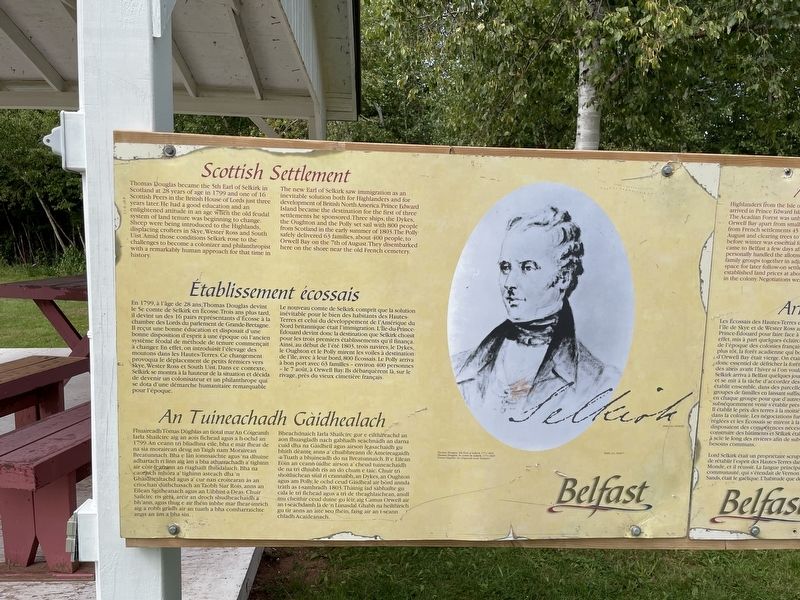
Thomas Douglas became the 5th Earl of Selkirk in Scotland at 28 years of age in 1799 and one of 16 Scottish Peers in the British House of Lords just three years later. He had a good education and an enlightened attitude in an age when the old feudal system of land tenure was beginning to change. Sheep were being introduced to the Highlands, displacing crofters in Skye, Wester Ross and South Uist. Amid those conditions Selkirk rose to the challenges to become a colonizer and philanthropist with a remarkably human approach for that time in history.
The new Earl of Selkirk saw immigration as an inevitable solution both for Highlanders and for development of British North America. Prince Edward Island became the destination for the first of three settlements he sponsored. Three ships, the Dykes, the Oughton and the Polly set sail with 800 people from Scotland in the early summer of 1803.The Polly safely delivered 63 families, about 400 people, to Orwell Bay on the 7th of August. They disembarked here on the shore near the old French cemetery.
En 1799, à l'âge de 28
this page online
Le nouveau comte de Selkirk comprit que la solution inévitable pour le bien des habitants des Hautes- Terres et celui du développement de l'Amérique du Nord britannique était l'immigration. L'Île-du-Prince- Édouard devint donc la destination que Selkirk choisit pour les trois premiers établissements qu'il finança. Ainsi, au début de l'été 1803, trois navires, le Dykes, le Oughton et le Polly mirent les voiles à destination de l'île, avec à leur bord,
Photographed by Jay Noble, August 22, 2026
2. Scottish Settlement Marker
Fhuaireadh Tomas Dùghlas an tiotal mar An Cóigeamh Iarla Shailcirc aig an aois fichead agus a h-ochd an 1799.An ceann trì bliadhna eile, bha e mar fhear de na sia morairean deug an Taigh nam Morairean Breatunnach. Bha e làn ionnsaichte agus 'na dhuine adhartach ri linn aig àm a bha atharrachadh a' tighinn air còir-fearainn an riaghailt fhiŭdalaich. Bha na caortich mhóra a' tighinn asteach dha 'n Ghàidhealtachd agus a' cur nan croitearan ás an crìochan dùthchasach an Taobh Siar Rois, anns an Eilean Sgitheanach agus an Uibhist-a-Deas. Chuir Sailcirc ris getà, aréir an droch shudheachaidh a bh'ann, agus thug e air fhéin inbhe mar fhear-imrich. aig a robh gràdh air an tuath a bha comharraichte anns an àm a bha sin.
Bheachdnaich Iarla Shailcirc gur e eilthireachd an aon fhuasgladh nach gabhadh seachnadh an darna cuid dha na Gàidheil agus airson leasachaidh gu bhith dèante anns a' chuibhreann de Ameireagaidh -a-Tuath a bhuineadh do na Breatunnaich. B'e Eilean Eòin an ceann-ùidhe airson a' cheud tuineachaidh de na trì dhiubh ris an do chum e taic. Chuir trì shoithichean siùil ri crannaibh, an Dykes, an Oughton agus am Polly, le ochd ceud Gàidheal air bord annda tràth as t-samhradh 1803. Thàinig iad sàbhailte gu cala le tri fichead agus a trì de theaghlaichean, anull mu cheithir ceud duine gu léir, aig Camus Orwell air an t-seachdamh là de'n Lùnasdal. Ghabh na heilthirich gu tìr anns an àite seo fhéin, faisg air an t-seann chladh Acaideanach.
Topics. This historical marker is listed in these topic lists: Immigration • Settlements & Settlers. A significant historical year for this entry is 1799.
Location. 46° 5.622′ N, 62° 54.684′ W. Marker is in Belfast, Prince Edward Island. It is on Selkirk Park Road. Touch for map. Marker is at or near this postal address: 112 Selkirk Park Road, Belfast PE C0A 1A0, Canada. Touch for directions.

Regionally, this marker is in the Maritimes and in Atlantic Canada. Globally, it is in the North Atlantic Region, North America, the Western Hemisphere, the Western World, and the Anglosphere. Historically, it finds itself in what was once a British colony and also the Viceroyalty of New France.
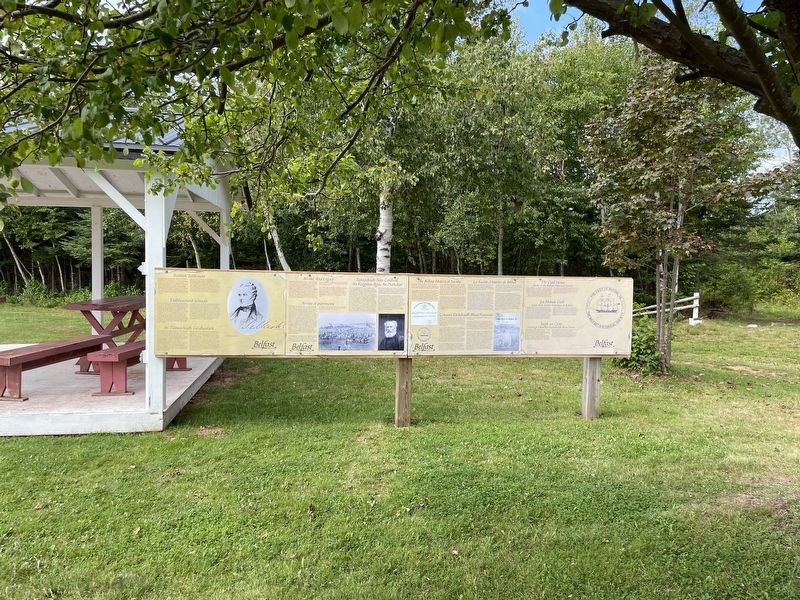
Other nearby markers. At least 8 other markers are within walking distance of this marker: The Belfast Historical Society (here, next to this marker); Arrival and Legacy (a few steps from this marker); The Croft House (a few steps from this marker); The Honourable J. Angus MacLean (within shouting distance of this marker); To Commemorate the Honourable J. Angus MacLean P.C, O.C., D.F.C. 1914-2000 (within shouting distance of this marker); Acadian Departure / Départ des Acadiens (about 90 meters away, measured in a direct line); Saint-Paul a la Pointe-Prim 1752-1758 (about 90 meters away); Acadian Settlement / Établissement acadien (about 90 meters away). Touch for a list and map of all markers in Belfast.
Credits. This page was last revised on September 16, 2026. It was originally submitted on September 2, 2026, by Jay Noble of Charlottetown, Prince Edward Island. This page has been viewed 10 times since then. Photos: 1, 2. submitted on September 2, 2026, by Jay Noble of Charlottetown, Prince Edward Island. • Andrew Ruppenstein was the editor who published this page.
