
Fort Frances in Rainy River District, Ontario — Central Canada (North America)
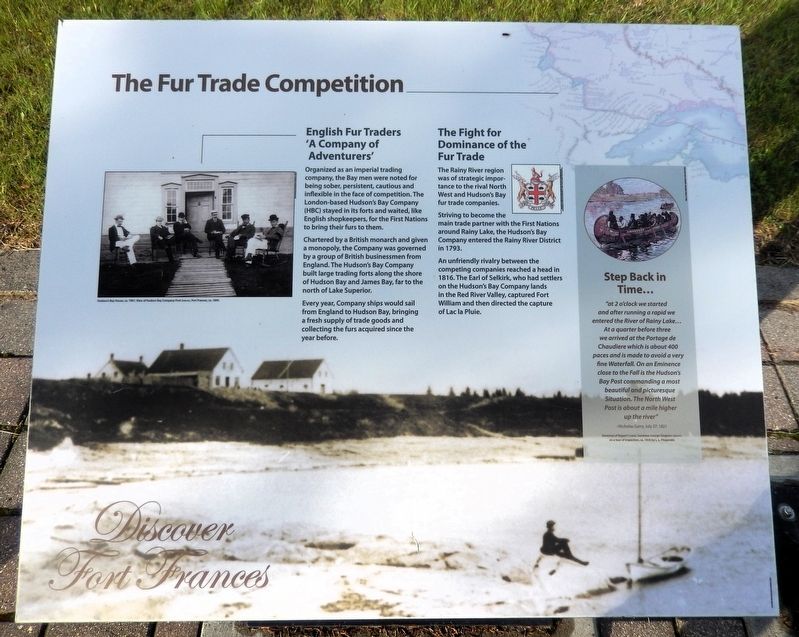
The Fur Trade Competition
| — | Discover Fort Frances | — |
Photographed by Cosmos Mariner, June 16, 2024
1. The Fur Trade Competition Marker
English Fur Traders ‘A Company of Adventurers’
Organized as an imperial trading company, the Bay men were noted for being sober, persistent, cautious and inflexible in the face of competition. The London-based Hudson's Bay Company (HBC) stayed in its forts and waited, like English shopkeepers, for the First Nations to bring their furs to them.
Chartered by a British monarch and given a monopoly, the Company was governed by a group of British businessmen from England. The Hudson's Bay Company built large trading forts along the shore of Hudson Bay and James Bay, far to the north of Lake Superior.
Every year, Company ships would sail from England to Hudson Bay, bringing a fresh supply of trade goods and collecting the furs acquired since the year before.
The Fight for Dominance of the Fur Trade
The Rainy River region was of strategic importance to the rival North West and Hudson's Bay fur trade companies.
Striving to become the main trade partner with the First Nations around Rainy Lake, the Hudson's Bay Company entered the Rainy River District in 1793.
An unfriendly rivalry between the competing companies reached a head in
this page online
Step Back in Time...
“at 2 o'clock we started and after running a rapid we entered the River of Rainy Lake... At a quarter before three we arrived at the Portage de Chaudiere which is about 400 paces and is made to avoid a very fine Waterfall. On an Eminence close to the Fall is the Hudson's Bay Post commanding a most beautiful and picturesque Situation. The North West Post is about a mile higher up the river”
—Nicholas Garry, July 27, 1821
[background image caption] View of Hudson Bay Company Post, Fort Frances, ca. 1899
Topics. This historical marker is listed in these topic lists: Forts and Castles • Indigenous Peoples and Communities • Industry & Commerce • Settlements & Settlers. A significant historical year for this entry is 1793.
Location. 48° 36.457′ N, 93° 22.302′ W. Marker is in Fort Frances, Ontario, in Rainy River District. It is at the intersection of Front Street and Williams Avenue, on the right when traveling east on Front Street. The marker
Courtesy Fort Frances Museum (978.039.024)
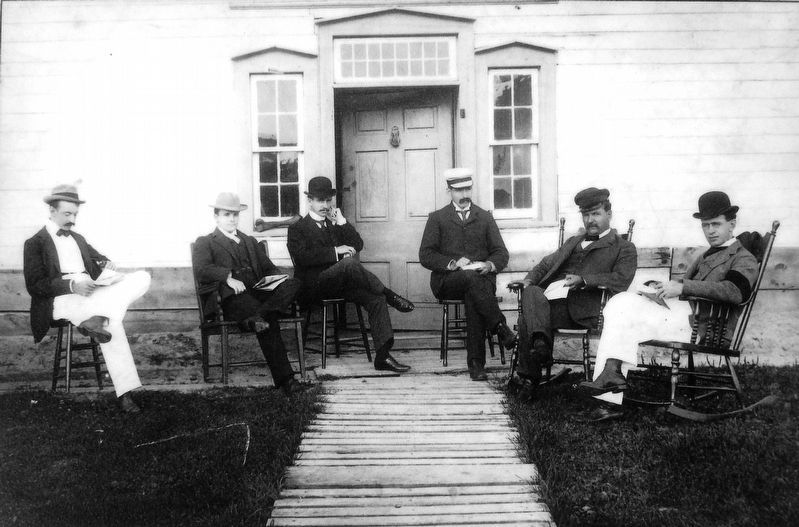
2. Marker detail: Hudson’s Bay House, ca. 1901

Regionally, this marker is in Northern Ontario and specifically in Northwest Ontario. It is also in Central Canada. Globally, it is in North America, the Great North Woods, the Western Hemisphere, the Western World, and the Anglosphere. Historically, it finds itself in what was once a British colony, the Viceroyalty of New France, the Haudenosaunee (Iroquois) Confederacy, and Rupert’s Land.
Other nearby markers. At least 8 other markers are within walking distance of this marker: Pelts, Paddles and Portages (here, next to this marker); Explore Fort Frances West (here, next to this marker); History of the Lookout Tower (approx. 0.3 kilometers away); Forest to Wood Yard (approx. 0.3 kilometers away); The Shevlin Wood Yard (approx. 0.3 kilometers away); The North West Mounted Police on the Dawson Route (approx. 0.3 kilometers away); a different marker also named Pelts, Paddles and Portages (approx. 0.4 kilometers away); Establishing the Fur Trade
Hudson’s Bay Company Archives
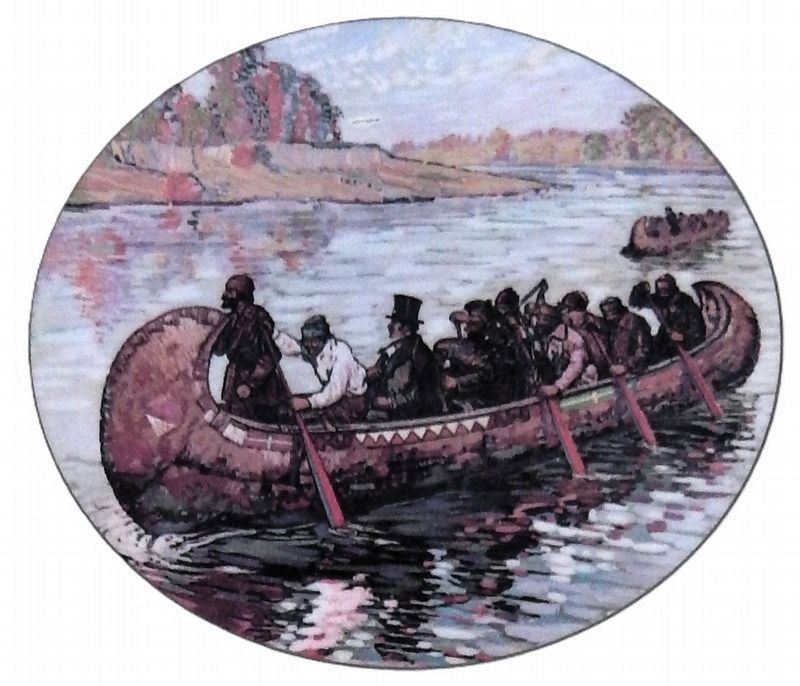
3. Marker detail: Governor George Simpson
Governor of Rupert's Land, on a tour of inspection.
ca. 1926 by L. L. Fitzgerald.
ca. 1926 by L. L. Fitzgerald.
Also see . . . Hudson's Bay Company (Wikipedia).
Excerpt: In 1779, other traders founded the North West Company (NWC) in Montreal as a seasonal partnership to provide more capital and to continue competing with the HBC. The NWC was the main rival in the fur trade. By 1784, the NWC had begun to make serious inroads into the HBC's profits. The competition led to the small Pemmican War in 1816, which culminated in the Battle of Seven Oaks on 19 June 1816. In 1821, the NWC and Hudson's Bay Company were forcibly merged by intervention of the British government to put an end to the violent competition. Of the 175 posts, 68 of them the HBC's, were reduced to 52 for efficiency and because many were redundant as a result of the rivalry and were inherently unprofitable.(Submitted on September 3, 2026, by Cosmos Mariner of Cape Canaveral, Florida.)
Photographed by Cosmos Mariner, June 16, 2024
4. The Fur Trade Competition Marker
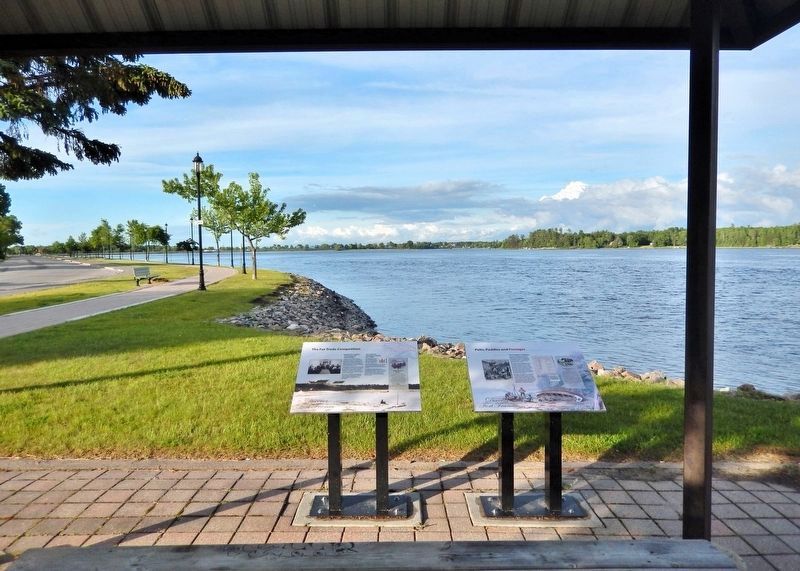
Looking east along the Rainy River. Front Street is on the left. This marker is the leftmost of two interpretive panels on the east side of the picnic shelter.
Credits. This page was last revised on September 3, 2026. It was originally submitted on September 3, 2026, by Cosmos Mariner of Cape Canaveral, Florida. This page has been viewed 4 times since then. Photos: 1, 2, 3, 4. submitted on September 3, 2026, by Cosmos Mariner of Cape Canaveral, Florida.
