Near Lyle in Klickitat County, Washington — The American West (Northwest)
"friendly village"
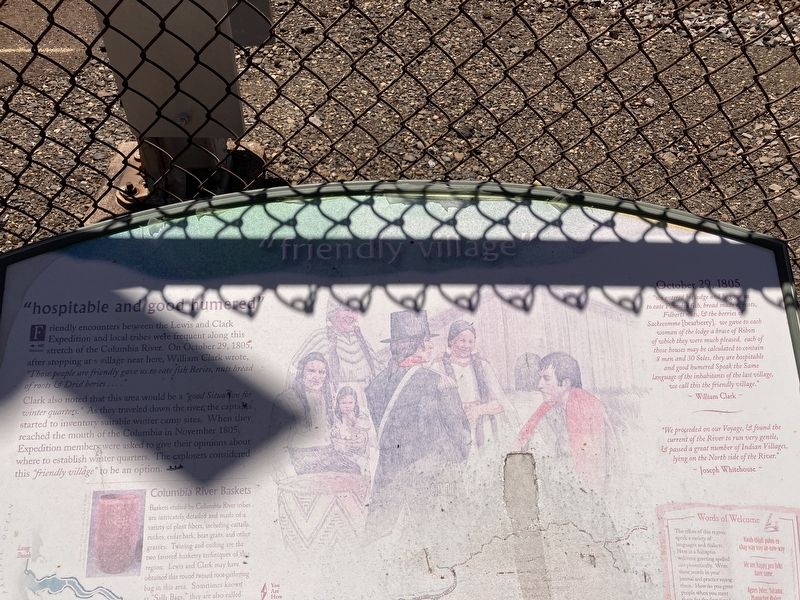
Photographed by Barry Swackhamer, June 12, 2026
1. "friendly village" Marker
"hospitable and good humoered"
Friendly encounters between the Lewis and Clark Expedition and local tribes were frequent along this stretch of the Columbia River. On October 29, 1805, after stopping at small village near here, William Clark wrote, "Those people are friendly gave us to eate fish Beries, nuts bread of roots & Dried beries ..."
Clark also noted that this area would be a "good Situation for winter quarters." As they traveled down the river, the captains started to inventory suitable winter camp sites. When they reached the mouth of the Columbia in November 1805, Expedition members were to give their opinions about where to establish winter quarters. The explorers considered this "friendly village" to be an option.
Columbia River Baskets
Baskets crafted by Columbia River tribes are intricately detailed and made of a variety of plant fibers, including cattails, rushes, cedar bark, bear grass and other grasses. Twining and coiling are the two favored baskets techniques of the region. Lewis and Clark may have obtained this round twined root-gathering bag in this area. Sometimes known as "Sally
this page online
"entered his lodge and he gave us to eate Pounded fish, bread made of roots, Filberts nuts, & berries of Sackecomme [bearberry] . we gave to each woman of the lodge a brace of Ribon of which they were much pleased. each of those housed may be calculated to contain 8 men and 30 Soles, they hospitable and good humered Speak the Same language of the inhabitants of the last village."
William Clark
"We proceed on our Voyage, & found the current of the River to run very gentle, & passed a great number of Indian Villages, lying on the North side of the River."
Joseph Whitehouse
Words of Welcome
The tribes of this region speak a variety of languages and dialects. Here is a Salmptin welcome greeting spelled out phonetically. Write these words in your journal and practice saying them. How do you greet people when you meet them for the first time'
Kwah-thlah puhm ee-chay way way an-now way
We are happy you folks have come.
Agnes Tulee, Yakama, Mamachet dialect
Erected by Washington Lewis & Clark Expedition Bicentennial Commission.
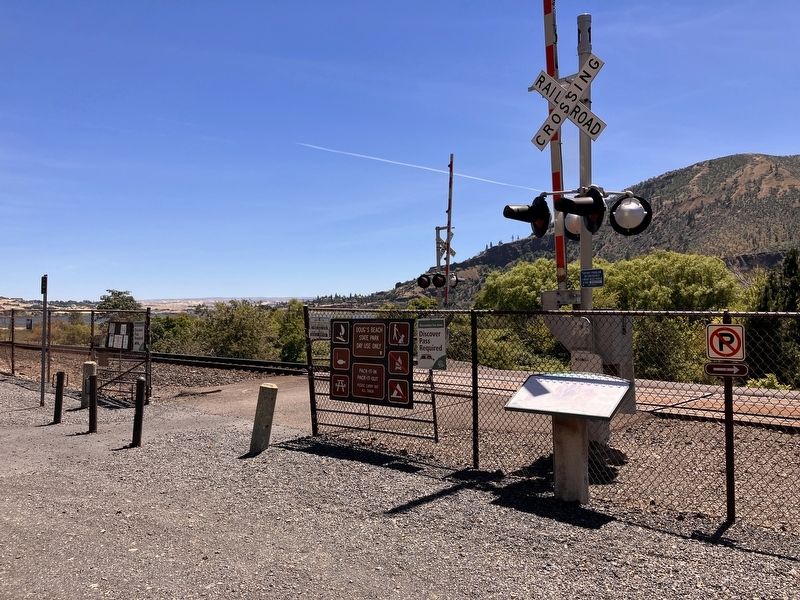
Photographed by Barry Swackhamer, June 12, 2026
2. "friendly village" Marker
Topics. This historical marker is listed in these topic lists: Exploration • Indigenous Peoples and Communities. A significant historical date for this entry is October 29, 1805.
Location. 45° 40.681′ N, 121° 14.106′ W. Marker is near Lyle, Washington, in Klickitat County. It is on Lewis and Clark Highway (Washington Route 14 at milepost 79), on the right when traveling east. This marker is located at Doug's Beach Stat4 Park. Touch for map. Marker is at or near this postal address: 8132 Lewis and Clark Highway, Lyle WA 98635, United States of America. Touch for directions.

Regionally, this marker is in Washington’s Columbia River Gorge, in the Columbia Basin and in Yakima Valley. It is also in the American Mountain West and in the Lewis & Clark Corridor. Globally, it is in North America, in the Cascade Range, on the Ring of Fire, in the Pacific Rim, in the Western Hemisphere, in the Western World, and in the Anglosphere.
Other nearby markers. At least 8 other markers are within 6 miles of this marker, measured as the crow flies: The History of the Columbia River Highway (approx. 2 miles away in Oregon); Rowena Crest - Ice Age Floods (approx. 3.1 miles away in Oregon); Rowena Crest - The Rowena Loops (approx. 3.1 miles away in Oregon); Preparing to leave the River (approx. 4.3 miles away); A Fluid Geologic Past (approx. 4.7 miles away); Transition Zones (approx. 4.7 miles away); Memaloose—Island of the Dead (approx. 5.1 miles away in Oregon); Memaloose Rest Area Oregon Trail Kiosk (approx. 5.2 miles away in Oregon). Touch for a list and map of all markers in Lyle.
Credits. This page was last revised on September 4, 2026. It was originally submitted on September 4, 2026, by Barry Swackhamer of Brentwood, California. This page has been viewed 9 times since then. Photos: 1, 2. submitted on September 4, 2026, by Barry Swackhamer of Brentwood, California.
