
Downtown in Saint Paul in Ramsey County, Minnesota — The American Midwest (Upper Plains)
Beating Back Pests and Diversifying Tree Populations
Venciendo las plagas y diversificando la población de árboles
Photographed by McGhiever, June 18, 2026
1. Beating Back Pests and Diversifying Tree Populations Marker

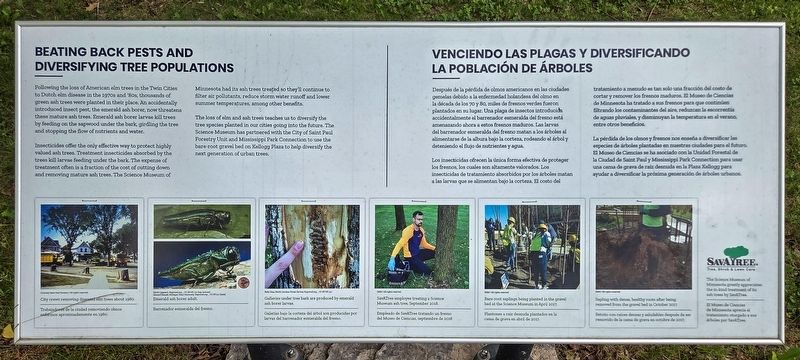
Following the loss of American elm trees in the Twin Cities to Dutch elm disease in the 1970s and '80s, thousands of green ash trees were planted in their place. An accidentally introduced insect pest, the emerald ash borer, now threatens these mature ash trees. Emerald ash borer larvae kill trees by feeding on the sapwood under the bark, girdling the tree and stopping the flow of nutrients and water.
Insecticides offer the only effective way to protect highly valued ash trees. Treatment insecticides absorbed by the trees kill larvae feeding under the bark. The expense of treatment often is a fraction of the cost of cutting down and removing mature ash trees. The Science Museum of Minnesota had its trees treated so they'll continue to filter air pollutants, reduce storm water runoff and lower summer temperatures, among other benefits.
The loss of elm and ash trees teaches us to diversify the tree species planted in our cities going into the future. The Science Museum has partnered with the City of Saint Paul Forestry Unit and Mississippi Park Connection to use the bare-root gravel bed on Kellogg Plaza to
this page online
Después de la pérdida de olmos americanos en las ciudades gemelas debido a la enfermedad holandesa del olmo en la década de los 70 y 80, miles de fresnos verdes fueron plantados en su lugar. Una plaga de insectos introducida accidentalmente el barrenador esmeralda del fresno está amenazando ahore a estos fresnos maduros. Las larvas del barrenador esmeralda del fresno matan a los árboles al alimentarse de la albura bajo la corteza, rodeando el árbol y deteniendo el flujo de nutrientes y agua.
Los insecticidas ofrecen la única forma efectiva de proteger los fresnos, los cuales son altamente valorados. Los insecticidas de tratamiento absorbidos por los árboles matan a las larvas que se alimentan bajo la corteza. El costo del tratamiento a menudo es tan solo una fracción del costo de cortar y remover los fresnos maduros. El Museo de Ciencias de Minnesota ha tratado a sus fresnos para que continúen filtrado los contaminantes del aire, reduzcan la escorrentía de aguas pluviales, y disminuyan la temperatura en el verano,
Photographed by McGhiever, June 18, 2026
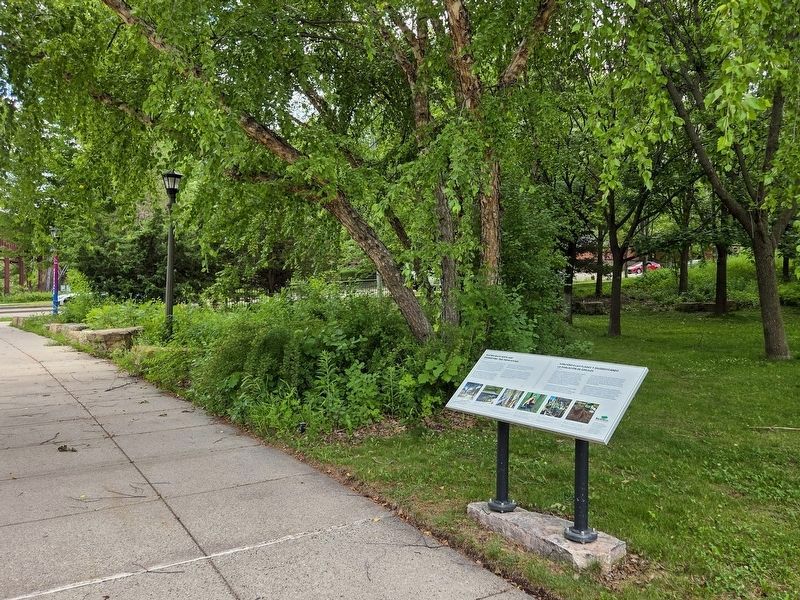
2. Beating Back Pests and Diversifying Tree Populations Marker east of Eagle Parkway
La pérdida de los olmos y fresnos nos enseña a diversificar las especies de árboles plantadas en nuestras ciudaded para el futuro. El Museo de Ciencias se ha asociado con la Unidad Forestal de la Ciudad de Saint Paul y Mississippi Park Connection para usar una cama de grava de raíz desnuda en la Plaza Kellogg para ayudar a diversificar la próxima generación de árboles urbanos.
City crews removing diseased elm trees about 1980.
Howard Russell, Michigan State University, Bugwood.org. CC-BY-3.0 (inset)
Emerald ash borer adult
Galleries under tree bark are produced by emerald ash borer larvae.
SavATree employee treating a Science Museum ash tree, September 2018.
Bare-root saplings being planted in the gravel bed at the Science Museum in April 2017.
Sapling with dense, healthy roots after being removed from the gravel bed in October 2017.
Erected by the Science Museum of Minnesota.
Topics. This historical marker is listed in this topic list: Environment. A significant historical year for this entry is 1970.
Location. 44° 56.477′ N, 93° 5.995′ W. Marker is in Saint Paul, Minnesota, in Ramsey County. It is in Downtown. It is at the intersection of Eagle Parkway and Shepard Road on Eagle Parkway. The marker is on the paved path leading to the back of the Science Museum of Minnesota. Touch for map. Marker is at or near this postal address: 210 Eagle Parkway, Saint Paul MN 55102, United States of America. Touch for directions.

Regionally, this marker is in the Twin Cities Metropolitan Area. It is also in the American Midwest, in the Corn Belt, and in the Great River Road Region. Globally, it is in North America, the Western Hemisphere, the Western World, and the Anglosphere. Historically, it finds itself in what was once Rupert’s Land, the territory of the Mississippian Culture, and the Louisiana Purchase.
Other nearby markers. At least 8 other markers are within walking distance of this marker: Living landmarks grace the shore (about 800 feet away, measured in a direct line); Giants populate the earth (about 800 feet away); The Father of Waters (approx. 0.2 miles away); Irvine Park / Irvine Park Historic District (approx. 0.2 miles away); Welcome to the Saint Paul Municipal Grain Terminal (approx. 0.2 miles away); A River in Decline (approx. 0.2 miles away); An Era of Restoration (approx. 0.2 miles away); Alexander Ramsey House (approx. 0.2 miles away). Touch for a list and map of all markers in Saint Paul.
Credits. This page was last revised on September 6, 2026. It was originally submitted on September 6, 2026, by McGhiever of Minneapolis, Minnesota. This page has been viewed 5 times since then. Photos: 1, 2. submitted on September 6, 2026, by McGhiever of Minneapolis, Minnesota.
