
Little River in Wyndham, Victoria, Australia — Oceania
Australian World War 1 Nurses Memorial
Photographed by Dean Barton-Ancliffe, August 11, 2026
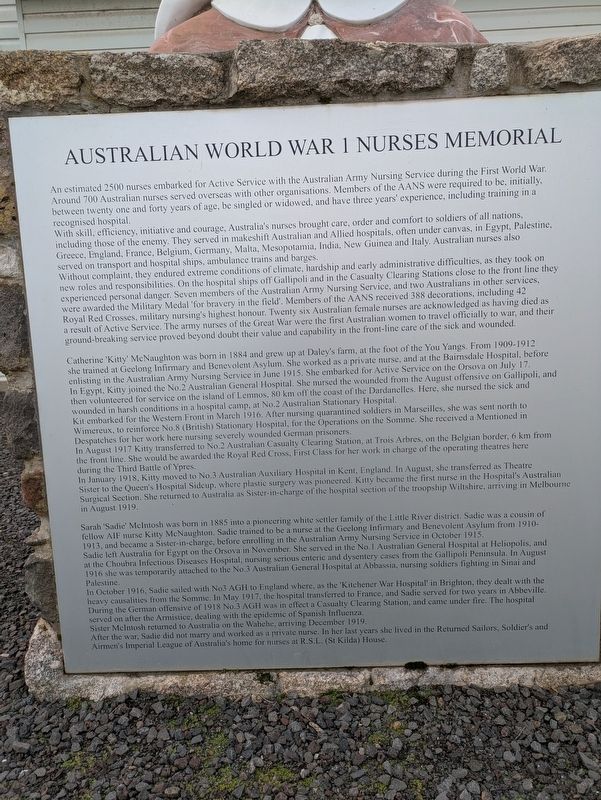
1. Australian World War 1 Nurses Memorial Marker
With skill, efficiency, initiative and courage, Australia's nurses brought care, order and comfort to soldiers of all nations, including those of the enemy. They served in makeshift Australian and Allied hospitals, often under canvas, in Egypt, Palestine, Greece, England, France, Belgium, Germany, Malta, Mesopotamia, India, New Guinea and Italy. Australian nurses also served on transport and hospital ships, ambulance trains and barges.
Without complaint, they endured extreme conditions of climate, hardship and early administrative difficulties, as they took on new roles and responsibilities. On the hospital ships off Gallipoli and in the Casualty Clearing Stations close to the front line they experienced personal danger. Seven members
this page online
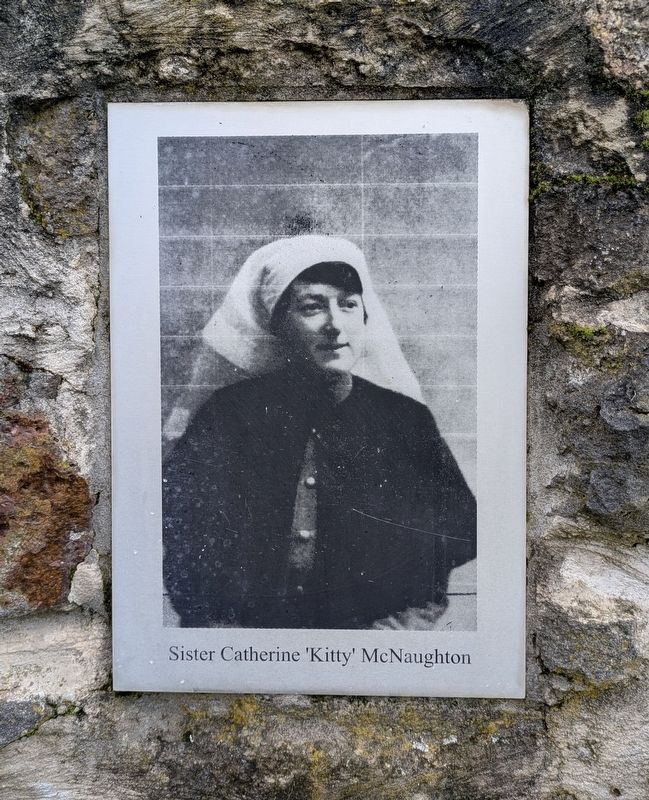
Catherine 'Kitty' McNaughton was born in 1884 and grew up at Daley's farm, at the foot of the You Yangs. From 1909-1912 she trained at Geelong Infirmary and Benevolent Asylum. She worked as a private nurse, and at the Bairnsdale Hospital, before enlisting in the Australian Army Nursing Service in June 1915. She embarked for Active Service on the Orsova on July 17.
In Egypt, Kitty joined the No.2 Australian General Hospital. She nursed the wounded from the August offensive on Gallipoli, and then volunteered for service on the island of Lemnos, 80 km off the coast of
Photographed by Dean Barton-Ancliffe, August 11, 2026
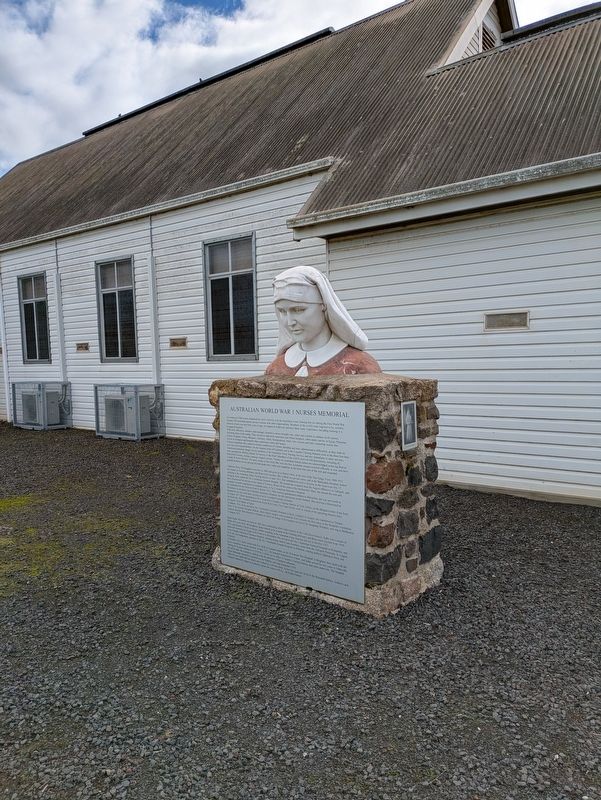
2. Australian World War 1 Nurses Memorial
Kit embarked for the Western Front in March 1916. After nursing quarantined soldiers in Marseilles, she was sent north to Wimereux, to reinforce No.8 (British) Stationary Hospital, for the Operations on the Somme. She received a Mentioned in Despatches for her work here nursing severely wounded German prisoners.
In August 1917 Kitty transferred to No.2 Australian Casualty Clearing Station, at Trois Arbres, on the Belgian border, 6 km from the front line. She would be awarded the Royal Red Cross, First Class for her work in charge of the operating theatres here during the Third Battle of Ypres.
In January 1918, Kitty moved to No.3 Australian Auxiliary Hospital in Kent, England. In August, she transferred as Theatre Sister to the Queen's Hospital Sidcup, where plastic surgery was pioneered. Kitty became the first nurse in the Hospital's Australian Surgical Section. She returned to Australia as Sister-in-charge of the hospital section of the troopship Wiltshire, arriving in Melbourne in August
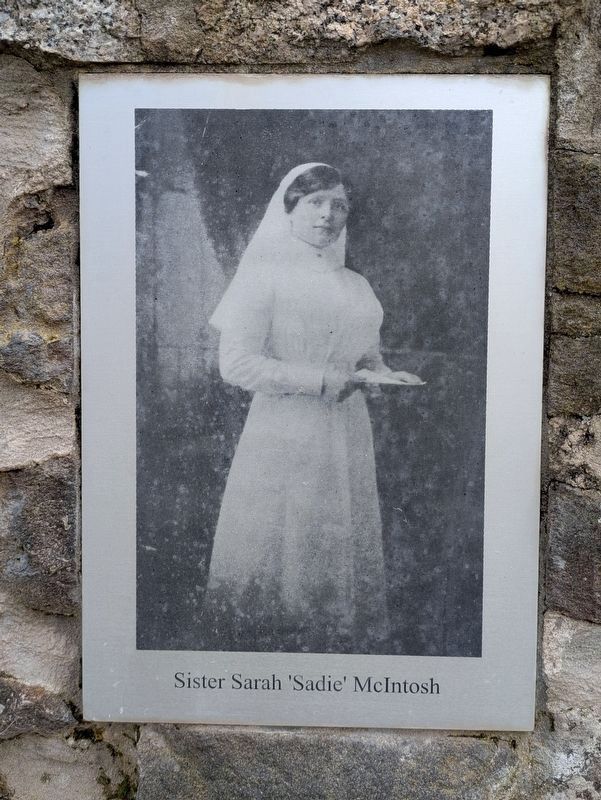
3. Sister Sarah 'Sadie' McIntosh
Sarah 'Sadie' McIntosh was born in 1885 into a pioneering white settler family of the Little River district. Sadie was a cousin of fellow AIF nurse Kitty McNaughton. Sadie trained to be a nurse at the Geelong Infirmary and Benevolent Asylum from 1910-1913, and became a Sister-in-charge, before enrolling in the Australian Army Nursing Service in October 1915.
Sadie left Australia for Egypt on the Orsova in November. She served in the No.1 Australian General Hospital at Heliopolis, and at the Choubra Infectious Diseases Hospital, nursing serious enteric and dysentery cases from the Gallipoli Peninsula. In August 1916 she was temporarily attached to the No.3 Australian General Hospital at Abbassia, nursing soldiers fighting in Sinai and Palestine.
In October 1916, Sadie sailed with No3 AGH to England where, as the 'Kitchener War Hospital' in Brighton, they dealt with the heavy causalities from the Somme. In May 1917, the hospital transferred to France, and Sadie served for two years in Abbeville.
During the German offensive of 1918 No.3 AGH was in effect a Casualty Clearing Station, and came under fire. The hospital served
August 11, 2026
4. Sister Catherine 'Kitty' McNaughton
Sister McIntosh returned to Australia on the Wahehe, arriving December 1919.
After the war, Sadie did not marry and worked as a private nurse. In her last years she lived in the Returned Sailors, Soldier's and Airmen's Imperial League of Australia's home for nurses at R.S.L. (St Kilda) House.
Erected 2015 by Australian Government.
Topics. This memorial is listed in these topic lists: Science & Medicine • War, World I.
Location. 37° 57.874′ S, 144° 29.98′ E. Memorial is in Little River, Victoria, in Wyndham. It is on Rothwell Road 0.1 kilometers north of Flinders Street, on the left when traveling north. Touch for map. Memorial is at or near this postal address: 8 Rothwell Road, Little River VIC 3211, Australia. Touch for directions.

Regionally, it is in Oceania, Australasia, the Pacific Ocean, South Pacific, the Pacific Rim, the Western World, and the Anglosphere. Historically, it finds itself in what was once a British colony.
Other nearby markers. At least one other marker is within
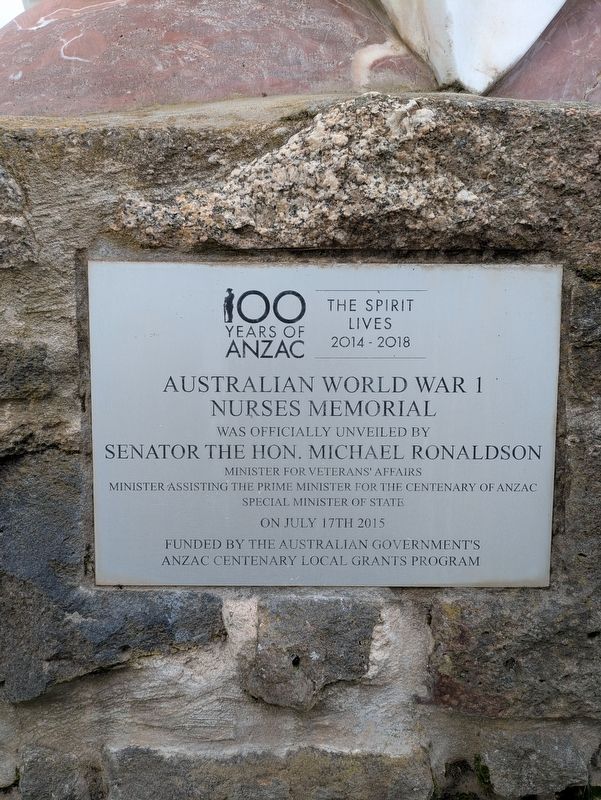
Photographed by Dean Barton-Ancliffe, August 11, 2026
5. Australian World War 1 Nurses Memorial Unveiling Plaque
Also see . . . Great War nurses. Australian War Memorial
More than 3,000 Australian civilian nurses volunteered for active service during the First World War. While enabling direct participation in the war effort, nursing also provided opportunities for independence and travel, sometimes with the hope of being closer to loved ones serving overseas.(Submitted on September 6, 2026, by Dean Barton-Ancliffe of Rowville, Victoria.)
The Australian Army Nursing Service (AANS) had been formed in July 1903 as part of the Australian Army Medical Corps. During the war more than 2,000 of its members served overseas alongside Australian nurses working with other organisations, such as the Queen Alexandra's Imperial Military Nursing Service (QAIMNS), the Red Cross, or privately sponsored facilities.
Credits. This page was last revised on September 7, 2026. It was originally submitted on September 6, 2026, by Dean Barton-Ancliffe of Rowville, Victoria. This page has been viewed 8 times since then. Photos: 1, 2, 3, 4, 5. submitted on September 6, 2026, by Dean Barton-Ancliffe of Rowville, Victoria. • Andrew Ruppenstein was the editor who published this page.
