Ironton in Lawrence County, Ohio — The American Midwest (Great Lakes)
Hanging Rock Iron Furnace Region
Photographed by Cosmos Mariner, August 28, 2021
1. Hanging Rock Iron Furnace Region Marker
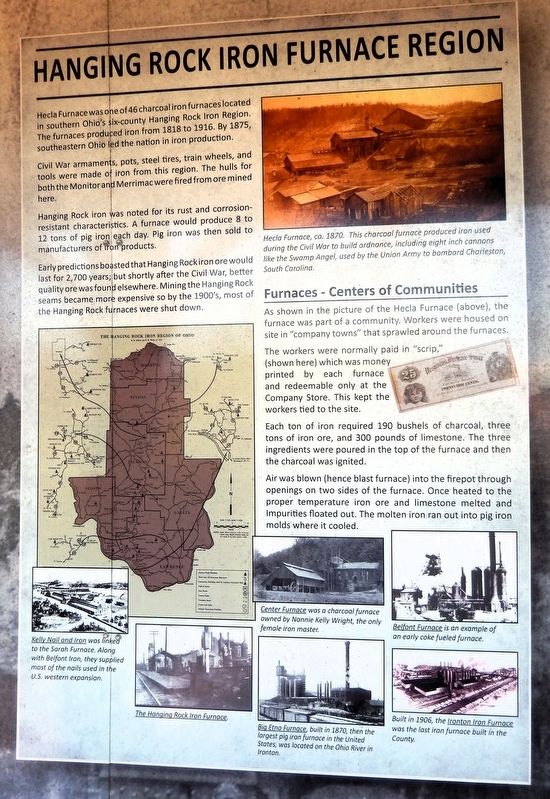
Hecla Furnace was one of 46 charcoal iron furnaces located in southern Ohio's six-county Hanging Rock Iron Region. The furnaces produced iron from 1818 to 1916. By 1875, southeastern Ohio led the nation in iron production.
Civil War armaments, pots, steel tires, train wheels, and tools were made of iron from this region. The hulls for both the Monitor and Merrimac were fired from ore mined here.
Hanging Rock iron was noted for its rust and corrosion-resistant characteristics. A furnace would produce 8 to 12 tons of pig iron each day. Pig iron was then sold to manufacturers of iron products.
Early predictions boasted that Hanging Rock iron ore would last for 2,700 years; but shortly after the Civil War, better quality ore was found elsewhere. Mining the Hanging Rock seams became more expensive so by the 1900's, most of the Hanging Rock furnaces were shut down.
Furnaces — Centers of Communities
As shown in the picture of the Hecla Furnace, the furnace was part of a community. Workers were housed on site in “company towns” that sprawled around the furnaces.
The workers were normally paid in “scrip,” which was money printed
this page online
Each ton of iron required 190 bushels of charcoal, three tons of iron ore, and 300 pounds of limestone. The three ingredients were poured in the top of the furnace and then the charcoal was ignited.
Air was blown (hence blast furnace) into the firepot through openings on two sides of the furnace. Once heated to the proper temperature, iron ore and limestone melted and impurities floated out. The molten iron ran out into pig iron molds where it cooled.
[photo captions]
• Kelly Nail and Iron was linked to the Sarah Furnace. Along with Belfont Iron, they supplied most of the nails used in the U.S. western expansion.
• The Hanging Rock Iron Furnace
• Center Furnace was a charcoal furnace owned by Nannie Kelly Wright, the only female iron master.
• Big Etna Furnace, built in 1870, then the largest pig iron furnace in the United States, was located on the Ohio River in Ironton.
• Belfont Furnace is an example of an early coke fueled furnace.
• Built in 1906, the Ironton Iron Furnace was the last iron furnace built in the county.
Erected by Ohio
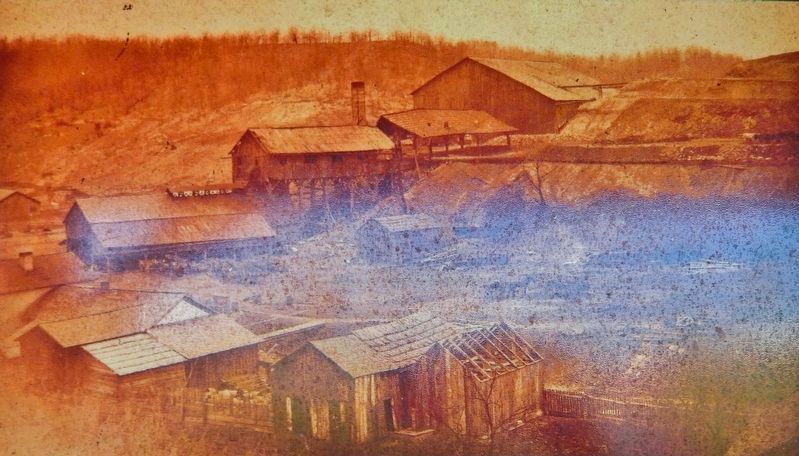
2. Marker detail: Hecla Furnace, ca. 1870
This charcoal furnace produced iron used during the Civil War to build ordnance, including eight-inch cannons like the Swamp Angel, used by the Union Army to bombard Charleston, South Carolina.
Topics. This historical marker is listed in these topic lists: Industry & Commerce • War, US Civil. A significant historical year for this entry is 1875.
Location. 38° 32.208′ N, 82° 40.621′ W. Marker is in Ironton, Ohio, in Lawrence County. It can be reached from the intersection of South 9th Street and Washington Street, on the right when traveling north. The marker is in the Ohio River Scenic Byway interpretive kiosk on the south side of the Frisch's Big Boy parking lot. Touch for map. Marker is at or near this postal address: 301 South 9th Street, Ironton OH 45638, United States of America. Touch for directions.

Regionally, this marker is in the Kyova Tri-State Region. It is also in the American Midwest, in the Ohio River Valley, in Appalachia, and specifically in Northern Appalachia. Globally, it is in North America, the Western Hemisphere, the Western World, and the Anglosphere. Historically, it finds itself in what was once the Haudenosaunee (Iroquois) Confederacy, the territory of the Mississippian Culture, and the Northwest Territory.
Other nearby markers. At
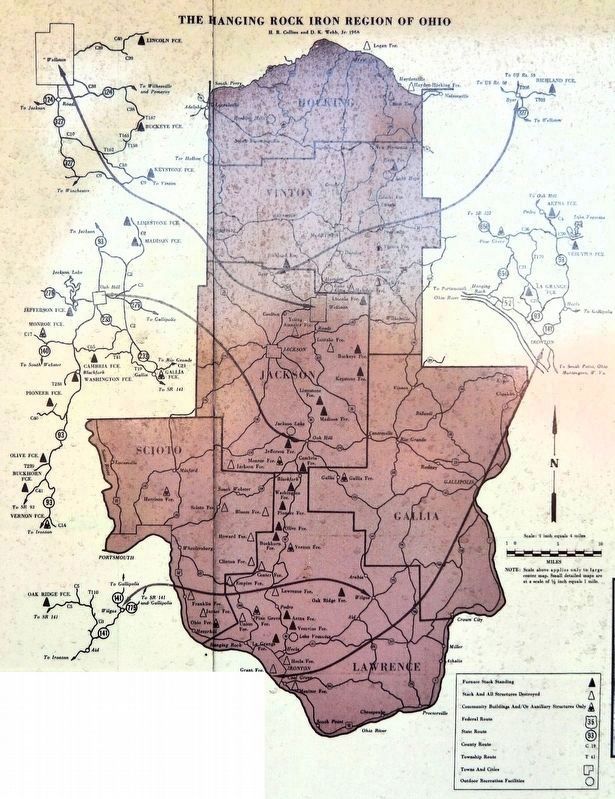
3. Marker detail: The Hanging Rock Iron Region of Ohio
H. R. Collins & D. K. Webb, Jr., 1966
Related markers. Click here for a list of markers that are related to this marker. Hanging Rock Iron Furnace Region
Photographed by Cosmos Mariner, August 28, 2021
4. Hanging Rock Iron Furnace Region Marker
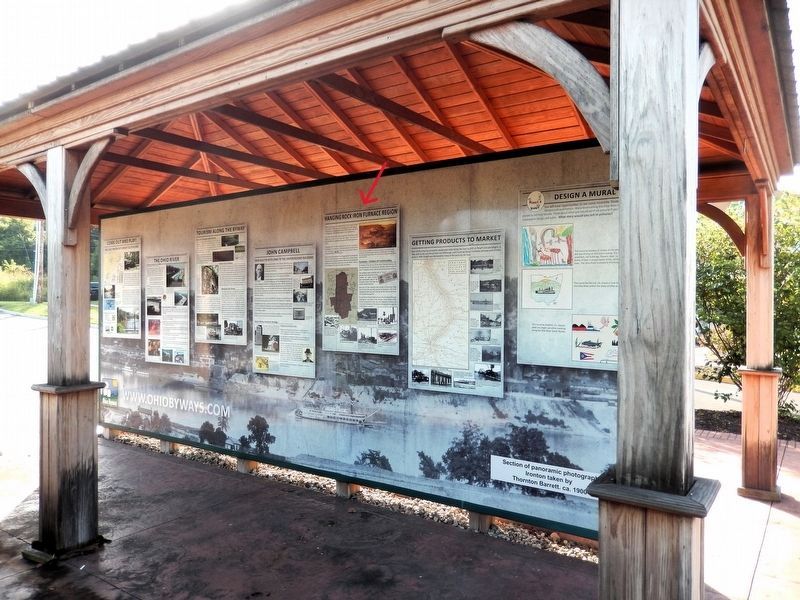
This marker is the third panel from the right on the north side of the Ohio River Scenic Byway interpretive kiosk.
Credits. This page was last revised on September 8, 2026. It was originally submitted on September 7, 2026, by Cosmos Mariner of Cape Canaveral, Florida. This page has been viewed 15 times since then. Photos: 1, 2, 3, 4. submitted on September 8, 2026, by Cosmos Mariner of Cape Canaveral, Florida.
