Lake Huntington in Sullivan County, New York — The American Northeast (Mid-Atlantic)
Western Sullivan County
| — | Borscht Belt Historical Marker Project | — |
Photographed by Jerry Klinger, 2026
1. Western Sullivan County Marker
West Sullivan County
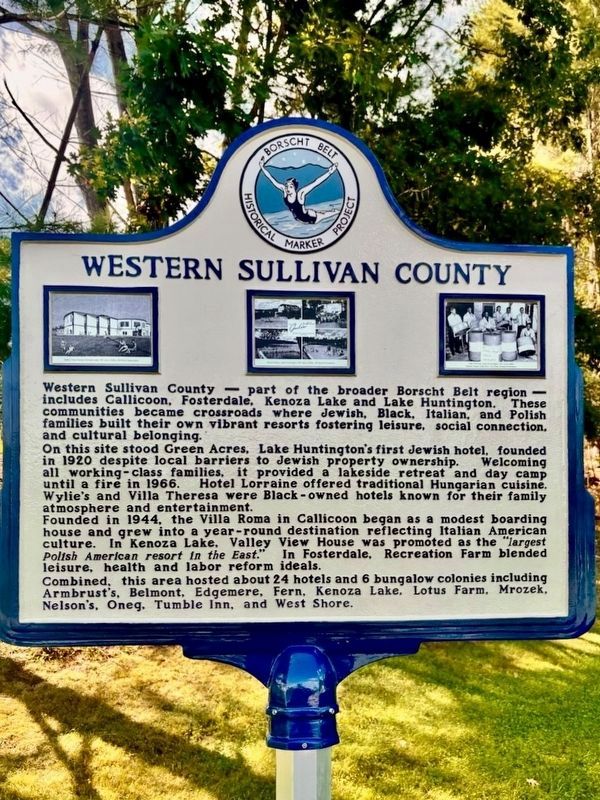
Western Sullivan County—part of the broader Borscht Belt region—includes Callicoon, Fosterdale, Kenoza Lake and Lake Huntington. These communities became crossroads where Jewish, Black, Italian, and Polish families built their own vibrant resorts fostering leisure, social connection, and cultural belonging.
On this site stood Green Acres, Lake Huntington’s first Jewish hotel, founded in 1920 despite local barriers to Jewish property ownership. Welcoming all working-class families, it provided a lakeside retreat and day camp until a fire in 1966. Hotel Lorraine offered traditional Hungarian cuisine. Wylie’s and Villa Theresa were Black-owned hotels known for their family atmosphere and entertainment.
Founded in 1944, the Villa Roma in Callicoon began as a modest boarding house and grew into a year-round destination reflecting Italian American culture. In Kenoza Lake, Valley View House was promoted as the “largest Polish American resort in the East.” In Fosterdale, Recreation Farm blended leisure, health and labor reform ideals.
Combined, this area hosted about 24 hotels and 6 bungalow
this page online
Borscht Belt
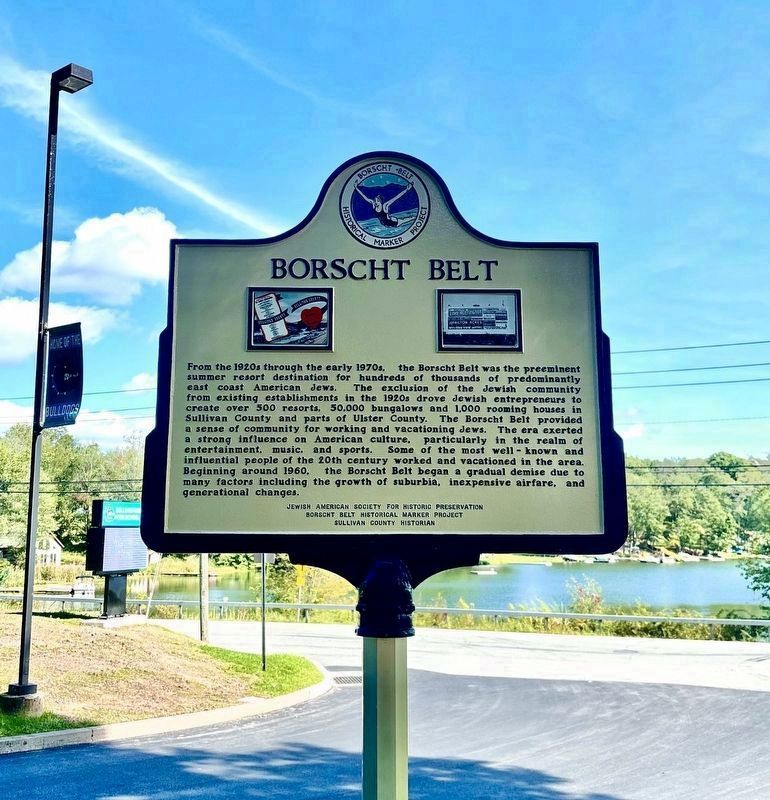
From the 1920s through the early 1970s. the Borscht Belt was the preeminent summer resort destination for hundreds of thousands of predominantly east coast American Jews. The exclusion of the Jewish community from existing establishments in the 1920s drove Jewish entrepreneurs to create over 500 resorts. 50,000 bungalows and 1.000 rooming houses in Sullivan County and parts of Ulster County. The Borscht Belt provided a sense of community for working and vacationing Jews. The era exerted a strong influence on American culture. particularly in the realm of entertainment. music. and sports. Some of the most well-known and influential people of the 20th century worked and vacationed in the area. Beginning around 1960, the Borscht Belt began a gradual demise due to many factors including the growth of suburbia, inexpensive airfare, and generational changes.
Erected 2026 by Jewish American Society for Historic Preservation, Borscht Belt Historical Marker Project, Sullivan County
Photographed by Marisa Scheinfeld, 2026
2. Western Sullivan County Marker
Topics and series. This historical marker is listed in these topic lists: Arts, Letters, Music • Civil Rights • Entertainment. In addition, it is included in the Borscht Belt Historical Marker Project, and the Jewish American Society for Historic Preservation. series lists.
Location. 41° 41.28′ N, 74° 59.431′ W. Marker is in Lake Huntington, New York, in Sullivan County. It is on Sullivan West High School 6604 NY-52, on the left when traveling north. Sullivan West High School 6604 NY-52. Touch for map. Marker is at or near this postal address: Sullivan West High School 6604 NY-52, Lake Huntington NY 12752, United States of America. Touch for directions.

Regionally, this marker is in Upstate New York and in the Hudson Valley. It is also in the American Northeast, in the Mid-Atlantic, in Appalachia, and specifically in Northern Appalachia. Globally, it is in North America, the Western Hemisphere, the Western World, and the Anglosphere. Historically, it finds itself in what was once New Netherland and also one of the original Thirteen Colonies.
Other nearby markers. At least 8 other markers are within 5 miles of this marker, measured as the crow flies: Fosterdale (approx. 1.7 miles away); Cushetunk (approx. 3.4 miles away in Pennsylvania); Heirsville (approx. 3.7 miles away); Jersey Claim Line (approx. 3.8 miles away); The First Baptist Church of Damascus, PA (approx. 4.1 miles away in Pennsylvania); Last Piece of Yasgur Farm (approx. 4.2 miles away); Max and Miriam Yasgur (approx. 4.2 miles away); Veterans Memorial (approx. 4½ miles away in Pennsylvania).
Also see . . . In Lake Huntington, a New Marker Tells a Bigger Borscht Belt Story. The marker, the 19th installed by the Borscht Belt Historical Marker Project, is an effort to expand the familiar story of the Catskills resort era beyond the region’s biggest and most famous hotels. It explores the intertwined histories of Lake Huntington, Fosterdale, Kenoza Lake and Callicoon — and the Jewish, Black, Italian and Polish communities that vacationed, worked and built lives there. ...And this one will be installed at a high school — the first such location for the project. For Scheinfeld, that is significant. Students will see the marker every day as they drive up the school driveway. “It brings it full circle why we’re doing this project, which is for the next generation,” she said. (Submitted on September 7, 2026, by Jerry Klinger of Boynton Beach, Florida.)
Credits. This page was last revised on September 11, 2026. It was originally submitted on September 7, 2026, by Jerry Klinger of Boynton Beach, Florida. This page has been viewed 22 times since then. Photos: 1, 2. submitted on September 7, 2026, by Jerry Klinger of Boynton Beach, Florida. • Andrew Ruppenstein was the editor who published this page.
Editor’s want-list for this marker. photo of the marker within its surroundings • Can you help?
