Michigan City in LaPorte County, Indiana — The American Midwest (Great Lakes)
Franklin Street Commercial Historic District
Photographed by Daniel Barriball, September 7, 2026
1. Franklin Street Commercial Historic District Marker, Side One
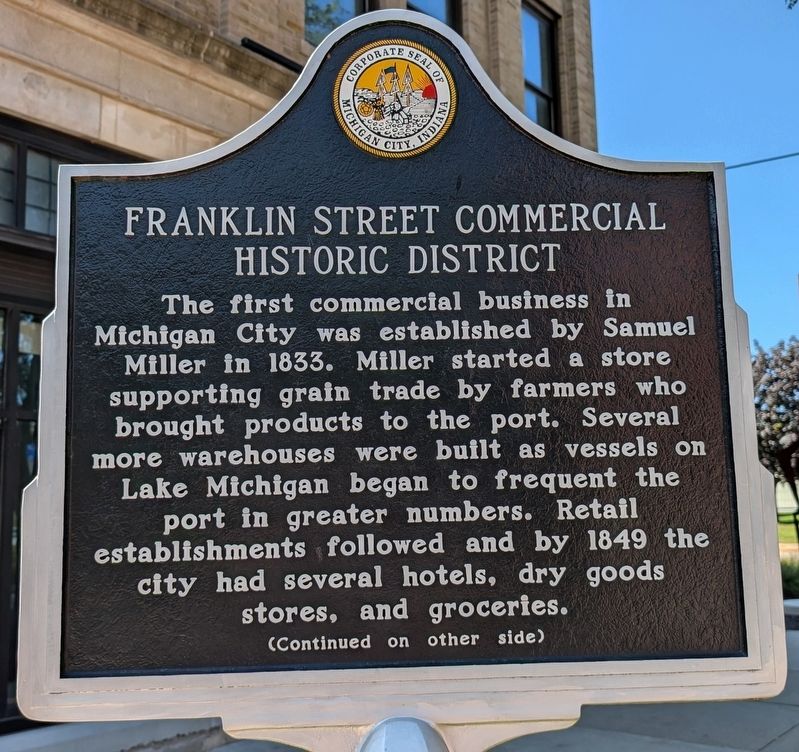
The first commercial business in Michigan City was established by Samuel Miller in 1833. Miller started a store supporting grain trade by farmers who brought products to the port. Several more warehouses were built as vessels on Lake Michigan began to frequent the port in greater numbers. Retail establishments followed and by 1849 the city had several hotels, dry goods stores, and groceries.
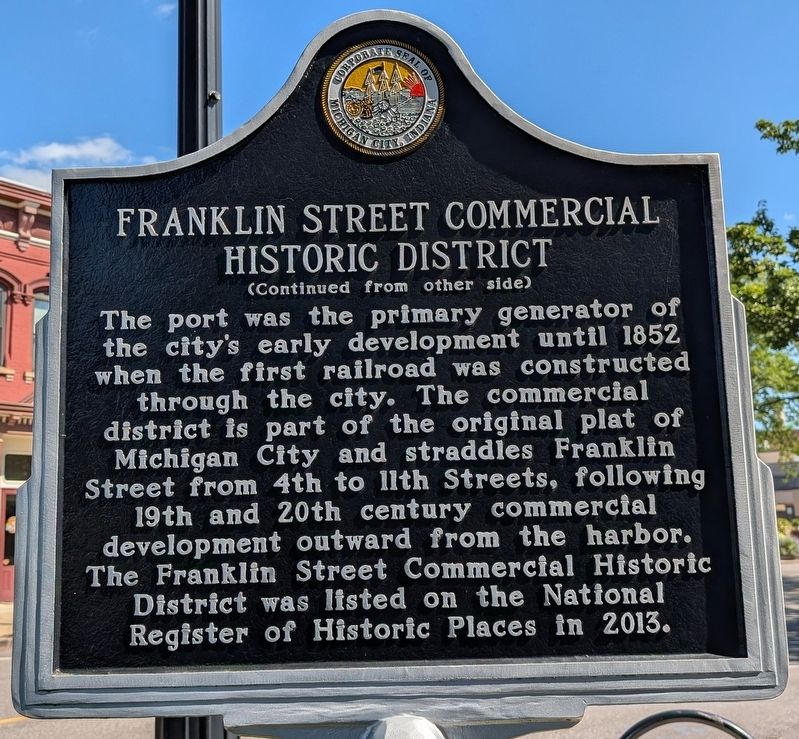
The port was the primary generator of the city's early development until 1852 when the first railroad was constructed through the city. The commercial district is part of the original plat of Michigan City and straddles Franklin Street from 4th to 11th Streets, following 19th and 20th century commercial development outward from the harbor. The Franklin Street Commercial Historic District was listed on the National Register of Historic Places in 2013.
Erected by Michigan City, Indiana.
Topics. This historical marker is listed in these topic lists: Industry & Commerce • Railroads & Streetcars • Waterways & Vessels. A significant historical year for this entry is 1833.
Location. 41° 43.089′ N, 86° 54.143′ W. Marker is in
this page online

Regionally, this marker is in Northwest Indiana, specifically on the Indiana Dunes and Lake Michigan Shore, and in Greater South Bend. It is also in the American Midwest and in the Corn Belt. Globally, it is in North America, on the Great Lakes, in the Western Hemisphere, in the Western World, and in the Anglosphere. Historically, it finds itself in what was once the territory of the Mississippian Culture and also the Northwest Territory.
Other nearby markers. At least 8 other markers are within walking distance of this marker: First Log Cabin in Michigan City (about 400 feet away, measured in a direct line); Michigan City Civil War Memorial (about 600 feet away); Michigan Road (about 600 feet away); The Lincoln Funeral Train (about 700 feet away); From Freight Cars to Outlet Stores
Photographed by Daniel Barriball, September 7, 2026
2. Franklin Street Commercial Historic District Marker, Side Two
Regarding Franklin Street Commercial Historic District.
Excerpt from the Statement of Significance in the National Register of Historic Places application:
The first commercial business in Michigan City was established by Samuel Miller in 1833. Miller started a commission store that supported the grain trade by local farmers who brought their products to the shipping port. Several more warehouses followed as vessels on Lake Michigan began to frequent the port in greater numbers. Retail establishments followed and by 1849 the city had several hotels, nine dry goods stores, one druggist, and seven groceries with general provisions. The port was the primary generator of the city's early development. In 1852 the first railroad was constructed through the city.
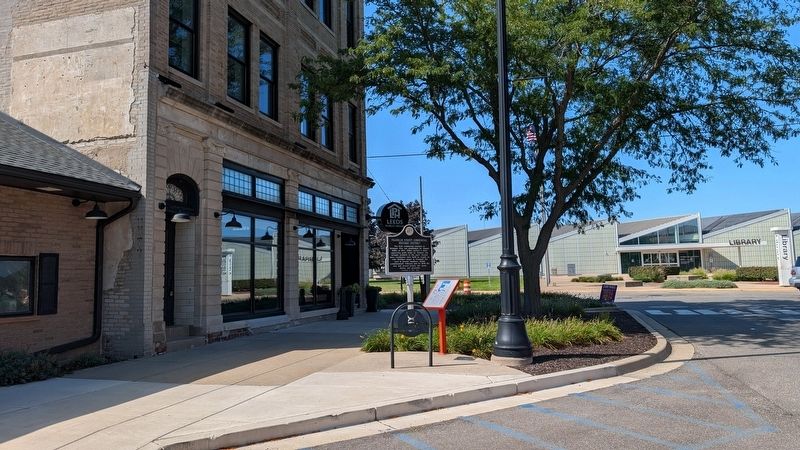
The original hub of the commercial district was located nearer the harbor on Franklin Street between Second and Michigan Streets.This was until about 1864 when commercial activity started to creep southward on Franklin Street, which had previously been a residential area. Franklin Street was the first to receive sidewalks in 1840 and the first to be planked in 1850. Prior to about 1890 very few commercial buildings were located south of Fifth Street (which was also called Market Street). An interurban line down the center of Franklin Street to neighborhoods on the south side of town, and the South Shore interurban line on 11th Street continued to draw commercial development southward on Franklin Street. This essentially created the city's sole commercial "main street" throughout the period of significance.Photographed by Daniel Barriball, September 7, 20263. Franklin Street Commercial Historic District Marker in context
Also see . . . Franklin Street Commercial Historic District. Indiana State Historic Architectural and Archaeological Research Database (SHAARD) National Register of Historic Places Application (Submitted on September 7, 2026, by Daniel Barriball of Chesterton, Indiana.)
Credits. This page was last revised on September 11, 2026. It was originally submitted on September 7, 2026, by Daniel Barriball of Chesterton, Indiana. This page has been viewed 7 times since then. Photos: 1, 2, 3. submitted on September 7, 2026, by Daniel Barriball of Chesterton, Indiana. • Devry Becker Jones was the editor who published this page.
