Belfast, Prince Edward Island — The Atlantic Provinces (North America)
Original Lighthouse Keeper's Cottage
La petite maison originale du gardien de phare
Photographed by Jay Noble, August 22, 2026
1. Original Lighthouse Keeper's Cottage Marker

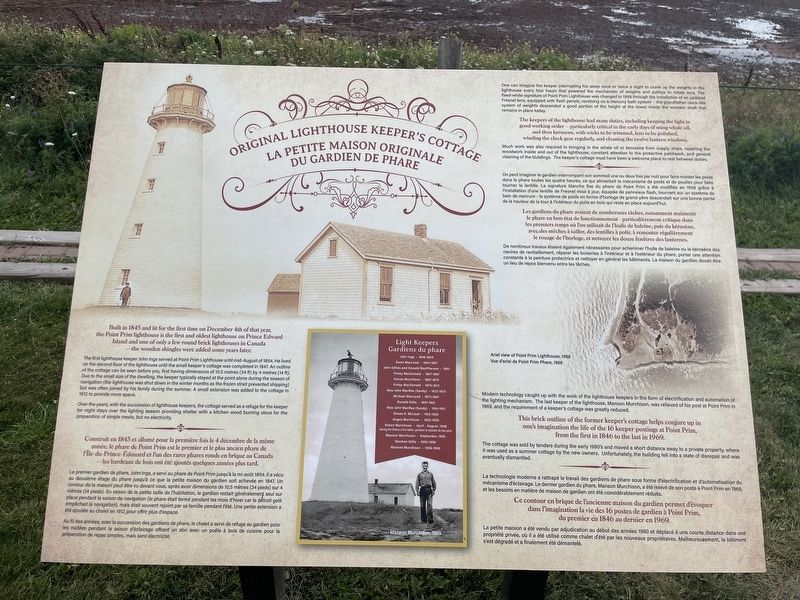
The first lighthouse keeper John Ings served at Point Prim Lighthouse until mid-August of 1854. He lived on the second floor of the lighthouse until the small keeper's cottage was completed in 1847. An outline of the cottage can be seen before you, first having dimensions of 10.5 metres (34 ft) by 4 metres (14 ft). Due to the small size of the dwelling, the keeper typically stayed at the point alone during the season of navigation (the lighthouse was shut down in the winter months as the frozen strait prevented shipping) but was often joined by his family during the summer. A small extension was added to the cottage in 1912 to provide more space.
Over the years, with the succession of lighthouse keepers, the cottage served as a refuge for the keeper for night stays over the lighting season providing shelter with a kitchen wood burning stove for the
this page online
Construit en 1845 et allumé pour la première fois le 4 décembre de la même année, le phare de Point Prim est le premier et le plus ancien phare de r'Île-du-Prince-Édouard et l'un des rares phares ronds en brique au Canada -les bardeaux de bois ont été ajoutés quelques années plus tard.
Le premier gardien de phare, John Ings, a servi au phare de Point Prim jusqu'à la mi-août 1854. Il a vécu au deuxième étage du phare jusqu'à ce que la petite maison du gardien soit achevée en 1847. Un contour de la maison peut être vu devant vous, après avoir dimensions de 10,5 mètres (34 pieds) sur 4 mètres (14 pieds). En raison de la petite taille de l'habitation, le gardien restait généralement seul sur place pendant la saison de navigation (le phare était fermé pendant les mois d'hiver car le détroit gelé empêchait la navigation), mais était souvent rejoint par sa famille pendant l'été. Une petite extension a été ajoutée au chalet en 1912 pour offrir plus d'espace.
Au fil des années, avec la succession des gardiens de phare, le chalet a servi de refuge au gardien pour les nuitées
Photographed by Jay Noble, August 22, 2026
2. Original Lighthouse Keeper's Cottage Marker
Light Keepers
Gardiens du phare
John Ings 1846-1854
Ewen MacLeod 1854-1857
John Gillies and Donald MacPherson 1857
Finlay MacDonald 1857-1867
Simon Murchison. 1867-1870
Finlay MacDonald. 1870-1872
Alex John MacRae (Sandy) 1872-1873
Michael MacLeod 1873-1897
Donald Gillis 1897-1910
Alex John MacRae (Sandy) 1910-1912
Simon A. McLean. 1912-1920
Angus Murchison 1920-1955
Simon Murchison - April - August, 1948
during the illness of his father, pendant la maladie de son père
Manson Murchison September, 1955
Norman Gillis 1955-1956
Manson Murchison 1956-1969
The keepers of the lighthouse had many duties, including keeping the light in good working order - particularly critical in the early days of using whale oil, and then kerosene, with wicks to be trimmed, lens to be polished, winding the clock gear regularly, and cleaning the twelve lantern windows.
Much work was also required in bringing in the whale oil or kerosene from supply ships, repairing the woodwork inside and out of the lighthouse, constant attention to the protective paintwork, and general cleaning of the buildings. The keeper's cottage must have been a welcome place to rest between duties.
On peut imaginer le gardien interrompant son sommeil une ou deux fois par nuit pour faire monter les poids dans le phare toutes les quatre heures, ce qui alimentait le mécanisme de poids et de poulies pour faire tourner la lentille. La signature blanche fixe du phare de Point Prim a été modifiée en 1958 grâce à l'installation d'une lentille de Fresnel mise à jour, équipée de panneaux flash, tournant sur un système de bain de mercure- le système de poids en forme d'horloge de grand-père descendait sur une bonne partie de la hauteur de la tour à l'intérieur du puits en bois qui reste en place aujourd'hui.
Les gardiens du phare avaient de nombreuses tâches, notamment maintenir le phare en bon état de fonctionnement - particulièrement critique dans les premiers temps où l'on utilisait de l'huile de baleine, puis du kérosène, avec.des mèches à tailler, des lentilles à polir, à remonter régulièrement le rouage de l'horloge, et nettoyer les douze fenêtres des lanternes.
De nombreux travaux étaient également nécessaires pour acheminer l'huile de baleine ou le kérosène des navires de ravitaillement, réparer les boiseries à l'intérieur et à l'extérieur du phare, porter une attention constante à la peinture protectrice et nettoyer en général les bâtiments. La maison du gardien devait être un lieu de repos bienvenu entre les tâches.
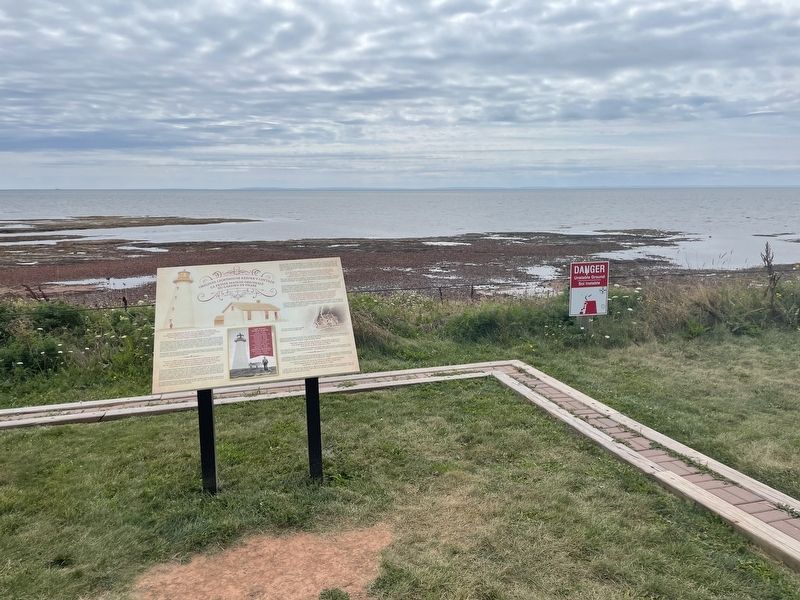
This brick outline of the former keeper's cottage helps conjure up in one's imagination the life of the 16 keeper postings at Point Prim, from the first in 1846 to the last in 1969.
The cottage was sold by tenders during the early 1980's and moved a short distance away to a private property, where it was used as a summer cottage by the new owners. Unfortunately, the building fell into a state of disrepair and was eventually dismantled.
La technologie moderne a rattrapé le travail des gardiens de phare sous forme d'électrification et d'automatisation du mécanisme d'éclairage. Le dernier gardien du phare, Manson Murchison, a été relevé de son poste à Point Prim en 1969, et les besoins en matière de maison de gardien ont été considérablement réduits.
Ce contour en brique de l'ancienne maison du gardien permet d'évoquer dans l'imagination la vie des 16 postes de gardien à Point Prim, du premier en 1846 au dernier en 1969.
La petite maision a été vendu par adjudication au début des années 1980 et déplacé à une courte distance dans une propriété privée, où il a été utilisé comme chalet d'été par les nouveaux propriétaires. Malheureusement, le bâtiment s'est dégradé et a finalement été démantelé.
Topics. This historical marker is listed in this topic list: Waterways & Vessels. A significant historical year for this entry is 1847.
Location. 46° 2.983′ N, 63° 2.352′ W. Marker is in Belfast, Prince Edward Island. It can be reached from Point Prim Road. Touch for map. Marker is at or near this postal address: 2147 Point Prim Road, Belfast PE C0A 1A0, Canada. Touch for directions.

Regionally, this marker is in the Maritimes and in Atlantic Canada. Globally, it is in the North Atlantic Region, North America, the Western Hemisphere, the Western World, and the Anglosphere. Historically, it finds itself in what was once a British colony and also the Viceroyalty of New France.
Other nearby markers. At least 8 other markers are within 11 kilometers of this marker, measured as the crow flies: The Early Years / Les Premières Années (within shouting distance of this marker); Point Prim Lighthouse / Le Phare de Point Prim (within shouting distance of this marker); Reliable Communication / Des Communications Fiables (within shouting distance of this marker); This Summer Will Be Different (within shouting distance of this marker); A Lighthouse is Born / La Naissance du Phare (within shouting distance of this marker); The 1864 Charlottetown Conference / La Conférence de Charlottetown de 1864 (within shouting distance of this marker); Saint-Paul a la Pointe-Prim 1752-1758 (approx. 10.9 kilometers away); In Memory of Thomas Douglas Selkirk (approx. 10.9 kilometers away). Touch for a list and map of all markers in Belfast.
Credits. This page was last revised on September 13, 2026. It was originally submitted on September 11, 2026, by Jay Noble of Charlottetown, Prince Edward Island. This page has been viewed 12 times since then. Photos: 1, 2. submitted on September 11, 2026, by Jay Noble of Charlottetown, Prince Edward Island. • Andrew Ruppenstein was the editor who published this page.
