Whitcomb, Washington — The American West (Northwest)
Land Full of Life
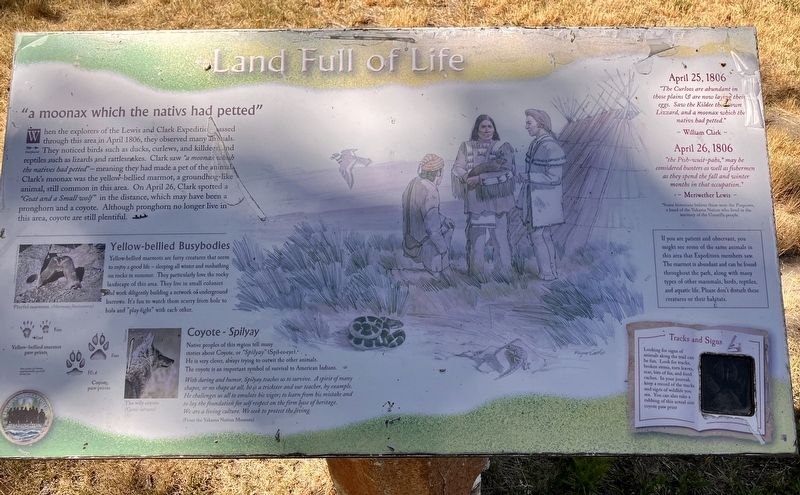
Photographed by Barry Swackhamer, June 13, 2026
1. Land Full of Life Marker
"a moonax which the nativs had petted"
When the explorers of the Lewis and Clark Expedition passed through this area in April 1806, they observed many animals. They noticed birds such as ducks, curlews, and killdeer and reptiles such as lizards and rattlesnakes. Clark saw "a moonax which the natives had petted" -meaning they had made a pet of the animal. Clark's moonax was the yellow-bellied marmot, a groundhog-like animal, still common in this area. On April 26, Clark spotted a "Goat and a Small wolf" in the distance, which may have been a pronghorn and a coyote. Although pronghorn no longer live in this area, coyote are still plentiful.
Yellow-bellied Busybodies
Yellow-bellied marmots are furry creatures that seem to enjoy a good life - sleeping all winter and sunbathing on the rocks in summer. They particularly love the rocky landscape of this area. They live in small colonies and work diligently building a network of underground burrows. It's fun to watch them scurry from hole to hole and "play-fight" with each other.
Coyote - Spilyay
Native peoples of this region tell many stories about Coyote, or "Splay"
this page online
With daring and humor, Spilyay teaches us to survive. A spirit of many shapes, or no shape at all, he is a trickster and our teacher, by example. He challenges us all to emulate his vigor; to learn from his mistake and to lay the foundation for self respect on the firm base of heritage. We are a living culture. We seek to protect the living. (From the Yakama Nation Museum)
"The Curloos are abundant in those plains & are now laying their eggs. Saw the Kildee the brown Lizzard, and a moonax which the nativs had petted."
William Clark
April 26, 1806
"the Pish-wuit-pahs,"may be considered hunters as well as fishermen as they spend the fall and winter months in that occupation."
Meriwether Lewis
"Some historians believe these were the Pisquows, a band of the Yakama Nation who lived in the territory of the Umatilla people.
If you are patient and observant, you might see some of the same animals in this area that Expedition members saw. The marmot is abundant
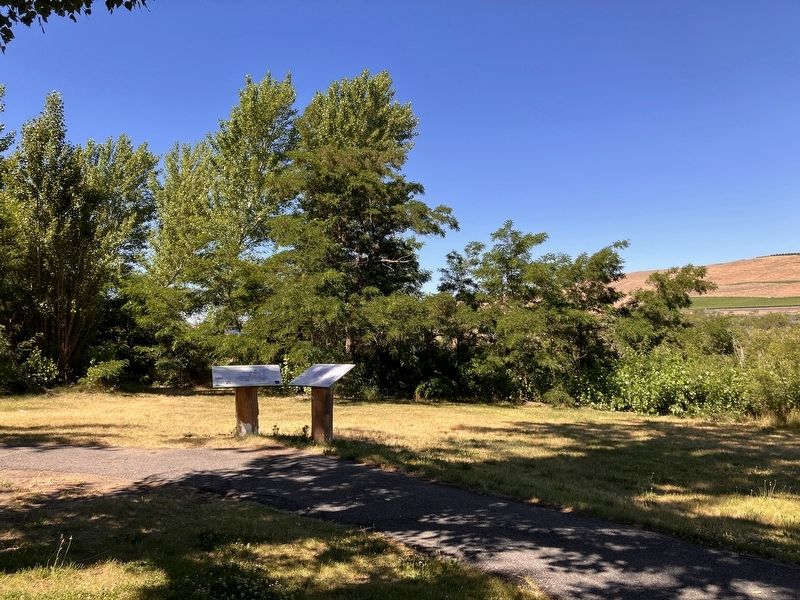
Photographed by Barry Swackhamer, June 13, 2026
2. Land Full of Life Marker
Erected by Washington Lewis & Clark Expedition Bicentennial Commission.
Topics and series. This historical marker is listed in these topic lists: Animals • Exploration • Indigenous Peoples and Communities. In addition, it is included in the Lewis & Clark Expedition series list. A significant historical date for this entry is April 26, 1806.
Location. 45° 51.169′ N, 119° 51.299′ W. Marker is in Whitcomb in , Washington. It is on Crow Butte State Park Road near Lewis & Clark Highway (Washington Route 14). This marker is located in Crow Butte State Park. Touch for map. Touch for directions.

Regionally, this marker is in the American Lewis & Clark Corridor. Globally, it is in North America, on the Pacific Rim, in the Western Hemisphere, in the Western World, and in the Anglosphere.
Other nearby markers. At least 4 other markers are within walking distance of this marker: Through the Sandy Plains (here, next to this marker); Ancient Times (within shouting distance of this marker); A Changing River (within shouting distance of this marker); In the Time of Contact (within shouting distance of this marker).
Credits. This page was last revised on September 17, 2026. It was originally submitted on September 11, 2026, by Barry Swackhamer of Brentwood, California. This page has been viewed 10 times since then. Photos: 1, 2. submitted on September 11, 2026, by Barry Swackhamer of Brentwood, California.
