Binnenstad in Amsterdam, North Holland, Netherlands — Northwestern Europe
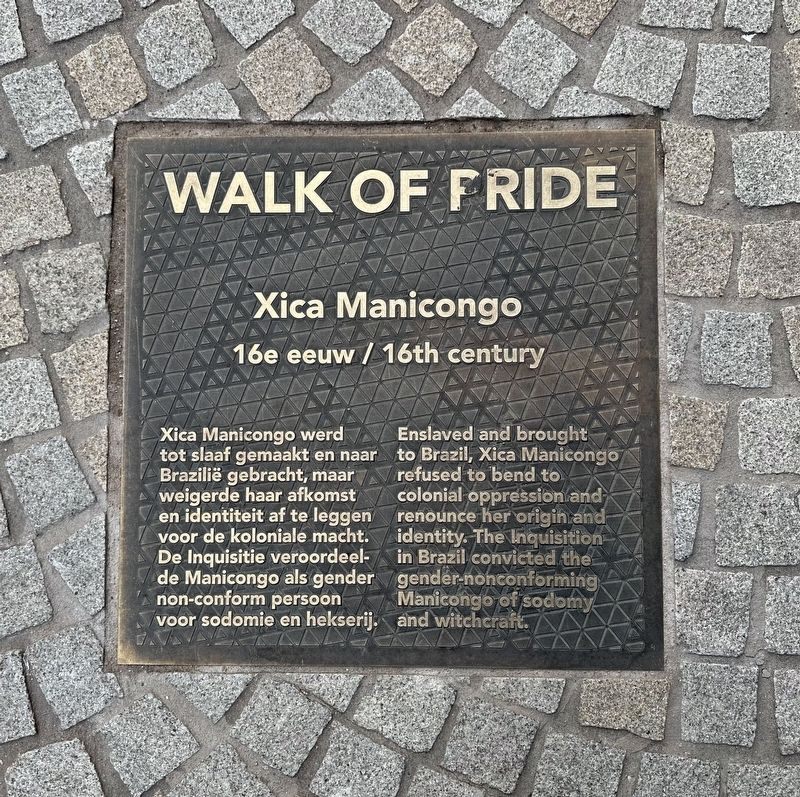
Xica Manicongo
| — | Walk of Pride Amsterdam | — |
Photographed by Andrew Ruppenstein, August 31, 2026
1. Xica Manicongo Marker

Xica Manicongo
16e eeuwe / 16th century
Erected 2026 by Walk of Pride Amsterdam. (Marker Number 04.)
Topics and series. This historical marker is listed in these topic lists: African Americans • Women. In addition, it is included in the Walk of Pride Amsterdam series list.
Location. 52° 22.397′ N, 4° 53.395′ E. Marker is in Amsterdam, Noord-Holland (North Holland). It is in Binnenstad. It is at the intersection of Raadhuisstraat and Spuistraat, on the right when traveling west on Raadhuisstraat. Touch for map. Marker is in this post office area: Amsterdam, Noord-Holland 1012 VK, Netherlands.
this page online

Regionally, it is in Europe, the European Union, Atlantic Europe, the Benelux Low Countries, the Schengen Area, Western Europe, and the Western World. Historically, it finds itself in what was once the Holy Roman Empire.
Other nearby markers. At least 8 other markers are within walking distance of this marker: Gesina Dekker (a few steps from this marker); Jillis Bruggeman (a few steps from this marker); David Kato (within shouting distance of this marker); FannyAnn Eddy (within shouting distance of this marker); Xulhaz Mannan (within shouting distance of this marker); Sarah Hegazi (within shouting distance of this marker); Emma Trosse (within shouting distance of this marker); Bier was hier / Beer was here (about 90 meters away, measured in a direct line). Touch for a list and map of all markers in Amsterdam.
Also see . . .
1. Francisco Manicongo (enslaved.org). Overview:
Francisco Manicongo was a Brazilian slave investigated by the Portuguese Inquisition in 1591 for sodomy and cross-dressing. He is considered Brazil’s first cross-dresser.(Submitted on September 12, 2026.)
2. Francisco Manicongo (Wikipedia, in Portuguese).
Photographed by Andrew Ruppenstein, August 31, 2026
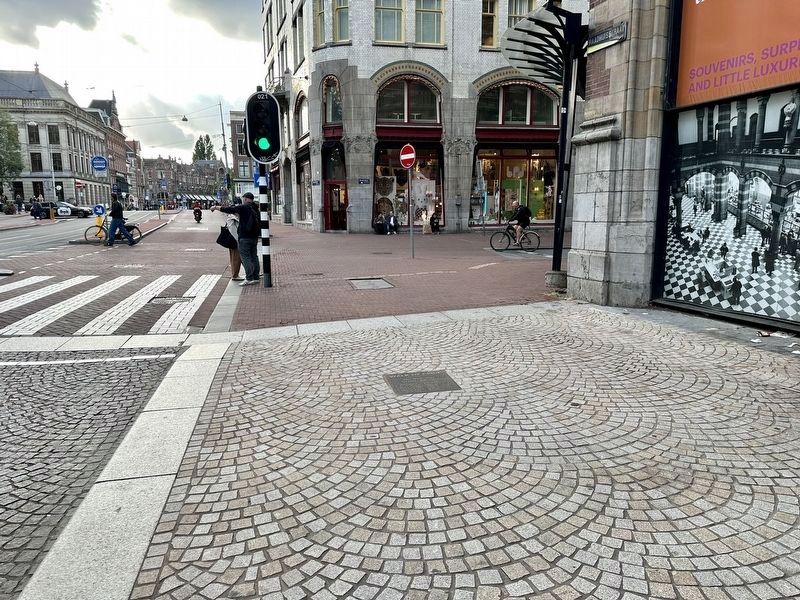
2. Xica Manicongo Marker - wide view, looking west on Raadhuisstraat
Francisco Manicongo, also known as Francisco de Congo (Kingdom of Congo — Salvador), was an African slave who lived in Salvador da Bahia, in the state of Brazil, in the second half of the 16th century. According to anthropologist and activist Luiz Mott, he was, along with Vitória do Benin, documented in Lisbon in 1556, one of the first documented cases of "homosexual" Africans, accused of being and dressing as an imbanda, a passive sodomite in the tradition of parts of the Congo. He gained prominence from the 1990s onwards, mainly among the LGBT community, after the dissemination of his case by Luiz Mott.(Submitted on September 12, 2026.)
The black transvestite activist Marjorie Marchi reinvented the historical figure in the 2000s, translating it as a transvestite with the social name Xica Manicongo. In 2010, the Xica Manicongo Award was created by the Association of Transvestites and Transsexuals of Rio de Janeiro (ASTRA-Rio), which Marchi presided over. In 2021, an urban quilombo in Rio de Janeiro was created and named "Xica Manicongo," in homage to the character created by Marchi.
Photographed by Andrew Ruppenstein, August 31, 2026
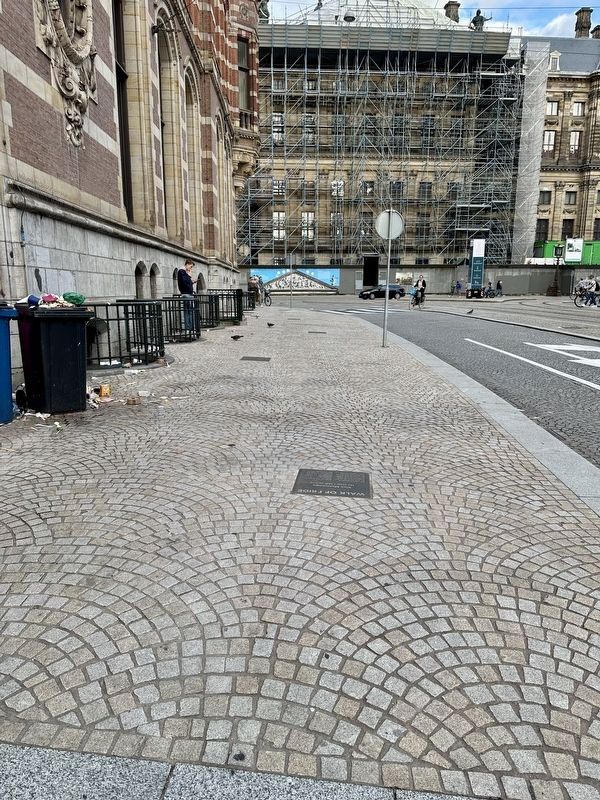
3. Xica Manicongo Marker - wide view, looking east on Raadhuisstraat…
towards the Walk of Pride starting point
Credits. This page was last revised on September 12, 2026. It was originally submitted on September 12, 2026, by Andrew Ruppenstein of Lamorinda, California. This page has been viewed 10 times since then. Photos: 1, 2, 3. submitted on September 12, 2026, by Andrew Ruppenstein of Lamorinda, California.
