
Mimico-Queensway in Toronto, Ontario — Central Canada (North America)
Lakeshore Asylum Cemetery c.1890-1979
⎯⎯⎯
Cimetière de l'asile du boulevard Lakeshore Vers 1890 a 1979
Photographed by Tim Boyd, September 7, 2026
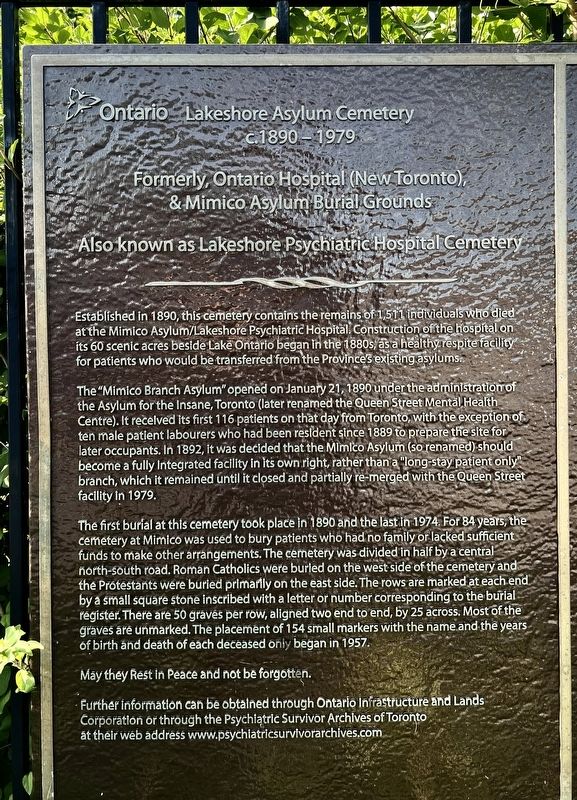
1. Lakeshore Asylum Cemetery c.1890-1979 side of marker

Formerly, Ontario Hospital (New Toronto), & Mimico Asylum Burial Grounds
Also known as Lakeshore Psychiatric Hospital Cemetery
Established in 1890, this cemetery contains the remains of 1,511 individuals who died at the Mimico Asylum/Lakeshore Psychiatric Hospital. Construction of the hospital on its 60 scenic acres beside Lake Ontario began in the 1880s, as a healthy respite facility for patients who would be transferred from the Province's existing asylums.
The "Mimico Branch Asylum" opened on January 21, 1890 under the administration of the Asylum for the Insane, Toronto (later renamed the Queen Street Mental Health Centre). It received its first 116 patients on that day from Toronto, with the exception of ten male patient labourers who had been resident since 1889 to prepare the site for later occupants. In 1892, it was decided that the Mimico Asylum (so renamed) should become a fully integrated facility in its own right, rather than a "long-stay patient only” branch, which it remained until it closed and partially re-merged with the Queen Street facility in 1979.
The
this page online
May they Rest in Peace and not be forgotten.
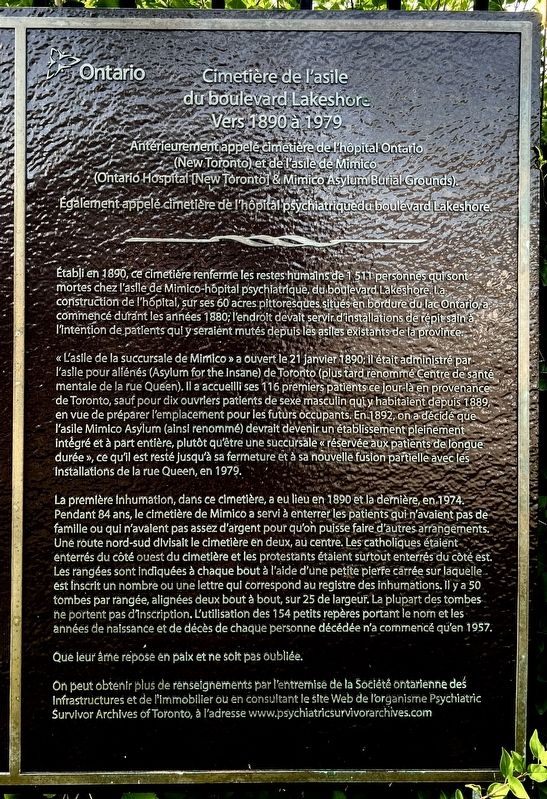
Antérieurement appelé cimetière de l'hôpital Ontario (New Toronto) et de l'asile de Mimico
(Ontario Hospital [New Torontol & Mimico Asylum Burial Grounds).
Egalement appelé cimetière de l'hôpital psychiatriqueda boulevard Lakeshore.
Établi en 1890, ce cimetière renferme les restes humains de
Photographed by Tim Boyd, September 7, 2026
2. Cimetière de l'asile du boulevard Lakeshore Vers 1890 a 1979 side of marker
«L'asile de la succursale de Mimico» a ouvert le 21 janvier 1890; il était administré par l'asile pour allénés (Asylum for the Insane) de Toronto (plus tard renommé Centre de santé mentale de la rue Queen). Il a accueilli ses 116 premiers patients ce jour-là en provenances de Toronto, sauf pour dix ouvriers patients de sexe masculin quly habitalent depuis 1889, en vue de préparer l'emplacement pour les futurs occupants. En 1892, on a décidé que l'asile Mimico Asylum (ainsi renommé) devrait devenir un établissement pleinement intégré et à part entière, plutôt qu'être une succursale « réservée aux patients de longue durée », ce qu'il est resté jusqu'à sa fermeture et à sa nouvelle fusion partielle avec les installations de la rue Queen, en 1979.
La première inhumation,
Photographed by Tim Boyd, September 7, 2026
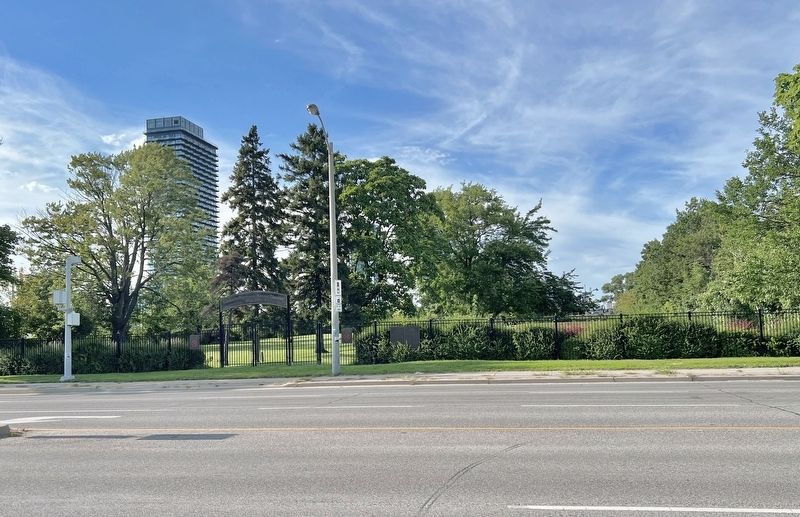
3. Lakeshore Asylum Cemetery c.1890-1979 / Cimetière de l'asile du boulevard Lakeshore Vers 1890 a 1979
Que leur âme repose en paix et ne soit pas oubliée
Erected by Government of Ontario.
Topics. This historical marker is listed in this topic list: Cemeteries & Burial Sites. A significant historical date for this entry is January 21, 1890.
Location. 43° 37.035′ N, 79° 31.09′ W. Marker is in
Photographed by Tim Boyd, September 7, 2026
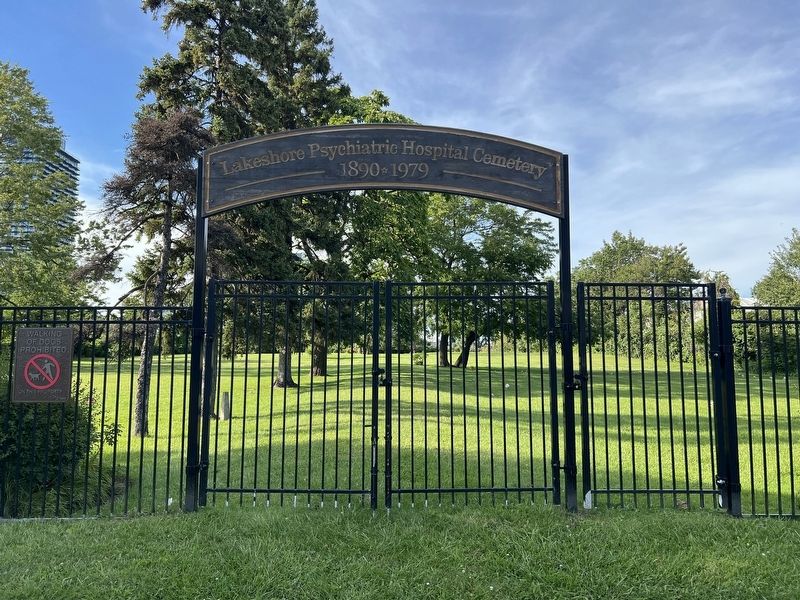
4. Lakeshore Asylum Cemetery c.1890-1979 gates

Regionally, this marker is in Greater Toronto and on the Golden Horseshoe. It is also in Central Canada. Globally, it is in North America, on the Great Lakes, in the Western Hemisphere, in the Western World, and in the Anglosphere. Historically, it finds itself in what was once a British colony, the Viceroyalty of New France, the Haudenosaunee (Iroquois) Confederacy, and Rupert’s Land.
Other nearby markers. At least 8 other markers are within 3 kilometers of this marker, measured as the crow flies: Long Branch Race Track (approx. 1.4 kilometers away); Queensway Market Gardens (approx. 1.4 kilometers away); The O’Connor-Lafferty House (approx. 1.5 kilometers away); Eden Court (approx. 1.6 kilometers away); Bell Telephone Company Building (approx. 1.8 kilometers away); Flight Lieutenant David Ernest Hornell, V.C. (approx. 2.4 kilometers away); New Toronto Filtration Plant/Lakeshore Pumping Station

Photographed by Tim Boyd, September 7, 2026
5. Lakeshore Asylum Cemetery in 2026
Credits. This page was last revised on September 13, 2026. It was originally submitted on September 12, 2026, by Tim Boyd of Hamilton, Ontario. This page has been viewed 7 times since then. Photos: 1, 2, 3, 4, 5. submitted on September 12, 2026, by Tim Boyd of Hamilton, Ontario. • Andrew Ruppenstein was the editor who published this page.
