Grachtengordel in Amsterdam, North Holland, Netherlands — Northwestern Europe
Herculine Barbin
| — | Walk of Pride Amsterdam | — |
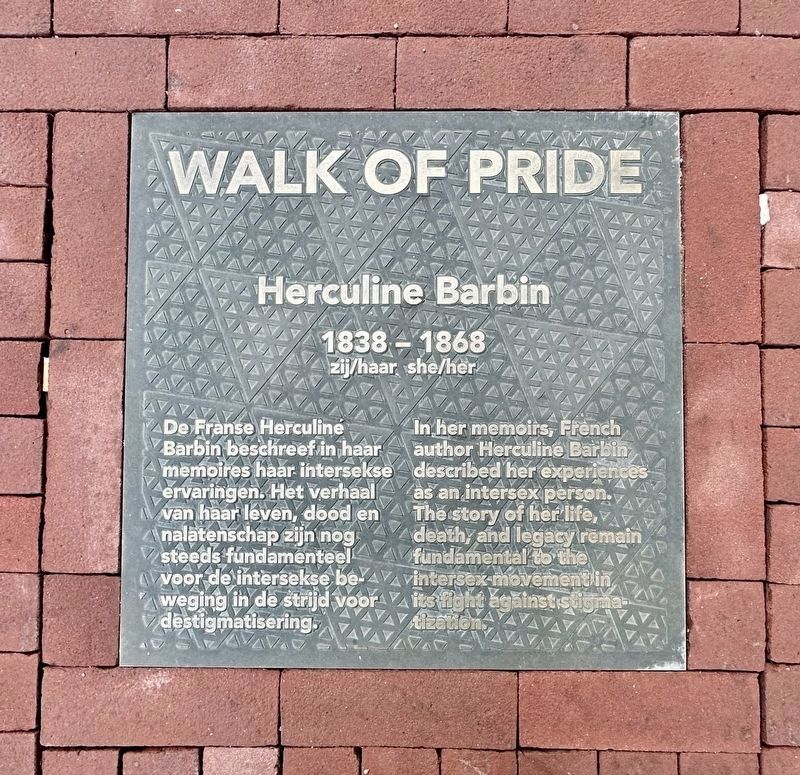
Photographed by Andrew Ruppenstein, August 31, 2026
1. Herculine Barbin Marker

Herculine Barbin
1838-1868
zij/haar she/her
Erected 2026 by Walk of Pride Amsterdam. (Marker Number 38.)
Topics and series. This historical marker is listed in these topic lists: Arts, Letters, Music • Women. In addition, it is included in the Walk of Pride Amsterdam series list. A significant historical date for this entry is November 8, 1838.
Location. 52° 22.427′ N, 4° 53.169′ E. Marker is in Amsterdam, Noord-Holland (North Holland). It is in Grachtengordel. It is on Raadhuisstraat west of Herengracht, on the right when traveling west. Touch for map. Marker is at or near this postal address: Raadhuisstraat 40A1, Amsterdam, Noord-Holland 1016 DG, Netherlands.
this page online

Regionally, it is in Europe, the European Union, Atlantic Europe, the Benelux Low Countries, the Schengen Area, Western Europe, and the Western World. Historically, it finds itself in what was once the Holy Roman Empire.
Other nearby markers. At least 8 other markers are within walking distance of this marker: Miriam van der Have (here, next to this marker); Marielle Franco (a few steps from this marker); Alje Klamer (a few steps from this marker); Brenda Howard (a few steps from this marker); Betty Paërl (a few steps from this marker); Thea Wickel (within shouting distance of this marker); Benno Premsela (within shouting distance of this marker); Georgina Beyer (about 90 meters away, measured in a direct line). Touch for a list and map of all markers in Amsterdam.
Also see . . .
1. Herculine Barbine (Wikipedia). Overview:
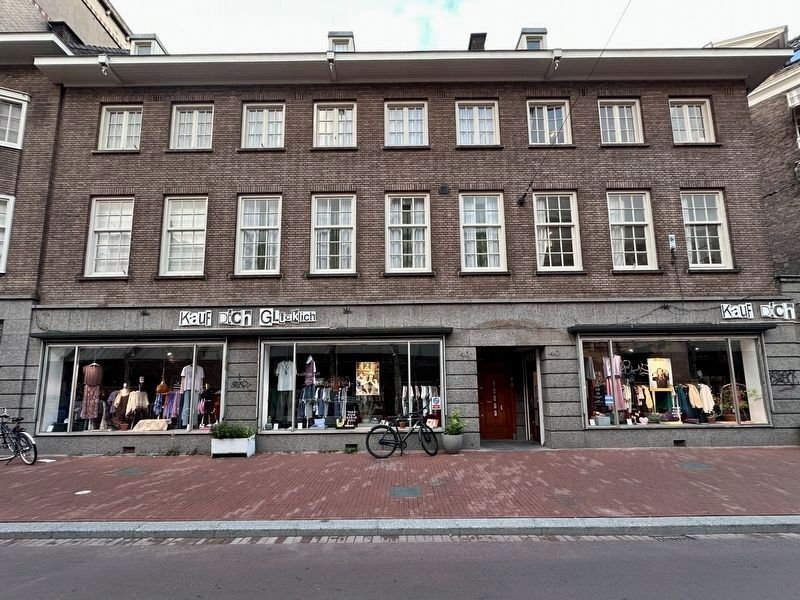
Herculine Adélaïde Barbin, later known as Abel Barbin (November 8, 1838 – February 1868), was a French intersex person who was assigned female at birth and raised in a convent, but was later reclassified as male by a court of law, after an affair and physical examination.(Submitted on September 15, 2026.)She is known for her memoir, Herculine Barbin, which was studied by Michel Foucault. Her birthday is marked as Intersex Day of Remembrance.Photographed by Andrew Ruppenstein, August 31, 20262. Herculine Barbin Marker - wide viewThe marker is visible here set into the pavement in the lower center of the picture.
2. Herculin Barbin (Making Queer History). Excerpt:
Herculine Barbin’s life is often introduced as a “case” — a nineteenth-century medico-legal puzzle that forced doctors and judges to decide what, exactly, made a person male or female. Born in 1838 in France and raised as a girl within Catholic schools and convents, Barbin would soon become the subject of medical examinations, legal judgments, and public scandals aimed at determining her “true sex.” The historical significance of her life, however, is not just tied to the ambiguity of her physical body but also to the extraordinary paper trail she managed to leave behind. Indeed, much of what we know about Barbin comes from her autobiographical memoir, written near the end of her life and after her legal sex reclassification–a groundbreaking text shaped by both hindsight and a need to justify a life that had been made publicly scandalous. This written work survived alongside a dense archive of medical, legal, and journalistic records, offering a rare first-person account of how sex was defined, enforced, and punished in the nineteenth century. Collectively, these materials reveal how Barbin’s personal experience was subordinated to institutional authority, as well as how the modern demand for a single, fixed sex could transform an individual’s life into a problem that needed to be corrected.(Submitted on September 15, 2026.)
3. Herculine Barbin – The Woman a French Court Legally FORCED to Become a Man (Youtube, 31:37). Description:
This video tells the true story of Herculine Barbin, one of the most significant intersex cases in modern history: her childhood in a poor, devout family and education through a convent scholarship, her love for a fellow teacher that led her to confess to a bishop, the medical examination and legal ruling that stripped her of the only identity she had ever known, and the poverty, isolation, and death that followed. We look at how her private memoir was recovered after her suicide, published without her consent in a forensic medical textbook, then rediscovered over a century later by philosopher Michel Foucault, and how scholars including Judith Butler and intersex researcher Morgan Holmes have argued over what her story actually means ever since.(Submitted on September 15, 2026.)
Additional keywords. lgbt, lgbtq, lgbtqia+
Credits. This page was last revised on September 15, 2026. It was originally submitted on September 15, 2026, by Andrew Ruppenstein of Lamorinda, California. This page has been viewed 10 times since then. Photos: 1, 2. submitted on September 15, 2026, by Andrew Ruppenstein of Lamorinda, California.
