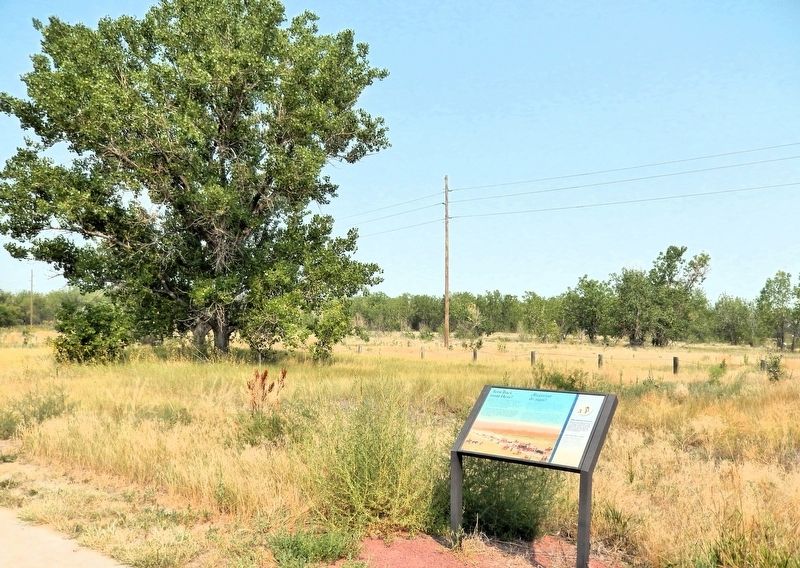
Turn Back from Here?/¿Regresar de aquí?


Although the trails to Oregon, California, and Utah had different beginning and end points, they all followed the Platte River and North Platte River. For emigrants to Oregon or California, Chimney Rock and Scotts Bluff showed they had come one-third the way; for Mormon pioneers, this was their halfway point to Utah. Here is where difficult decisions were made.
The emigrants' journey thus far had been hot, but relatively flat and easy. Just beyond Mitchell Pass at Scotts Bluff lay the rugged terrain of the Rocky Mountains and its harsh weather. The vast majority of travelers pushed on to their destinations. But some turned back at this point and used the expression “I have seen the elephant” to describe their feelings.
What would you have done?
Would you have allowed the upcoming mountains and cold weather to stop your journey? Consider the hardships that emigrants faced as you travel the 50 miles to Fort Laramie, Wyoming, where you can learn more about how mountain landscapes influenced the routes of the trails west.
Aunque las rutas de Oregon, California
this page online
La travesía de los emigrantes hasta entonces habla sido calurosa, pero relativamente plana y fácil. Poco después de Mitchell Pass en Scotts Bluff se encontraba el terreno escabroso de las montañas rocosas con su clima severo. La vasta mayoría de los viajeros siguieron a sus destinos. Pero algunos retrocedían en este punto y usaban la frase “He visto al elefante” para expresar los sentimientos de haber pasado y sobrevivido momentos difíciles en la vida.
¿Qué habría hecho usted?
¿Hubiese usted permitido que las montañas y clima frío venidero detuvieran su viaje? Considere las dificultades que los emigrantes encaraban mientras usted viaja ochenta kilómetros a Fort Laramie, Wyoming, donde puede aprender más sobre como los paisajes montañosos influenciaron las rutas del camino al oeste.
Erected by National
Topics. This historical marker is listed in these topic lists: Roads & Vehicles • Settlements & Settlers.
Location. 41° 51.114′ N, 103° 40.183′ W. Marker is in Scottsbluff, Nebraska, in Scotts Bluff County. It can be reached from Five Rocks Road (Avenue I) 0.4 miles south of South Beltline Highway West (State Highway 79H Spur). The marker is on the Monument Valley Pathway, just east of Riverside Park. Touch for map. Marker is in this post office area: Scottsbluff NE 69361, United States of America. Touch for directions.

Regionally, this marker is in the Nebraska Panhandle. It is also in the American Midwest, in the Corn Belt, and on the prairies. Globally, it is in North America, the Western Hemisphere, the Western World, and the Anglosphere. Historically, it finds itself in what was once the Louisiana Purchase.
Other nearby markers. At least 8 other markers are within walking distance of this marker: Me-a-pa-te (about 600 feet away, measured in a direct line); The Great Platte River Road/El camino del gran Río Platte (about 700 feet away); Marching to Zion/Marchando al monte Sion (approx. 0.2 miles away); The “Flat Water” Platte River/El Río Platte de agua plana (approx. ¼ mile away); North Platte River Flooding (approx. 0.3 miles away); The Fur Trade/El comercio de piel (approx. 0.3 miles away); Rapid Changes/Cambios rápidos (approx. 0.3 miles away); Settling the North Platte Valley/Colonizando el valle North Platte (approx. half a mile away). Touch for a list and map of all markers in Scottsbluff.
Also see . . . Seeing the Elephant (Wikipedia).
Excerpt: The phrase seeing the elephant is an Americanism which refers to gaining experience of the world. It was a popular expression of the mid to late 19th century throughout the United States, notably in the Mexican–American War, the Texan Santa Fe Expedition, the American Civil War, the 1849 Gold Rush, and the Westward Expansion Trails (Oregon Trail, California Trail, Mormon Trail).(Submitted on September 15, 2026, by Cosmos Mariner of Cape Canaveral, Florida.)The first references of elephants in trail narratives and letters are positive allusions. The reference appears primarily in the Oregon Trail, California Trail, and Mormon Trail. Hopes at the beginning of the trail tended to be high and the elephant excitement directly linked to this level of anticipation. In reading through dozens of trail diaries, not a single author was found who wrote of dreading to see the elephant in this beginning stage of the trail. As travelers became tired and hungry and saw family members and travel companions die of disease and accidents, reality began to set in. The elephant was not everything they hoped it would be. One bad day was not often treated to elephant status in a pioneer's journal, but successive unfortunate days or occurrences were not only notable themselves but also noteworthy of an elephant reference. As the miles rolled on and the pioneers continued dealing with hardships, their optimistic attitudes plummeted and the elephant was used as a kind of scapegoat for their troubles. The elephant that had demonstrated their excitement was now portraying their concerns. The mythical animal that had imbedded hopefulness in travelers was starting to present a different side.
Credits. This page was last revised on September 16, 2026. It was originally submitted on September 15, 2026, by Cosmos Mariner of Cape Canaveral, Florida. This page has been viewed 10 times since then. Photos: 1, 2. submitted on September 15, 2026, by Cosmos Mariner of Cape Canaveral, Florida.
