Scottsbluff in Scotts Bluff County, Nebraska — The American Midwest (Upper Plains)
The Fur Trade/El comercio de piel
Photographed by Cosmos Mariner, August 1, 2021
1. The Fur Trade/El comercio de piel Marker

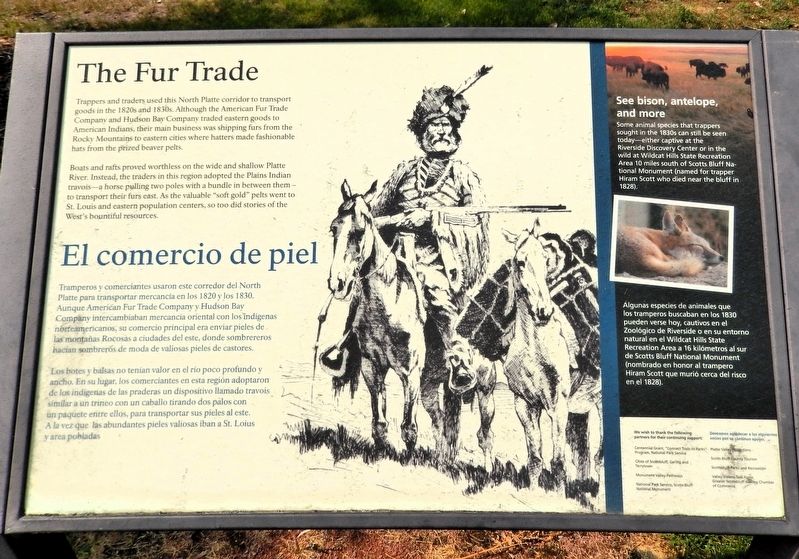
Trappers and traders used this North Platte corridor to transport goods in the 1820s and 1830s. Although the American Fur Trade Company and Hudson Bay Company traded eastern goods to American Indians, their main business was shipping furs from the Rocky Mountains to eastern cities, where hatters made fashionable hats from the prized beaver pelts.
Boats and rafts proved worthless on the wide and shallow Platte River. Instead, the traders in this region adopted the Plains Indian travois — a horse pulling two poles with a bundle in between them — to transport their furs east. As the valuable “soft gold” pelts went to St. Louis and eastern population centers, so too did stories of the West's bountiful resources.
See bison, antelope, and more
Some animal species that trappers sought in the 1830s can still be seen today — either captive at the Riverside Discovery Center or in the wild at Wildcat Hills State Recreation Area 10 miles south of Scotts Bluff National Monument (named for trapper Hiram Scott who died near the bluff in 1828).
Tramperos y comerciantes usaron este
this page online
Los botes y balsas no tenían valor en el río poco profundo y ancho. En su lugar, los comerciantes en esta región adoptaron de los indígenas de las praderas un dispositivo llamado travois similar a un trineo con un caballo tirando dos palos con un paquete entre ellos, para transportar sus pieles al este. A la vez que las abundantes pieles valiosas iban a St. Louis y area pobladas.
Ver bisontes, antílopes y más
Algunas especies de animales que los tramperos buscaban in los 1830 pueden verse hoy, cautivos en el Zoológico de Riverside o en su entorno natural en el Wildcat Hills State Recreation Area a 16 kilómetros al sur de Scotts Bluff National Monument (nombrado en honor al trampero Hiram Scott, que murió cerca del risco en el 1828).
Erected by National Parks Service, Cities
Photographed by Cosmos Mariner, August 1, 2021
2. The Fur Trade/El comercio de piel Marker
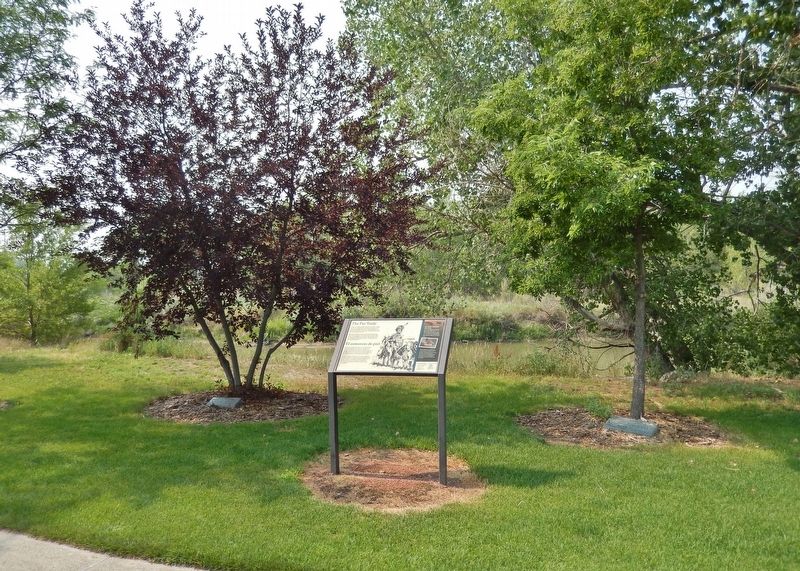
Looking south from the Monument Valley Pathway. The North Platte River is in the background.
Topics. This historical marker is listed in these topic lists: Animals • Indigenous Peoples and Communities • Industry & Commerce.
Location. 41° 51.126′ N, 103° 39.793′ W. Marker is in Scottsbluff, Nebraska, in Scotts Bluff County. It can be reached from the intersection of South Beltline Highway West and 10th Street, on the right when traveling east. The marker is on the Monument Valley Pathway in YMCA Park. Touch for map. Marker is at or near this postal address: 4010 10th Street, Gering NE 69341, United States of America. Touch for directions.

Regionally, this marker is in the Nebraska Panhandle. It is also in the American Midwest, in the Corn Belt, and on the prairies. Globally, it is in North America, the Western Hemisphere, the Western World, and the Anglosphere. Historically, it finds itself in what was once the Louisiana Purchase.
Other nearby markers. At least 8 other markers are within walking distance of this marker: North Platte River Flooding (a few steps from this marker); The “Flat Water” Platte River/El Río Platte de agua plana (about 400 feet away, measured in a direct line); The Great Platte River Road/El camino del gran Río Platte (approx. 0.2 miles away); Turn Back from Here?/¿Regresar de aquí? (approx. 0.3 miles away); Me-a-pa-te (approx. 0.4 miles away); Marching to Zion/Marchando al monte Sion (approx. half a mile away); Rapid Changes/Cambios rápidos (approx. 0.7 miles away); The Old Post Office (approx. 0.7 miles away). Touch for a list and map of all markers in Scottsbluff.
Related markers. Click here for a list of markers that are related to this marker.
Also see . . .
1. Travois (Wikipedia).
Excerpt: An A-frame structure used to drag loads over land, most notably by the Plains Indians of North America. The basic construction consists of a platform or netting mounted on two long poles, lashed in the shape of an A-frame; the frame is dragged with the sharply pointed end forward. The travois is dragged by hand, sometimes fitted with a shoulder harness for more efficient dragging, or dragged by dogs or horses. Although considered more primitive than wheel-based forms of transport, on the type of territory where the travois was used (forest floors, soft soil, snow, etc.), rather than roadways, wheels would have encountered difficulties which would have made them less efficient. As such the travois was employed by coureurs des bois in New France's fur trade with the Plains Tribes.(Submitted on September 17, 2026, by Cosmos Mariner of Cape Canaveral, Florida.)
2. Hiram Scott (c. 1805–1828) (Wikipedia).
Excerpt: American mountain man, trapper, and pelt trader who trapped and took part in expeditions throughout the western United States during the 1820s. Born in Missouri, Scott joined the Rocky Mountain Fur Company in 1822 and took part in the first fur trade expedition at the Great Salt Lake in Utah. He died at age 23 near a cliff along the North Platte River in Nebraska which was named in his honor. The circumstances leading to his demise have given rise to many diverse accounts and theories.(Submitted on September 17, 2026, by Cosmos Mariner of Cape Canaveral, Florida.)
Credits. This page was last revised on September 17, 2026. It was originally submitted on September 15, 2026, by Cosmos Mariner of Cape Canaveral, Florida. This page has been viewed 8 times since then. Photos: 1, 2. submitted on September 17, 2026, by Cosmos Mariner of Cape Canaveral, Florida.
