Islamorada in Monroe County, Florida — The American South (South Atlantic)
San Pedro
Underwater Archaeological Preserve
courtesy Florida State Parks
1. San Pedro Marker
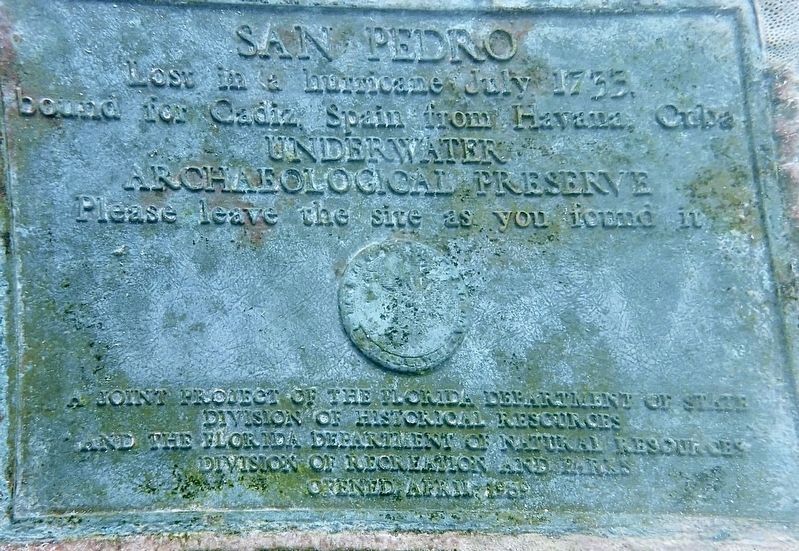
Lost in a hurricane July 1733, bound for Cadiz, Spain from Havana, Cuba.
Underwater Archaeological Preserve.
Please leave the site as you found it.
A joint project of the Florida Department of State Division of Historical Resources and the Florida Department of Natural Resources Division of Recreation and Parks. Opened April 1989.
Erected 1989 by Florida State Parks.
Topics. This historical marker is listed in this topic list: Waterways & Vessels. A significant historical year for this entry is 1733.
Location. 24° 51.98′ N, 80° 40.691′ W. Marker is in Islamorada, Florida, in Monroe County. This marker lies in 18 feet of water one mile south of Indian Key. Touch for map. Marker is in this post office area: Islamorada FL 33036, United States of America. Touch for directions.

Regionally, this marker is on the Florida Keys. It is also in the American South and on the Gulf Coast. Globally, it is in the North Atlantic Region, North America, a Gulf of Mexico state, the Western Hemisphere, the Western World, and the Anglosphere. Historically, it finds itself in what was once New Spain,
this page online
Other nearby markers. At least 8 other markers are within 2 miles of this marker, measured as the crow flies: Tea Table Key (approx. 1.6 miles away); San Pedro Underwater Archaeological Preserve (approx. 1.6 miles away); Indian Key Historic State Park (approx. 1.6 miles away); Triangle of History (approx. 1.6 miles away); Juan Ponce de Leon (approx. 1.6 miles away); Rafters (approx. 1.6 miles away); Spanish Treasure Fleet of 1733 (approx. 1.6 miles away); Florida East Coast Railroad Oversea Extension (approx. 1.6 miles away). Touch for a list and map of all markers in Islamorada.
Regarding San Pedro. On July 13, 1733, the New Spain Fleet left Havana bound for Spain packed with goods to support the empire. The fleet consisted of three armed galleons and 18 merchant ships packed with tanned hides, rare spices, precious jewels, silver and gold.
Two days into the journey, the weather turned and the crew feared a hurricane was imminent. The fleet was directed to turn around and make their way back to Havana, but it was

courtesy Florida State Parks
2. San Pedro Marker
The surviving crew members found refuge on the nearby islands and cobbled together makeshift shelters from the wreckage until rescue vessels arrived.
The rescue vessels came with supplies, divers, soldiers and salvage equipment to help the men and salvage the treasures that the vessels were transporting. The ships that could not be refloated were burned to the water line so divers could access their lower holds and the ships' locations would be hidden from looters. The salvage mission continued for several years.
The San Pedro was one of the merchant vessels of the Spanish Plate Fleet of 1733. This 287’ Dutch-built galleon was carrying 1,600 pesos in Mexican silver and many crates of Chinese porcelain. She was also loaded with other New World treasures including cochineal (to make red dye) and indigo (to make blue dye).
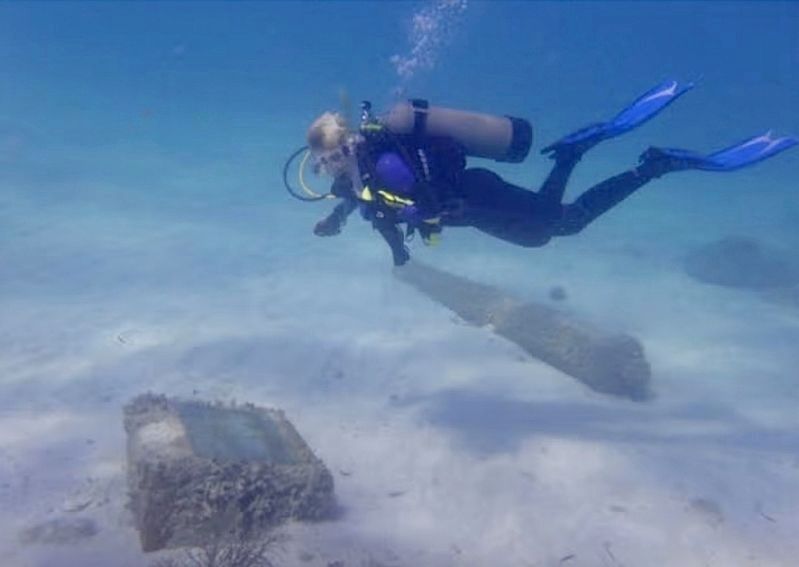
After the hurricane struck, the San Pedro was full of water and her decks awash; however, nearly all the cargo was salvaged and taken to a nearby salvage camp on Indian Key. Today her remains lie in 18 feet of water
courtesy Florida State Parks
3. San Pedro Marker
In the 1960s, the San Pedro was discovered by locals and recovery efforts during this time removed small silver coins dated between 1731 and 1733 as well as her cannons and other hardware.
In 1988, the wreck of the San Pedro was chosen to become Florida’s second Underwater Archaeological Preserve. The San Pedro’s remains were carefully mapped by state archaeologists and students from Florida State University and Indiana University.
To augment the site, a bronze plaque was placed among the ballast stones, as well as a 1733 anchor from another ship. Cement cannons were also brought in to replace the original cannons removed by salvors.
Today divers and snorkelers can visit the site and explore one of Florida’s oldest shipwreck sites.
When visiting the San Pedro remember to take only pictures and leave only bubbles.
-from Florida State Parks
Credits. This page was last revised on September 16, 2026. It was originally submitted on September 16, 2026, by Craig Baker of Sylmar, California. This page has been viewed 11 times since then. Photos: 1, 2, 3. submitted on September 16, 2026, by Craig Baker of Sylmar, California.
