Îlot Sacré in Bruxelles in Bruxelles-Capitale, Brussels, Belgium — Northwestern Europe
The Royal Saint-Hubert Galleries
Les Galeries Royales Saint-Hubert
⎯⎯⎯
De Koninklijke Sint-Hubertusgalerijen

Photographed by Ian Lefkowitz, September 10, 2026
1. The Royal Saint-Hubert Galleries Marker

Les Galeries Royales Saint-Hubert
Edifié comme une liaison entre deux pôles commerciaux, ce passage couvert monumental est parmi les premiers de cette ampleur à avoir été construits en Europe. Inaugurées en 1847, les Galeries furent dessinées dès 1838 par J.P. Cluysenaar. A la fois rue et monument, elles associent aux fonctions d’habitation et de commerce une dimension socio-culturelle, abritant notamment deux théâtres. Conçues en style néo-Renaissance italienne, elles constituent également un témoin significatif des prouesses et des innovations de l’architecture de métal et de verre.
De Koninklijke Sint-Hubertusgalerijen
Deze monumentale overdekte straat die twee commerciële centra verbond en tot de eerste van deze omvang behoorde in Europa, werd ingehuldigd in 1847, hoewel de plannen reeds in 1838 getekend waren door J.-P. Cluysenaar. Het gaat tegelijk om een straat en om een monument, waarvan de woon- en handelsfunctie nog aangevuld wordt door een socio-culturele dimensie, wegens de aanwezigheid van twee schouwburgen. De stijl is die van de Italiaanse neorenaissance, maar ook typische innovaties en krachttoeren eigen aan de architectuur van glas en metaal komen voor.
The Royal Saint-Hubert Galleries
Designed as a connection between two commercial poles, this monumental covered gallery was one of the first of this size built in Europe. Inaugurated in 1847, the Galleries were designed as of 1838 by J.P. Cluysenaar. Both street and monument, the Galleries fulfilled commercial as well as housing functions and also had a social and cultural dimension, notably hosting two theatres. Built in Italian Renaissance style, they also bear witness to the prowess and the innovations of steel and glass architecture.
Die Königlichen Sankt-Hubertus-Galerien
Diese monumentale
this page online
Topics. This historical marker is listed in these topic lists: Architecture • Roads & Vehicles. A significant historical date for this entry is June 20, 1847.
Location. 50° 50.915′ N, 4° 21.342′ E. Marker is in Bruxelles, Région Bruxelloise (Brussels), in Bruxelles-Capitale. It is in Îlot Sacré. It is at the intersection of Galerie du Roi and Rue de l'Ecuyer, on the right when traveling east on Galerie du Roi. Touch for map. Marker is at or near this postal address: Galerie du Roi 36, Bruxelles, Région Bruxelloise 1000, Belgium. Touch for directions.

Regionally, it is in Europe, the
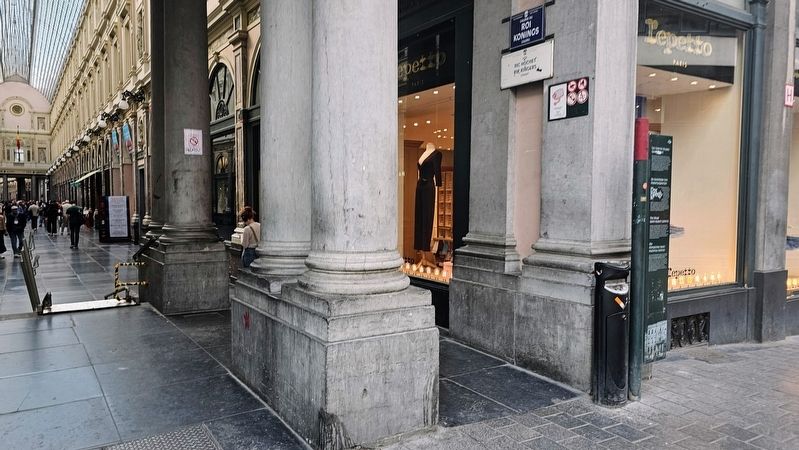
Photographed by Ian Lefkowitz, September 10, 2026
2. The Royal Saint-Hubert Galleries Marker
This marker is located at the northern entrance to the Royal Saint-Hubert Galleries. An identical marker is located at the southern entrance.
Other nearby markers. At least 8 other markers are within walking distance of this marker: Cinématographe Lumière (within shouting distance of this marker); Second Centenary of Cinema Projections in Belgium (within shouting distance of this marker); Galeries St. Hubert (about 90 meters away, measured in a direct line); Neuhaus Chocolates (about 120 meters away); a different marker also named The Royal Saint-Hubert Galleries (about 210 meters away); Les Premiers Drapeaux Belges / De Eerste Belgische Vlaggen / The First Belgian Flags (about 240 meters away); Victor Hugo (approx. 0.3 kilometers away); The Execution of the Counts of Egmont and Horn (approx. 0.3 kilometers away). Touch for a list and map of all markers in Bruxelles.
Also see . . . Galeries Royales Saint-Hubert Guide 2026 — Europe’s Oldest Shopping Arcade (Brussels Tourism).
In the 1830s, Brussels was a growing city without elegant(Submitted on September 16, 2026, by Ian Lefkowitz of New York, New York.)shopping infrastructure. Belgian architect Jean-Pierre Cluysenaar proposed a covered passage to compete with Paris’s Galeries de Bois (1786). The Galeries Royales Saint-Hubert opened on 20 June 1847, with King Leopold I attending the inauguration. The arcade radically innovated in two ways: monumental proportions (8 metres wide, 18 metres high under the glass roof) and three-level elevation — never before had such a long and high covered passage been achieved.Photographed by Ian Lefkowitz, September 10, 20263. The Royal Saint-Hubert GalleriesThe Galleries are one of the first glazed arcades in Europe.


May 15, 2023
4. The Royal Saint-Hubert Galleries and marker
Credits. This page was last revised on September 16, 2026. It was originally submitted on September 16, 2026, by Ian Lefkowitz of New York, New York. This page has been viewed 11 times since then. Photos: 1, 2, 3. submitted on September 16, 2026, by Ian Lefkowitz of New York, New York. 4. submitted on September 16, 2026. • Andrew Ruppenstein was the editor who published this page.
