Gouda, South Holland, Netherlands — Northwestern Europe
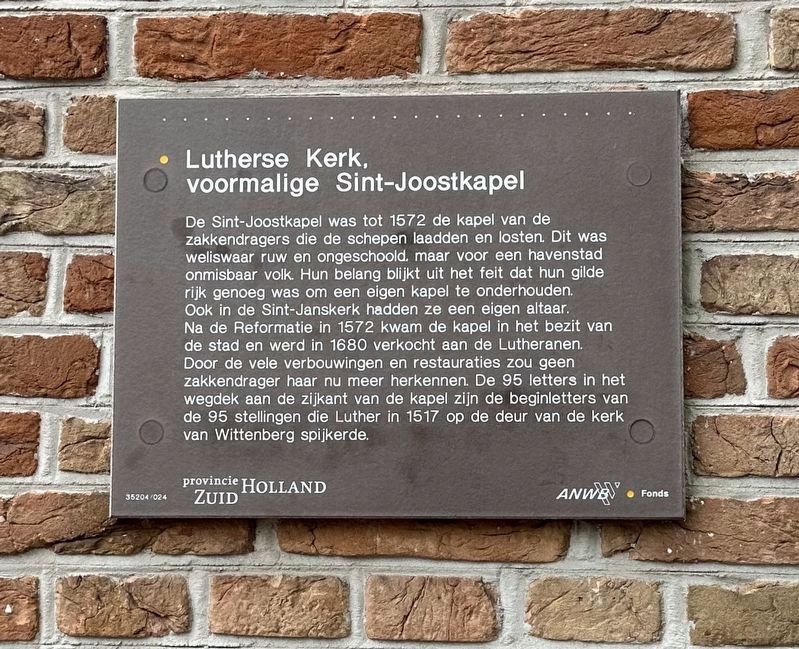
Lutherse Kerk, voormalige Sint-Joostkapel
⎯⎯⎯
Lutheran Church, formerly the St. Joost Chapel
Photographed by Andrew Ruppenstein, September 2, 2026
1. Lutheran Church, formerly the St. Joost Chapel Marker

De Sint-Joostkapel was tot 1572 de kapel van de zakkendragers die de schepen laadden en losten. Dit was weliswaar ruw en ongeschoold, maar voor een havenstad onmisbaar volk. Hun belang blijkt uit het feit dat hun gilde rijk genoeg was om een eigen kapel te onderhouden. Ook in de Sint-Janskerk hadden ze een eigen altaar. Na de Reformatie in 1572 kwam de kapel in het bezit van de stad en werd in 1680 verkocht aan de Lutheranen. Door de vele verbouwingen en restauraties zou geen zakkendrager haar nu meer herkennen. De 95 letters in het wegdek aan de zijkant van de kapel zijn de beginletters van de 95 stellingen die Luther in 1517 op de deur van de kerk van Wittenberg spijkerde.
Lutheran Church, formerly the St. Joost Chapel
Until 1572, the St. Joost Chapel served as the chapel for the porters who loaded and unloaded ships. Although they were rough and uneducated, they were indispensable to a port city. The importance of their guild is evident from the fact that it was wealthy enough to maintain its own chapel; they also had their
this page online
Erected by Provincie Zuid Holland, ANWB, VVV. (Marker Number 35204/024.)
Topics. This historical marker is listed in these topic lists: Labor Unions • Religion & Religious Structures. A significant historical year for this entry is 1572.
Location. 52° 0.606′ N, 4° 42.425′ E. Marker is in Gouda, Zuid-Holland (South Holland). It is at the intersection of Lage Gouwe and Lange Groenendaal, on the right when traveling north on Lage Gouwe. Touch for map. Marker is at or near this postal address: Lage Gouwe 134, Gouda, Zuid-Holland 2801 LK, Netherlands. Touch for directions.

Regionally, it is in Europe, the European Union, Atlantic Europe, the Benelux Low Countries, the Schengen Area, Western Europe,
Photographed by Andrew Ruppenstein, September 2, 2026
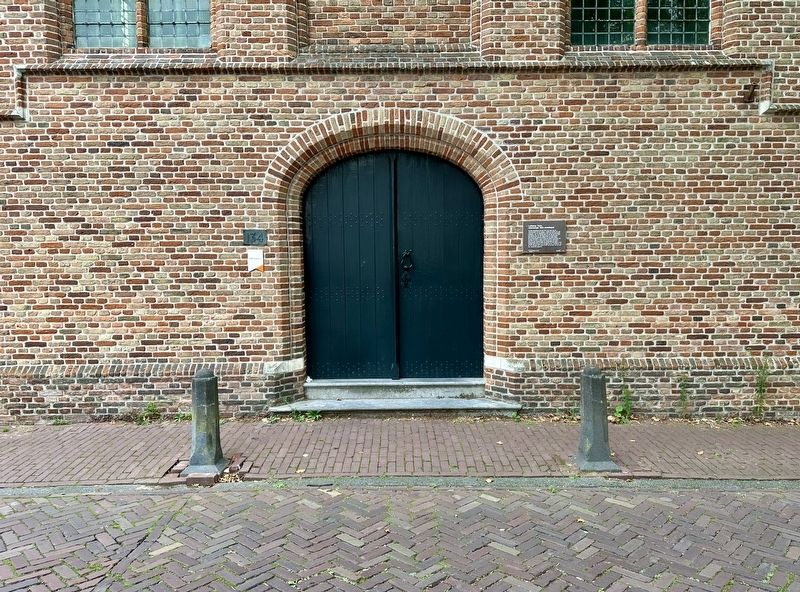
2. Lutheran Church, formerly the St. Joost Chapel Marker - wide view
Other nearby markers. At least 8 other markers are within walking distance of this marker: Het Goudse Badhuis / The Gouda Bathhouse (about 90 meters away, measured in a direct line); Magazijn De Zon / “The Sun Warehouse” (about 210 meters away); Salomon Benjamin Gompers (about 210 meters away); Elisabeth Gompers - van Tijn (about 210 meters away); Reintje Margaretha Gompers (about 210 meters away); Etty Gompers (about 210 meters away); Benjamin Gompers (about 210 meters away); Voormalige synagoge / Former Synagogue (about 210 meters away). Touch for a list and map of all markers in Gouda.
Also see . . . Sint-Joostkapel (Gouda) (Wikipedia, in Dutch). Excerpt (in translation):
The Sint-Joostkapel dates back to the 15th century. The chapel was dedicated to Saint Jodocus (known locally as Sint Joost), the patron saint of Gouda’s peat and sack carriers. He was invoked for intercession and aid during impending childbirth.(Submitted on September 17, 2026.)
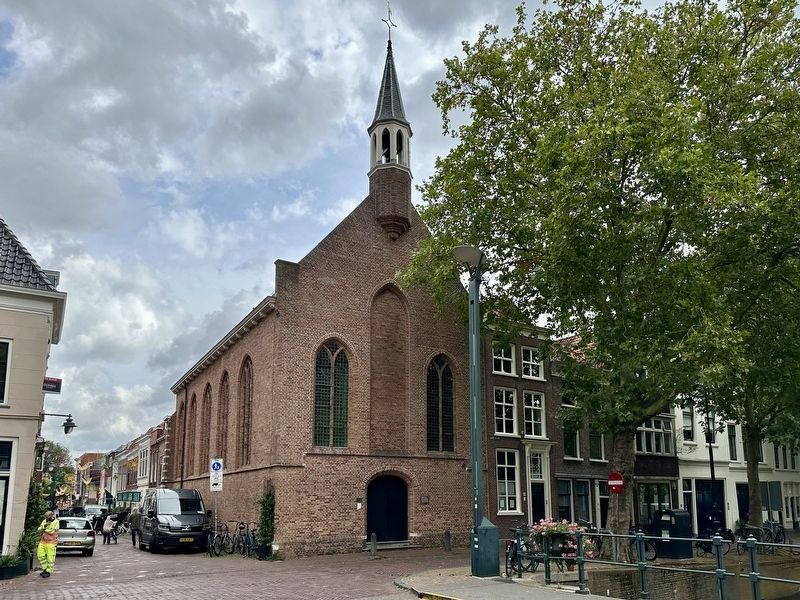
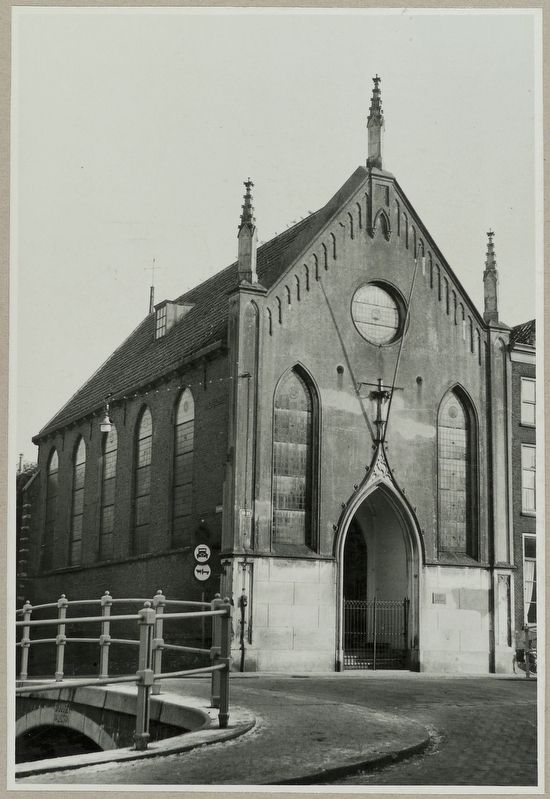
Following the Reformation in 1572, the chapel was initially used asa peat shed and, from 1577 onwards, as a storage space for fire buckets and ladders. In 1680, the city council sold the building—excluding the tower and its bell—to the Evangelical Lutheran Congregation (ELG) for 400 ducatons. They restored the building and officially inaugurated it as a church in 1682...Photographed by Andrew Ruppenstein, September 2, 20263. Lutheran Church, formerly the St. Joost Chapel and markerThe church building underwent restoration in 1762, 1790, 1806, 1838, and 1869. During the 1838 restoration, the windows were enlarged and the stained-glass windows were sold. The tower was demolished during the 1869 restoration because the street in front of the church was lowered to make way for a movable bridge over the Gouwe. The most extensive restoration took place in 1957; the church was almost entirely demolished and rebuilt. On the front façade, a blind window marks the location of the former church tower. The new front façade was topped with a projecting turret. - Wikipedia (in translation)
Additional keywords. longshoremen
courtesy Rijksdienst voor Cultureel Erfgoed (via Wikimedia Commons under CC 4.0 license)
4. Sint-Joostkapel
Credits. This page was last revised on September 17, 2026. It was originally submitted on September 17, 2026, by Andrew Ruppenstein of Lamorinda, California. This page has been viewed 6 times since then. Photos: 1, 2, 3, 4. submitted on September 17, 2026, by Andrew Ruppenstein of Lamorinda, California.
