Galva in Henry County, Illinois — The American Midwest (Great Lakes)
The Push/Pull
Galva, Illinois ↔ Gävle, Sweden

Photographed by Cosmos Mariner, June 24, 2021
1. The Push/Pull Marker
The “Push” was Sweden’s economic answer to reducing its population.
The “Pull” was America’s economic answer to help develop its land.
In the 1840's, significant numbers of Swedish citizens began to immigrate to the United States. The “Push” to emigrate from their homeland came because of overpopulation, lack of land, antiquated customs, indebtedness, the political/religious atmosphere and unusually harsh weather leading often to crop failures resulting in the lack of both food and work in Sweden. It was a difficult decision to emigrate. But America was growing and needed people to populate the west. (The thought of settling in the east seldom entered the Swedes' minds; their prime goal was to head west to acquire farmland.) Many were drawn to migrate by newspaper stories about earlier emigrants who also sent home “Amerika letters” tickets and money to friends and relatives, creating a “chain migration”. For some, their original intention may have been to eventually return to Sweden with money to start over, or retire, yet many prospered and stayed. In the second wave of mass migration from the early 1890's to 1920, emigration
this page online
The American industrial revolution and westward expansion provided the “Pull” and European-trained and educated Swedes found America as the perfect place to go. Life was getting more and more complicated, but they accepted the “America way”. Most stayed, largely in the west, initially to farm on homestead land, then to help industry. Galva offered much: a Swedish Lutheran church, friendly countrymen and/or relatives, jobs, some land and a large nearby Swedish settlement called Bishop Hill — where they could find respite. And for farmers that stayed around Galva, there were no rocks to be picked before planting the rich prairie loam.
The years of 1860-1890 were the heyday of Swedish mass immigration, usually by train from Chicago, ending at our railroad station in our park. Around 1870, a temporary lull in emigration took place but regained momentum in 1880, because traveling by ship and rail was more efficient and inexpensive by then. Agents were set up in Sweden to sell tickets and land,
Photographed by Cosmos Mariner, June 24, 2021
2. The Push/Pull Marker
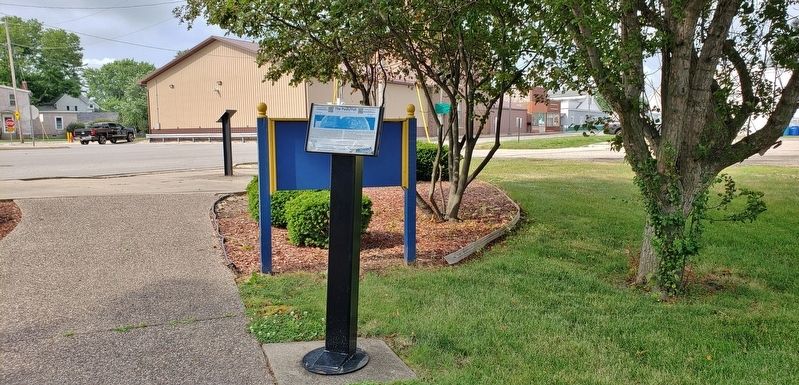
Looking northeast from the northeast corner of Veterans Memorial Park. The Front Street & Northwest 2nd Avenue intersection is in the background.
The hustle and bustle must have been quite exhilarating, as the young town grew and prospered. Nonetheless, times changed, and the large influx of Swedish immigrants dwindled in 1890 due to a depression in 1893, but rose again briefly for about twenty-five years. The second influx brought reforms in the Swedish emigration laws, transportation, freedom and changes in the economy. Even though many returned to Sweden, others continued west, enticed often by railroads, and brought the founding of new towns like Galva, Iowa, Galva, and Falun, Kansas. Some even went as far west as California and Alaska.
Galva lost its passenger rail service in 1962, and the Burlington line depot was torn down a few years later. But the “Push and Pull” of migration was a win-win for both America and Sweden, with both gaining from internal and external migration of people and ideas, exhibited right here in Galva, Illinois, sister city to Gävle, Sweden where many of its first emigrants sailed.
In Sweden, around 2012 many fine timbered “farmer castles” in the Hälsingland/Gävle area were recognized by the United Nations [UNESCO] as a World Heritage Site. These homes were built or expanded during the nineteenth century. The wealth needed to erect them came from their timber and flax industry. It is a foregone conclusion that “Amerika letters” were instrumental in helping to create today’s prosperous Sweden. While emigration certainly reduced population pressures, it also brought fresh ideas home by letters, news accounts, travel reports and returnees, many with American capital. Galva is proud to have been part of those changes and Sweden’s prosper.
[image captions]
• [global map across center] The solid line in red is the basic route many of the Swedes took. The trip took about two to three months, depending on the route/mode of transportation. Dashed lines indicate other possible routes.
• [bottom left] An advertisement to by tickets and go to the World’s Fair in 1933 — Known as the “Century of Progress” exhibition in Chicago
• [bottom right] The C. B. & Q. depot — remodeled in 1927 — Known as the Burlington railroad, just east of the park
Topics. This historical marker is listed in these topic lists: Immigration • Settlements & Settlers.
Location. 41° 9.998′ N, 90° 2.661′ W. Marker is in Galva, Illinois, in Henry County. It is at the intersection of Front Street and Northwest 2nd Avenue, on the right when traveling east on Front Street. The marker is beside the walkway near the northeast corner of Veterans Memorial Park. Touch for map. Marker is at or near this postal address: 338 Front Street, Galva IL 61434, United States of America. Touch for directions.

Regionally, this marker is in Northern Illinois. It is also in the American Midwest and in the Corn Belt. Globally, it is in North America, the Western Hemisphere, the Western World, and the Anglosphere. Historically, it finds itself in what was once the territory of the Mississippian Culture and also the Northwest Territory.
Other nearby markers. At least 8 other markers are within walking distance of this marker: Galva, Illinois in the 1870's (a few steps from this marker); The Galva Creamery (within shouting distance of this marker); Wistrand Manufacturing Co. and the Blue Star line (within shouting distance of this marker); Sgt. Schuyler Brent Patch (within shouting distance of this marker); Hayes Pump and Planter Company (within shouting distance of this marker); Olof Krans (about 300 feet away, measured in a direct line); Galva Opera House/Temperance Hall (about 300 feet away); The Scrap Drive of 1942 (about 400 feet away). Touch for a list and map of all markers in Galva.
Also see . . . About Galva (City of Galva).
Excerpt: Founded in 1854 by William and James Wiley as a railroad hub on the Chicago, Burlington & Quincy line, Galva was named in honor of its sister city, Gävle, Sweden — reflecting its strong Scandinavian-American roots. Our closeknit citizens — a blend of longtime homesteaders, growing families, entrepreneurs, educators, and newcomers — drive a strong community spirit. In the early 20th century, Galva became a regional hub for agriculture and commerce, with railroads and local industry fueling steady growth. The city’s Swedish-American roots remained strong through community traditions and family histories passed down through generations. From its railroad legacy to its cultural continuity, Galva’s past remains an active part of its identity today. A bit of Galva’s history can also be seen and learned about in Veterans Park, just follow the walking paths to see the History Walk panel displays.(Submitted on September 21, 2026, by Cosmos Mariner of Cape Canaveral, Florida.)
Credits. This page was last revised on September 21, 2026. It was originally submitted on September 19, 2026, by Cosmos Mariner of Cape Canaveral, Florida. This page has been viewed 6 times since then. Photos: 1, 2. submitted on September 21, 2026, by Cosmos Mariner of Cape Canaveral, Florida.
