Quadrate in Mannheim, Baden-Württemberg, Germany — Central Europe
Wohnhäuser der Familie Lanz A 2, 6 + 7
⎯⎯⎯
Residences of the Lanz Family, A 2, 6 + 7
| — | Kulturdenkmal / Cultural MonumenT | — |
Photographed by James Hulse, September 16, 2026
1. Wohnhäuser der Familie Lanz A 2, 6 + 7 / Residences of the Lanz Family, A 2, 6 + 7 Marker

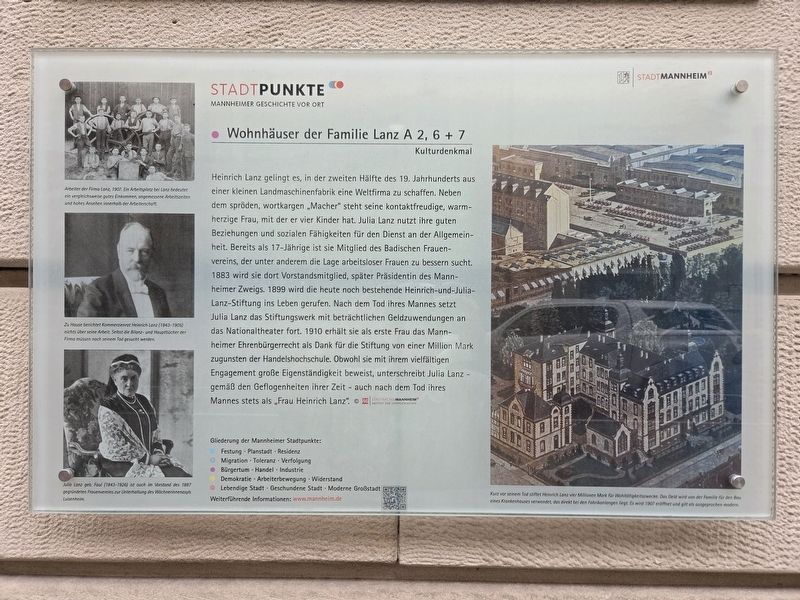
Arbeiter der Firma Lanz, 1907. Ein Arbeitsplatz bei Lanz bedeutet ein vergleichsweise gutes Einkommen, angemessene Arbeitszeiten und hohes Ansehen innerhalb der Arbeiterschaft.
Zu Hause berichtet Kommerzienrat Heinrich Lanz (1843–1905) nichts über seine Arbeit. Selbst die Bilanz- und Hauptbücher der Firma müssen nach seinem Tod gesucht werden.
Julia Lanz geb. Faul (1843–1926) ist auch im Vorstand des 1887 gegründeten Frauenvereins zur Unterhaltung des Wöchnerinnenasyls Luisenheim.
Kurz vor seinem Tod stiftet Heinrich Lanz vier Millionen Mark für Wohltätigkeitszwecke. Das Geld wird von der Familie für den Bau eines Krankenhauses verwendet, das direkt bei den Fabrikanlagen liegt. Es wird 1907 eröffnet und gilt als ausgesprochen modern.
© Stadtarchiv Mannheim Institut Für Stadtgeschichte
During
this page online
Workers at the Lanz company, 1907. Employment at Lanz offered a comparatively good income, reasonable working hours and high standing among workers.
Privy Commercial Councillor Heinrich Lanz (1843–1905) never discussed his work at home. Even the company’s balance sheets and main account books had to be searched for after his death.
Julia Lanz, née Faul (1843–1926), also served on the board of the Women’s Association for the Support of the Luisenheim Maternity Asylum, founded in 1887.
Shortly before his death, Heinrich Lanz donated four million marks to charitable causes. His family used the money to build a hospital directly beside the factory grounds. It opened in 1907 and was considered exceptionally modern.
Erected by City
Photographed by James Hulse, September 16, 2026
2. Wohnhäuser der Familie Lanz A 2, 6 + 7 / Residences of the Lanz Family, A 2, 6 + 7 Marker
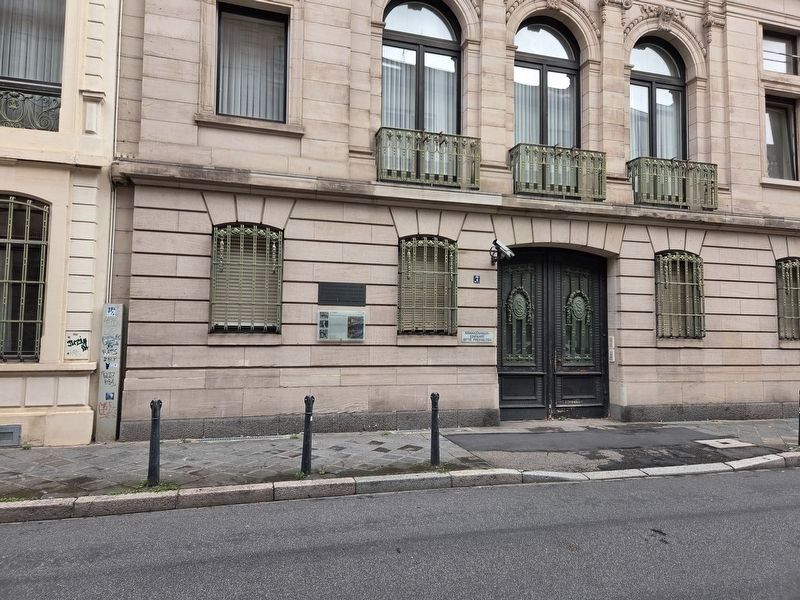
The bronze plaque above is for the Lanz House.
Topics. This historical marker is listed in these topic lists: Charity & Public Work • Industry & Commerce • Women. A significant historical year for this entry is 1883.
Location. 49° 29.133′ N, 8° 27.717′ E. Marker is in Mannheim, Baden-Württemberg. It is in Quadrate. It is on A2 just south of B2, on the right when traveling north. Touch for map. Marker is at or near this postal address: A2 7, Mannheim BW 68159, Germany. Touch for directions.

Regionally, this marker is on the German Upper Rhine. Globally, it is in Europe, the European Union, Atlantic Europe, Central Europe, the Schengen Area, Western Europe, and the Western World. Historically, it finds itself in what was once the Roman Empire, the Holy Roman Empire, and the former West Germany.
Other nearby markers. At least 8 other markers are within walking distance of this marker: Wohnhaus von Heinrich und Julia Lanz / Home of Heinrich and Julia Lanz (here, next to this marker); Wohnhaus von August von Kotzebue, A 2, 5 / Residence of August von Kotzebue, A 2, 5 (within shouting distance of this marker); Nationaltheater B 3
Photographed by James Hulse, September 16, 2026
3. Wohnhäuser der Familie Lanz A 2, 6 + 7 / Residences of the Lanz Family, A 2, 6 + 7 Marker
Credits. This page was last revised on September 21, 2026. It was originally submitted on September 20, 2026, by James Hulse of Medina, Texas. This page has been viewed 362 times since then. Photos: 1, 2, 3. submitted on September 21, 2026, by James Hulse of Medina, Texas.
