E6 in Mannheim, Baden-Württemberg, Germany — Central Europe
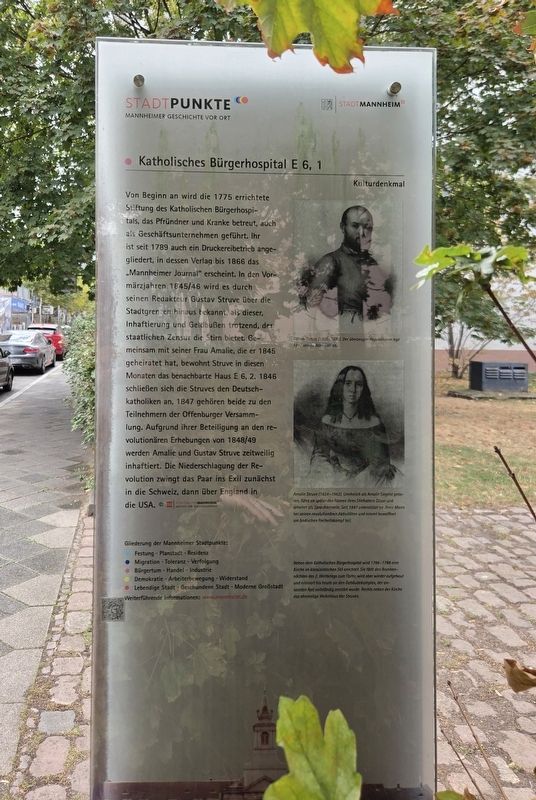
Katholisches Bürgerhospital, E 6, 1
⎯⎯⎯
Catholic Citizens’ Hospital, E 6, 1
| — | Kulturdenkmal / Cultural Monument | — |
Photographed by James Hulse, September 16, 2026
1. Katholisches Bürgerhospital, E 6, 1 / Catholic Citizens’ Hospital, E 6, 1 Marker

Gustav Struve (1805–1870). Der überzeugte Republikaner legt 1847 seinen Adelstitel ab.
Amalie Struve (1824–1862). Unehelich als Amalie Siegrist geboren, führt sie später den Namen ihres Stiefvaters Düsar und arbeitet als Sprachlehrerin. Seit 1847 unterstützt sie ihren Mann bei seinen revolutionären Aktivitäten und nimmt bewaffnet am badischen Freiheitskampf teil.
Neben dem Katholischen Bürgerhospital wird 1786–1788 eine Kirche im klassizistischen Stil errichtet. Sie fällt den Bombennächten des 2. Weltkriegs zum Opfer, wird aber wieder aufgebaut und erinnert bis heute an den Gebäudekomplex, der ansonsten fast vollständig zerstört wurde. Rechts neben der Kirche das ehemalige Wohnhaus der Struves.
© Stadtarchiv Mannheim Institut Für Stadtgeschichte
Weiterführende Informationen: www.mannheim.de
From its beginning,
this page online
Gustav Struve (1805–1870). The committed republican renounced his noble title in 1847.
Amalie Struve (1824–1862). Born outside marriage as Amalie Siegrist, she later adopted the surname of her stepfather, Düsar, and worked as a language teacher. Beginning in 1847, she supported her husband’s revolutionary activities and participated while armed in the Baden struggle for freedom.
A Neoclassical church was built beside the Catholic Citizens’ Hospital between 1786 and 1788. It was destroyed during the bombing raids of World War II but was rebuilt and continues to recall the larger complex, which was otherwise almost completely destroyed. To the right of the church is the former home of the Struves.
Further
Photographed by James Hulse, September 16, 2026
2. Katholisches Bürgerhospital, E 6, 1 / Catholic Citizens’ Hospital, E 6, 1 Marker
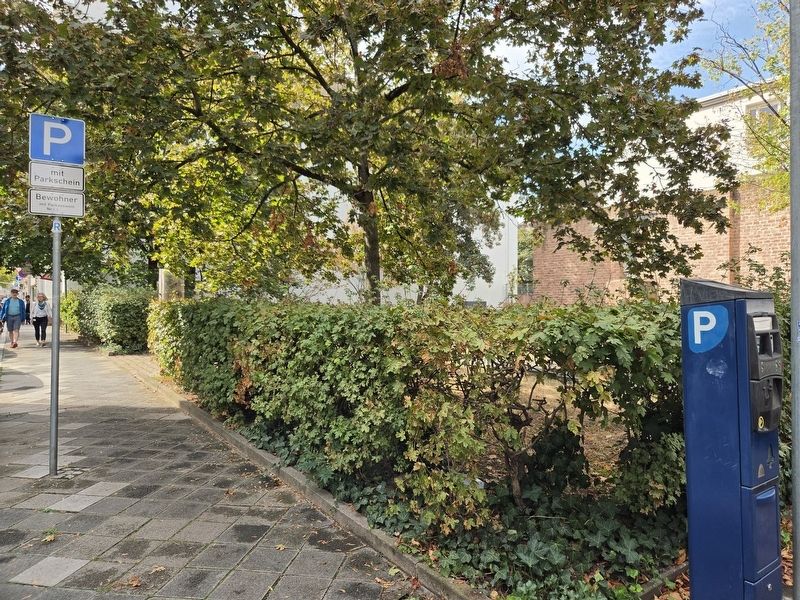
The marker is along and partially hidden in the bushes on the right side of the sidewalk.
Topics. This historical marker is listed in these topic lists: Religion & Religious Structures • Science & Medicine. A significant historical year for this entry is 1775.
Location. 49° 29.393′ N, 8° 27.745′ E. Marker is in Mannheim, Baden-Württemberg. It is in E6. It is on E6 just south of Fressgasse, on the left when traveling north. Touch for map. Marker is at or near this postal address: E6 5, Mannheim BW 68159, Germany. Touch for directions.

Regionally, this marker is on the German Upper Rhine. Globally, it is in Europe, the European Union, Atlantic Europe, Central Europe, the Schengen Area, Western Europe, and the Western World. Historically, it finds itself in what was once the Roman Empire, the Holy Roman Empire, and the former West Germany.
Other nearby markers. At least 8 other markers are within walking distance of this marker: Friedensengel, E 6 / Angel of Peace, E 6 (here, next to this marker); Gedenken an die Mannheimer Sinti / In Memory of Mannheim’s Sinti (a few steps from this marker); Sozialer Wohnungsbau im Quadrat F 5 / Social Housing in Square F 5 (within shouting distance of this marker); Goethe-Zitat über Mannheim / Goethe Quotation About Mannheim (about 90 meters away, measured in a direct line); Börse E 4, 14-16 / Stock Exchange E 4, 14-16 (about 120 meters away); Städtisches Leihamt D 4, 9-10 / Municipal Loan Office D 4, 9-10 (about 120 meters away); Veteranendenkmal / Veterans Memorial (about 150 meters away); Trinitatiskirche, G 4 / Trinity Church, G 4 (about 150 meters away). Touch for a list and map of all markers in Mannheim.
More about this marker. There is a non-related marker separately attached on the other side of the post.
Credits. This page was last revised on September 22, 2026. It was originally submitted on September 20, 2026, by James Hulse of Medina, Texas. This page has been viewed 5 times since then. Photos: 1, 2. submitted on September 22, 2026, by James Hulse of Medina, Texas.
