Innenstadt/Jungbusch in Mannheim, Baden-Württemberg, Germany — Central Europe
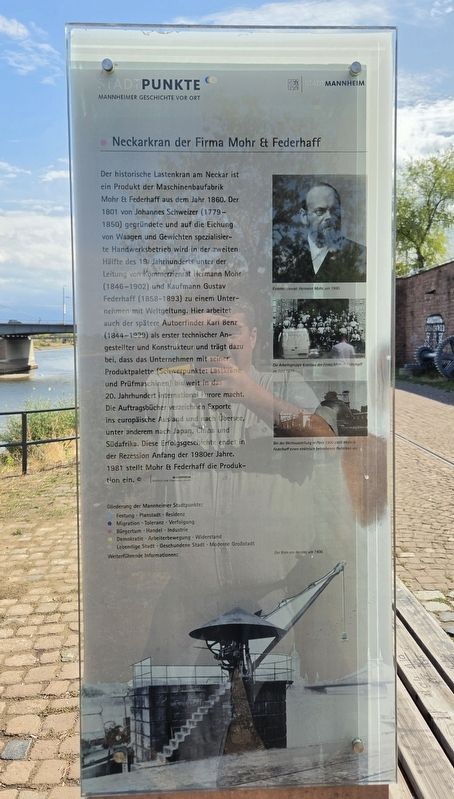
Neckarkran der Firma Mohr & Federhaff
⎯⎯⎯
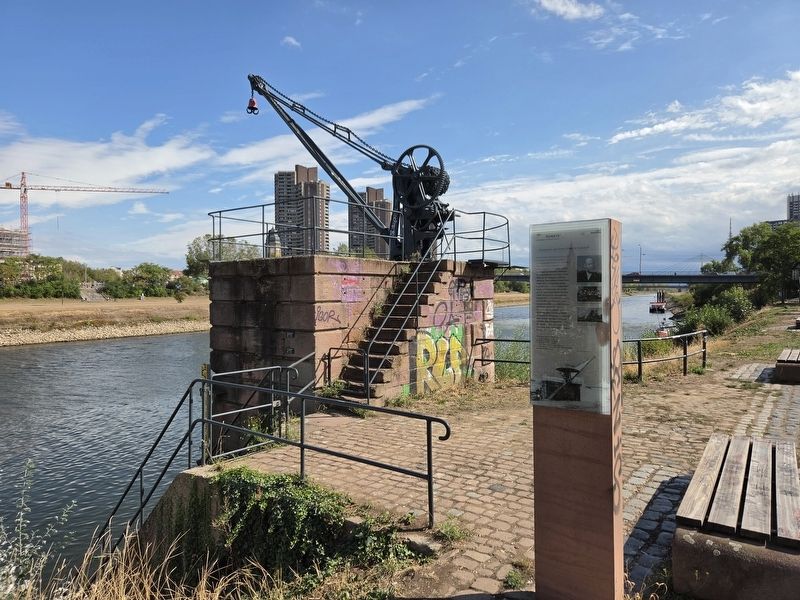
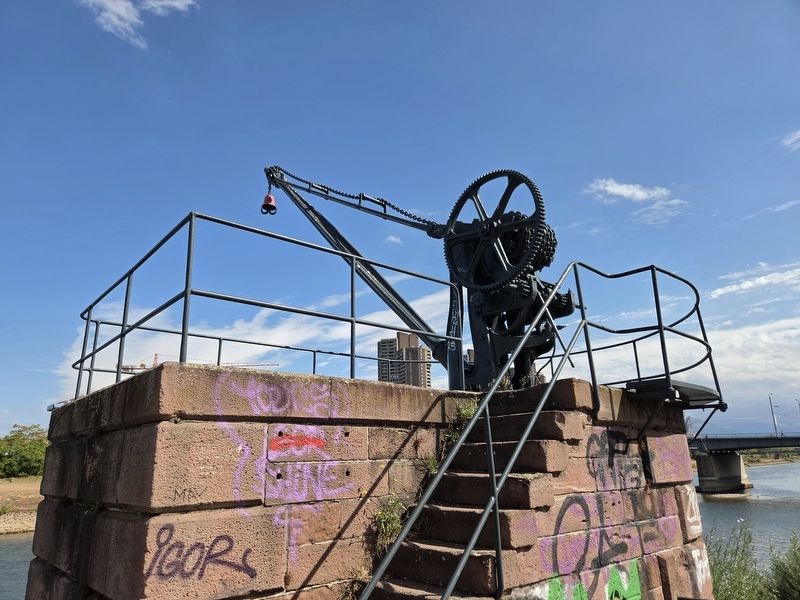
Neckar Crane of the Mohr & Federhaff Company
Photographed by James Hulse, September 16, 2026
1. Neckarkran der Firma Mohr & Federhaff / Neckar Crane of the Mohr & Federhaff Company Marker

Kommerzienrat Hermann Mohr, um 1900.
Die Arbeitsgruppe Kranbau der Firma Mohr & Federhaff im Jahr 1899.
Bei der Weltausstellung in Paris 1900 stellt Mohr & Federhaff einen elektrisch betriebenen Portalkran vor.
Der Kran am Neckar, um 1900.
Weiterführende Informationen: www.mannheim.de
© Stadtarchiv Mannheim Institut Für Stadtgeschichte
The historic cargo crane on the Neckar was manufactured by the Mohr & Federhaff engineering company in 1860. Johannes Schweizer (1779–1850) founded the workshop in 1801, specializing in the calibration of scales and weights. During the second half of the 19th century, under the leadership of commercial councilor Hermann Mohr (1846–1902) and businessman Gustav Federhaff (1858–1893), it developed into a company with a worldwide reputation. Karl Benz (1844–1929), who later invented the
this page online
Commercial councilor Hermann Mohr, around 1900.
The crane-construction work group of the Mohr & Federhaff company in 1899.
At the 1900 World’s Fair in Paris, Mohr & Federhaff presented an electrically powered gantry crane.
The crane on the Neckar, around 1900.
Further information: www.mannheim.de
Erected by Stadtarchiv Mannheim – Institut für Stadtgeschichte.
Topics. This historical marker is listed in this topic list: Waterways & Vessels. A significant historical year for this entry is 1860.
Location. 49° 29.659′ N, 8° 28.156′ E. Marker is in Mannheim, Baden-Württemberg. It is in Innenstadt/Jungbusch. It can be reached from Luisenring 0.1 kilometers west of
Photographed by James Hulse, September 16, 2026
2. Neckarkran der Firma Mohr & Federhaff / Neckar Crane of the Mohr & Federhaff Company Marker

Regionally, this marker is on the German Upper Rhine. Globally, it is in Europe, the European Union, Atlantic Europe, Central Europe, the Schengen Area, Western Europe, and the Western World. Historically, it finds itself in what was once the Roman Empire, the Holy Roman Empire, and the former West Germany.
Other nearby markers. At least 8 other markers are within walking distance of this marker: Hochbunker Neckarvorlandstraße / Neckarvorlandstraße Air-Raid Bunker (here, next to this marker); Schiffs- und Maschinenbau AG Mannheim – Schimag (a few steps from this marker); Festungsfunde beim Bau des Regenüberlaufbeckens (within shouting distance of this marker); Museumsschiff Mannheim / Mannheim Museum Ship (within shouting distance of this marker); Die Stadtentwässerung – wie alles begann / Urban Drainage – How It All Began (within shouting distance of this marker); Aalschokker / Eel-Fishing Boat (within shouting distance of this marker); Alexander Sender Wassermann
Photographed by James Hulse, September 16, 2026
3. Neckarkran der Firma Mohr & Federhaff / Neckar Crane of the Mohr & Federhaff Company
More about this marker. There is a non-related marker separately attached on the other side of the post.
Credits. This page was last revised on September 22, 2026. It was originally submitted on September 20, 2026, by James Hulse of Medina, Texas. This page has been viewed 5 times since then. Photos: 1, 2, 3. submitted on September 22, 2026, by James Hulse of Medina, Texas.
