Innenstadt/Jungbusch in Mannheim, Baden-Württemberg, Germany — Central Europe
Schiffs- und Maschinenbau AG Mannheim – Schimag
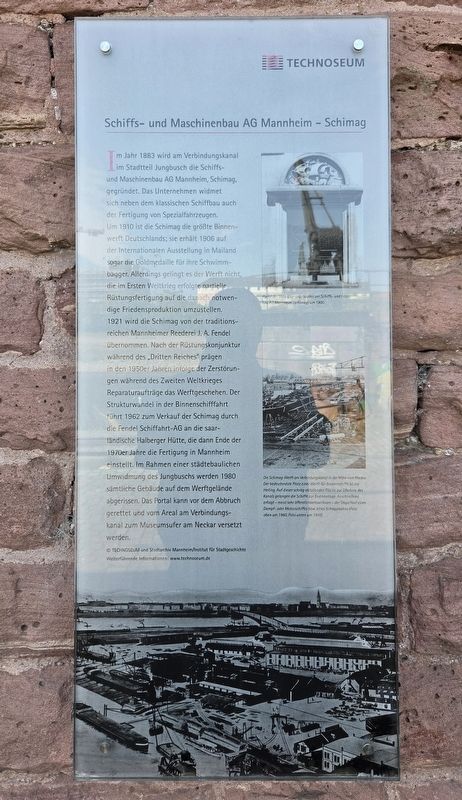
Mannheim Shipbuilding and Mechanical Engineering Corporation – Schimag
Photographed by James Hulse, September 16, 2026
1. Schiffs- und Maschinenbau AG Mannheim – Schimag Marker

Portal des Verwaltungsgebäudes der Schiffs- und Maschinenbau AG Mannheim (Schimag) um 1900.
Die Schimag-Werft am Verbindungskanal in der Nähe vom Neckar. Der bedeutendste Platz einer Werft für Binnenschiffe ist die Helling. Auf dieser schräg abfallenden Fläche zur Uferlinie des Kanals gelangen die Schiffe zur Endmontage. Anschließend erfolgt – meist sehr öffentlichkeitswirksam – der Stapellauf eines Dampf- oder Motorschiffes bzw. eines Schleppkahns (Foto oben um 1960, Foto unten um 1910).
Weiterführende Informationen: www.technoseum.de
© Technoseum und Stadtarchiv Mannheim/Institut für Stadtgeschichte
The
this page online
Photographed by James Hulse, September 16, 2026
2. Schiffs- und Maschinenbau AG Mannheim – Schimag Marker
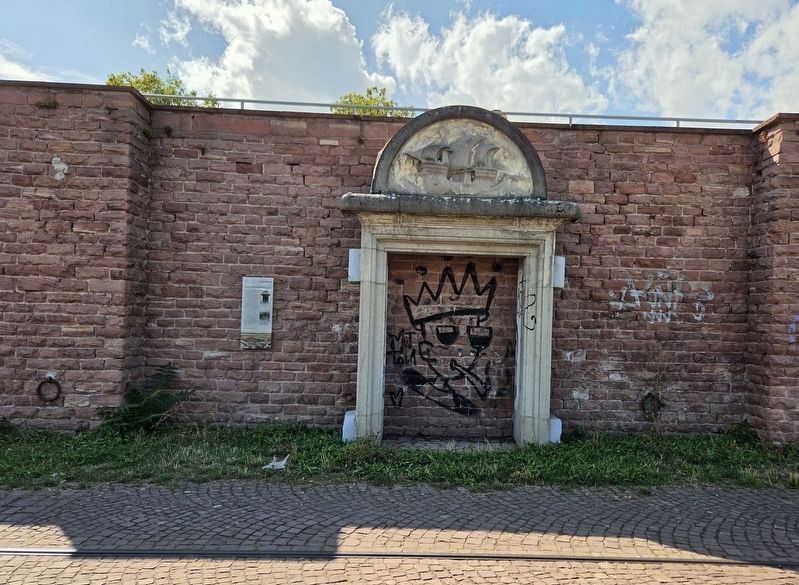
The former entrance portal to the company business is on the right side of the marker.
Entrance portal of the administrative building of the Mannheim Shipbuilding and Mechanical Engineering Corporation (Schimag), around 1900.
The Schimag shipyard on the connecting canal near the Neckar. The most important area of an inland shipyard is the slipway. Ships travel along this sloping surface toward the canal’s shoreline for final assembly. This is followed—usually with considerable public attention—by the launching of a steamship, motor vessel, or tow barge. The upper photograph dates from around 1960 and the lower photograph from around 1910.
Further information: www.technoseum.de
Erected by Technoseum und Stadtarchiv Mannheim/Institut für Stadtgeschichte.
Topics. This historical marker is listed in this topic list: Waterways & Vessels. A significant historical year for this entry is 1883.
Location. 49° 29.653′ N, 8° 28.159′ E. Marker is in Mannheim, Baden-Württemberg. It is in Innenstadt/Jungbusch. It can be reached from Luisenring 0.1 kilometers west of Kurpfalzbrücke, on the right when traveling west.
Photographed by James Hulse, September 16, 2026
3. Schiffs- und Maschinenbau AG Mannheim – Schimag Marker
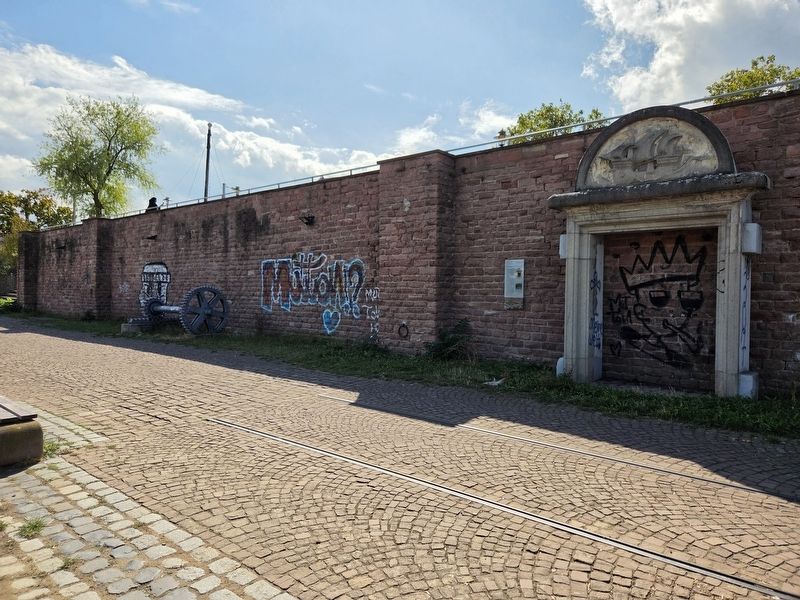
The view of the markers along the river front.

Regionally, this marker is on the German Upper Rhine. Globally, it is in Europe, the European Union, Atlantic Europe, Central Europe, the Schengen Area, Western Europe, and the Western World. Historically, it finds itself in what was once the Roman Empire, the Holy Roman Empire, and the former West Germany.
Other nearby markers. At least 8 other markers are within walking distance of this marker: Hochbunker Neckarvorlandstraße / Neckarvorlandstraße Air-Raid Bunker (a few steps from this marker); Neckarkran der Firma Mohr & Federhaff / Neckar Crane of the Mohr & Federhaff Company (a few steps from this marker); Festungsfunde beim Bau des Regenüberlaufbeckens (within shouting distance of this marker); Die Stadtentwässerung – wie alles begann / Urban Drainage – How It All Began (within shouting distance of this marker); Aalschokker / Eel-Fishing Boat (within shouting distance of this marker); Museumsschiff Mannheim / Mannheim Museum Ship (within shouting distance of this marker); Alexander Sender Wassermann (about 210 meters away, measured in a direct line); Mathilde Wassermann (about 210 meters away). Touch for a list and map of all markers in Mannheim.
Credits. This page was last revised on September 22, 2026. It was originally submitted on September 20, 2026, by James Hulse of Medina, Texas. This page has been viewed 3 times since then. Photos: 1, 2, 3. submitted on September 22, 2026, by James Hulse of Medina, Texas.
