Galva in Henry County, Illinois — The American Midwest (Great Lakes)
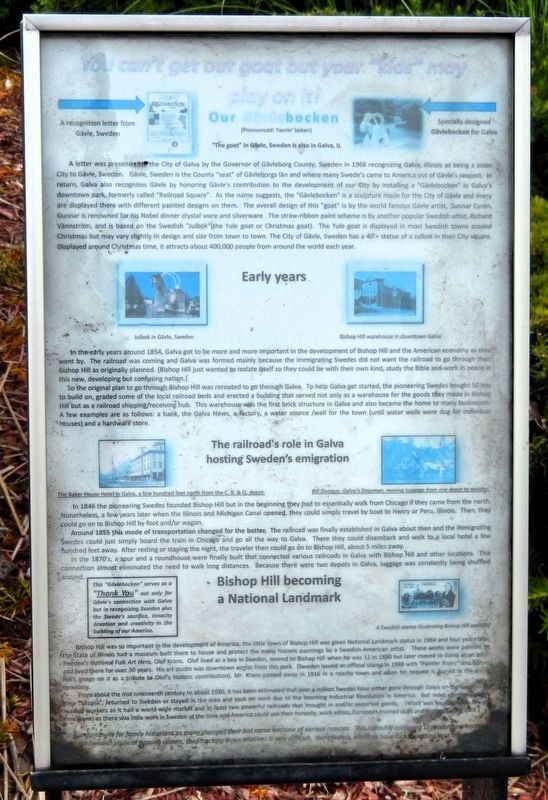
Our Gävlebocken
(Pronounced: Yaevle’ boken)
| — | “The goat” in Gävle, Sweden is also in Galva, IL | — |
Photographed by Cosmos Mariner, June 24, 2021
1. Our Gävlebocken Marker
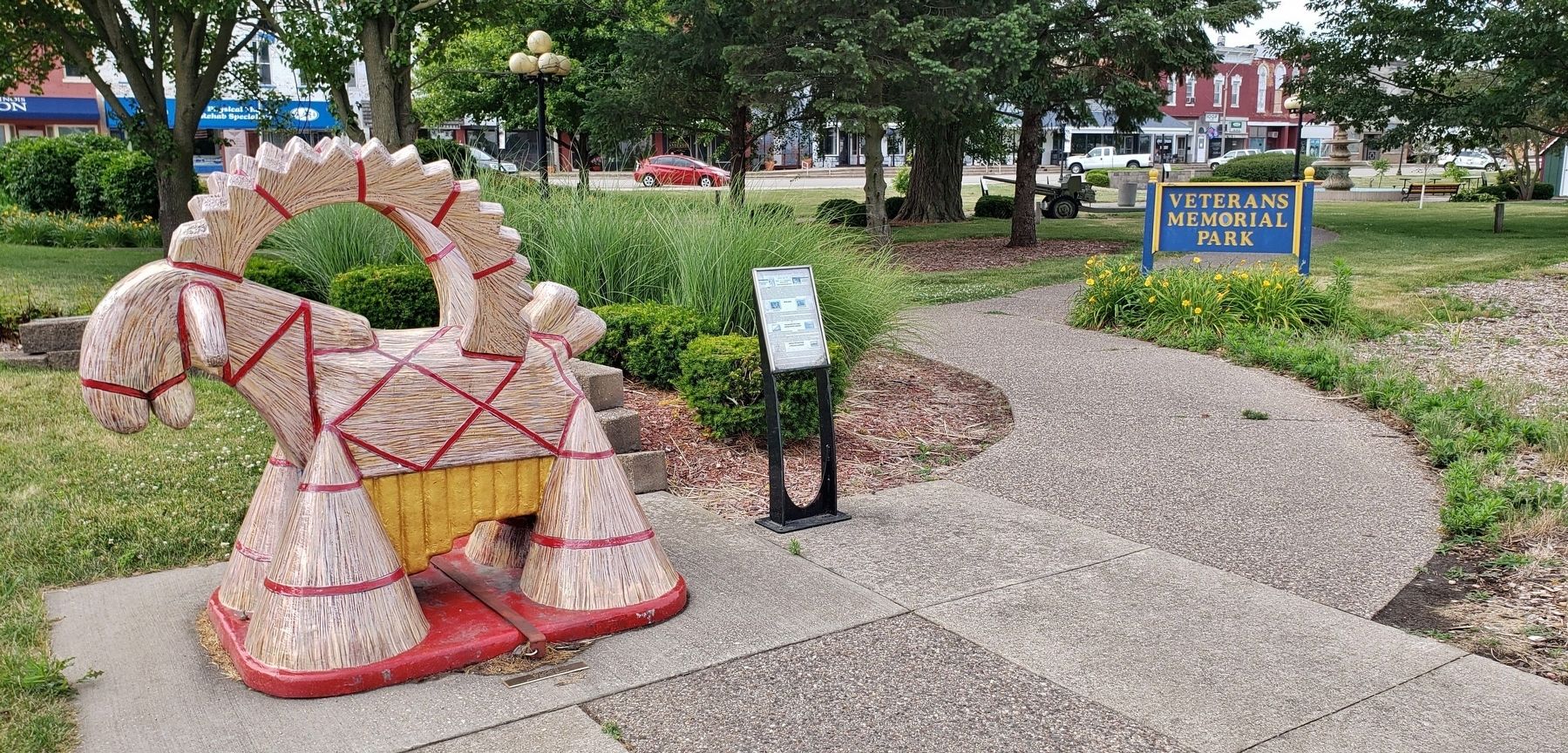
A letter was presented to the City of Galva by the Governor of Gävleborg County, Sweden in 1966 recognizing Galva, Illinois as being a sister city to Gävle, Sweden. Gävle, Sweden is the County “seat” of Gävleborgs län and where many Swede's came to America out of Gävle's seaport. In return, Galva also recognizes Gävle by honoring Gävle's contribution to the development of our city by installing a “Gävlebocken” in Galva downtown park, formerly called “Railroad Square”. As the name suggests, the “Gävlebocken” is a sculpture made for the City of Gävle and many are displayed there with different painted designs on them. The overall design of this “goat” is by the world famous Gävle artist, Gunnar Cyrén. Gunnar is renowned for his Nobel dinner crystal ware and silverware. The straw-ribbon paint scheme is by another popular Swedish artist, Richard Vännström, and is based on the Swedish “Julbok” (the Yule goat or Christmas goat). The Yule goat is displayed in most Swedish towns around Christmas but may vary slightly in design and size from town to town. The City of Gävle, Sweden has a 40'+ statue of a Julbok in their City square. Displayed around Christmas time, it attracts about 400,000 people from around the world each year.
Early Years
In the early years around 1854, Galva got to be more and more important in the development of Bishop Hill and the American economy as time went by. The railroad was coming and Galva was formed mainly because the immigrating Swedes did not want the railroad to go through their Bishop Hill as originally planned. (Bishop Hill just wanted to isolate itself so they could be with their own kind, study the Bible and work in peace in this new, developing but confusing nation.)
So the original plan to go through Bishop Hill was rerouted to go through Galva. To help Galva get started, the
this page online
The railroad’s role in Galva hosting Sweden’s emigration
In 1846 the pioneering Swedes founded Bishop Hill but in the beginning they had to essentially walk from Chicago if they came from the north. Nonetheless, a few years later when the Illinois and Michigan Canal opened, they could simply travel by boat to Henry or Peru, Illinois. Then, they could go on to Bishop Hill by foot and/or wagon.
Around 1855 this mode of transportation changed for the better. The railroad was finally established in Galva about then and the immigrating Swedes could just simply board the train in Chicago and go all the way to Galva. There they could disembark and walk to
Photographed by Cosmos Mariner, June 24, 2021
2. Our Gävlebocken Marker
Looking northeast through Veterans Memorial Park from the southwest corner of the park.
In the 1870's, a spur and a roundhouse were finally built that connected various railroads in Galva with Bishop Hill and other locations. This connection almost eliminated the need to walk long distances. Because there were two depots in Galva, luggage was constantly being shuffled around.
Bishop Hill becoming a National Landmark
Bishop Hill was so important in the development of America, the little town of Bishop Hill was given National Landmark status in 1984 and four years later the State of Illinois had a museum built there to house and protect the many historic paintings by a Swedish-American artist. These works were painted by Sweden's National Folk Art Hero, Olof Krans. Olof lived as a boy in Sweden, moved to Bishop Hill when he was 12 in 1850 but later moved to Galva as an adult and lived there for over 30 years. His art studio was downtown across from this park. (Sweden issued an official stamp in 1988 with “Painter Krans” and Bishop Hill’s image on it as a tribute to Olof’s historic contribution.) Mr. Krans passed away in 1916 in a nearby town and upon his request is buried in the Galva cemetery.
From about the mid nineteenth century to about 1930, it has been estimated that over a million Swedes have either gone through Galva on their way to their “utopia”, returned to Sweden or stayed in the area and took on work due to the booming Industrial Revolution in America. But most went on to Galva as it needed workers, had a world-wide market and at least two powerful railroads that brought in and/or exported goods. (Work was an attraction for there was little work in Sweden at the time and America could use their honesty, work ethics, European-trained skills and their spirit.)
It is unfortunate for family historians as many changed their last name because of various reasons. This is doubly confusing to researchers because of the Swedish unusual naming system, thus tracking down relatives is very difficult. Nonetheless, you may have luck by setting your [illegible].
[image captions]
• A recognition letter from Gävle, Sweden
• Specially designed Gävlebocken for Galva
• Julbok in Gävle, Sweden
• Bishop Hill warehouse in downtown Galva
• The Baker House Hotel in Galva, a few hundred feet north from the C. B. & Q. depot
• Bill Doogue, Galva’s drayman, moving luggage from one depot to another
• This Gävlebocken serves as a “Thank You” not only for Gävle’s connection with Galva but in recognizing Sweden plus the Swede’s sacrifice, tenacity, devotion and creativity in the building of our America.
• A Swedish stamp illustrating Bishop Hill and Olof
Topics. This historical marker is listed in these topic lists: Immigration • Railroads & Streetcars • Religion & Religious Structures • Settlements & Settlers.
Location. 41° 9.944′ N, 90° 2.733′ W. Marker is in Galva, Illinois, in Henry County. It is on Exchange Street just south of Front Street, on the right when traveling north. The marker is beside the walkway at the southwest corner of Veterans Memorial Park. Touch for map. Marker is at or near this postal address: 338 Front Street, Galva IL 61434, United States of America. Touch for directions.

Regionally, this marker is in Northern Illinois. It is also in the American Midwest and in the Corn Belt. Globally, it is in North America, the Western Hemisphere, the Western World, and the Anglosphere. Historically, it finds itself in what was once the territory of the Mississippian Culture and also the Northwest Territory.
Other nearby markers. At least 8 other markers are within walking distance of this marker: The Scrap Drive of 1942 (within shouting distance of this marker); To the Sons of this Community Who Gave Their Future to Preserve Our Heritage (within shouting distance of this marker); Galva Opera House/Temperance Hall (within shouting distance of this marker); Olof Krans (within shouting distance of this marker); George Helgesen Fitch (within shouting distance of this marker); Hayes Pump and Planter Company (within shouting distance of this marker); Sgt. Schuyler Brent Patch (within shouting distance of this marker); Wistrand Manufacturing Co. and the Blue Star line (about 300 feet away, measured in a direct line). Touch for a list and map of all markers in Galva.
Related markers. Click here for a list of markers that are related to this marker.
Also see . . .
1. Galva, Illinois (Wikipedia).
Excerpt: Cousins William L. Wiley (1820–1900) and James Wiley (1817–1886) founded Galva in 1854. The name Galva honors the Swedish immigrants of nearby Bishop Hill and refers to Gävle, Sweden which is the town's sister city. Today around 80% of the town has Scandinavian ancestry. Galva was a railroad town. Galva was laid out along the Chicago, Burlington and Quincy Railroad (Burlington Route) with the help of Bishop Hill trustees who invested heavily in Galva.(Submitted on September 22, 2026, by Cosmos Mariner of Cape Canaveral, Florida.)
2. Bishop Hill, Illinois (Wikipedia).
Excerpt: The village was founded in 1846 by Swedish immigrants affiliated with the Pietist movement, led by Eric Jansson. Prior to founding the Bishop Hill Colony, Jansson preached to his followers in Sweden about what he considered to be the abominations of the Lutheran Church and emphasized the doctrine that the faithful were without sin. As Jansson's ideas became more radical, he began to lose support from many of his sympathizers and was forced to leave Sweden in the midst of growing persecution. Jansson had previously sent Olof Olsson, a trusted follower, as an emissary to the United States to find a suitable location where the Janssonists could set up a utopian community centered on their religious beliefs. According to Jansson, this community would become the “New Jerusalem,” and their beliefs would soon spread across the world. As a result, 1400 colonists emigrated from Sweden to their new home in western Illinois.(Submitted on September 22, 2026, by Cosmos Mariner of Cape Canaveral, Florida.)
Credits. This page was last revised on September 22, 2026. It was originally submitted on September 21, 2026, by Cosmos Mariner of Cape Canaveral, Florida. This page has been viewed 3 times since then. Photos: 1, 2. submitted on September 21, 2026, by Cosmos Mariner of Cape Canaveral, Florida.
