Central Business District in Melbourne, Victoria, Australia — Oceania
Former Royal Mint
Photographed by Dean Barton-Ancliffe, August 11, 2026
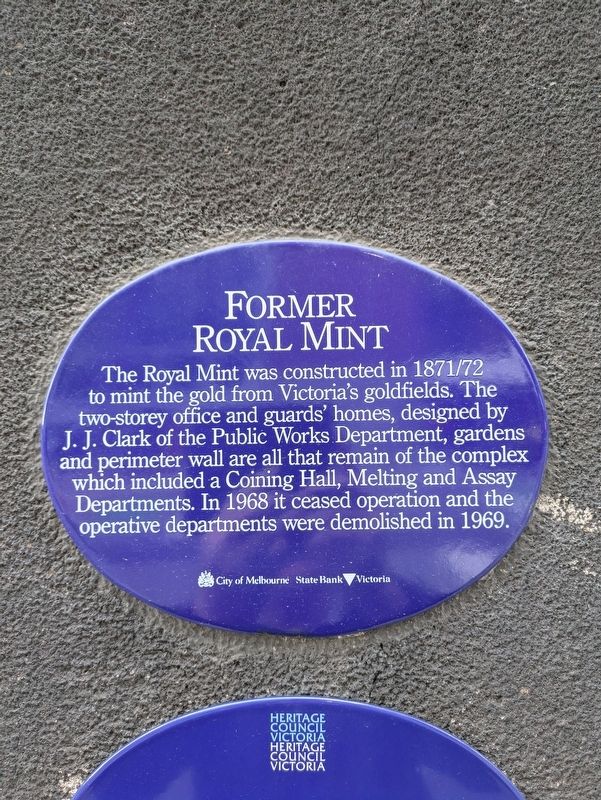
1. Former Royal Mint Marker
The Royal Mint was constructed in 1871/72 to mint the gold from Victoria's goldfields. The two-storey office and guards' homes, designed by J. J. Clark of the Public Works Department, gardens and perimeter wall are all that remain of the complex which included a Coining Hall, Melting and Assay Departments. In 1968 it ceased operation and the operative departments were demolished in 1969.
Erected by City of Melbourne and State Bank Victoria.
Topics. This historical marker is listed in these topic lists: Architecture • Colonial Era. A significant historical year for this entry is 1871.
Location. 37° 48.753′ S, 144° 57.417′ E. Marker is in Melbourne, Victoria. It is in the Central Business District. It is at the intersection of William Street and Little Lonsdale Street, on the left when traveling south on William Street. Touch for map. Marker is at or near this postal address: 280 William Street, Melbourne VIC 3000, Australia. Touch for directions.

Regionally, it is in Oceania, in Australasia, in the Pacific Ocean, in South Pacific, on the Pacific Rim, in the Western World, and in the Anglosphere. Historically,
this page online
Other nearby markers. At least 8 other markers are within walking distance of this marker: Former Royal Mint - Heritage Council (here, next to this marker); Flagstaff Gardens - Mapping 170 Years of Change (about 150 meters away, measured in a direct line); Exhibition Building - William Street (about 210 meters away); The Flagstaff Gardens (about 210 meters away); Federal Coffee Palace (about 210 meters away); First Princes Bridge, Melbourne (about 210 meters away); Melbourne (Bird's Eye View) 1882 (about 210 meters away); Panoramic View of Melbourne (about 210 meters away). Touch for a list and map of all markers in Melbourne.
Also see . . . Former Royal Mint Site. Working Heritage
The Royal Mint was first opened in 1872 to manufacture gold coins and operated as a key institution in the development of Melbourne as a city, Victoria as a colony, and Australia as a nation. The Mint complex originally included factories, grand civic buildings, residential quarters, laboratories, furnaces, chimneys, and coining rooms.(Submitted on September 9, 2026, by Dean Barton-Ancliffe of Rowville, Victoria.)
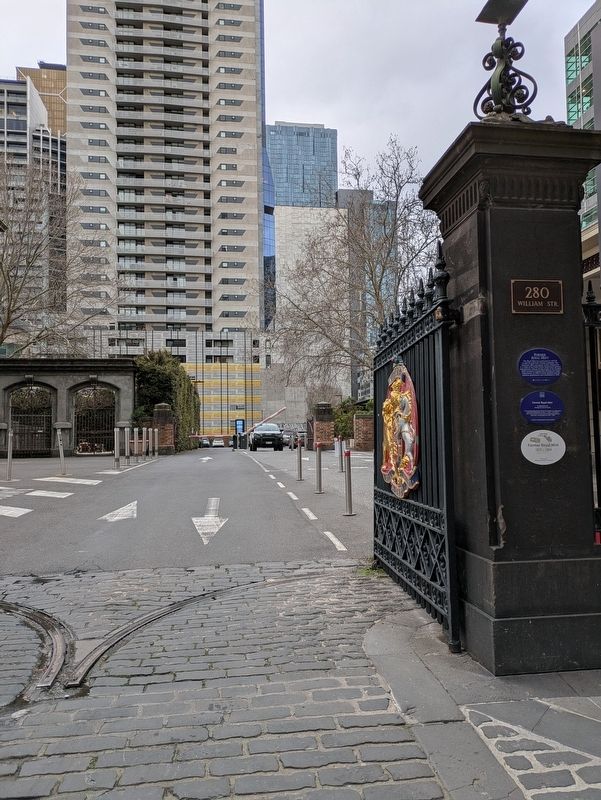
The gleaming coat of arms, impressive architecture andimposing brick wall of the Former Royal Mint are familiar to many Melbournians, some of whom may have also visited the site when it operated as the Registry of Civil Marriages in the 1970s and 80s.Photographed by Dean Barton-Ancliffe, August 11, 20262. Former Royal Mint Marker at the old Entrance Gate
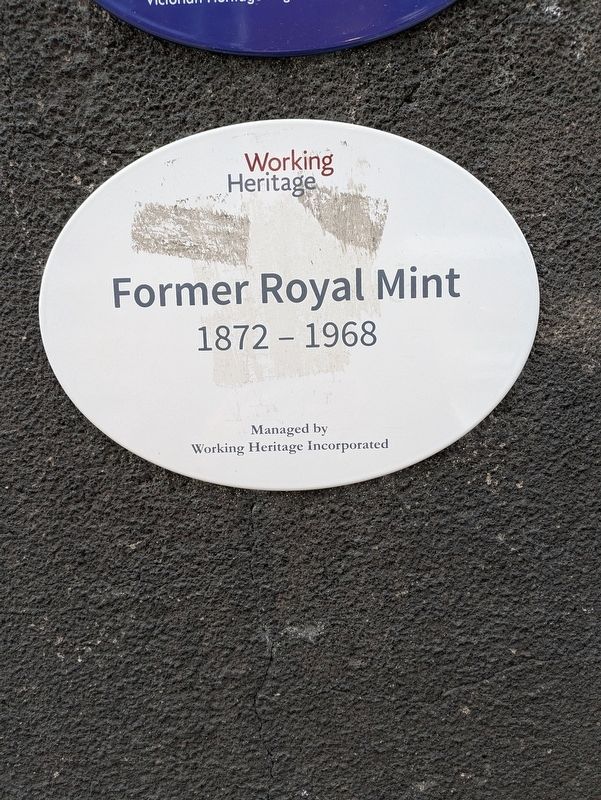
The Former Royal Mint was the first property to come under Working Heritage’s (originally Mint Inc) management in 1998. We have carried out major works to conserve the buildings, adapting them for use as a museum, bar/restaurant and office. The site of the demolished factory is a public car park that helps fund our operations and the conservation of Victoria’s cultural heritage.
Photographed by Dean Barton-Ancliffe, August 11, 2026
3. Former Royal Mint Working Heritage Marker
Credits. This page was last revised on September 22, 2026. It was originally submitted on September 9, 2026, by Dean Barton-Ancliffe of Rowville, Victoria. This page has been viewed 15 times since then. Last updated on September 22, 2026, by Dean Barton-Ancliffe of Rowville, Victoria. Photos: 1, 2, 3. submitted on September 9, 2026, by Dean Barton-Ancliffe of Rowville, Victoria. • Devry Becker Jones was the editor who published this page.
