Downtown Springfield in Greene County, Missouri — The American Midwest (Upper Plains)
Rotary, Springfield, and the Birth of Route 66
Photographed by Jason Voigt, September 23, 2026
1. Rotary, Springfield, and the Birth of Route 66 Marker
first of two parts
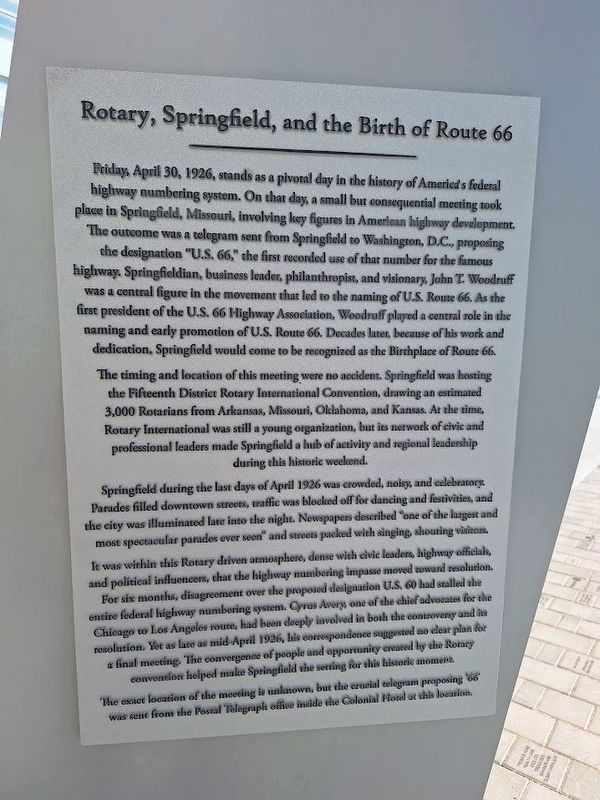
Friday, April 30, 1926, stands as a pivotal day in the history of America's federal highway numbering system. On that day, a small but consequential meeting took place in Springfield, Missouri, involving key figures in American highway development. The outcome was a telegram sent from Springfield to Washington, D.C., proposing the designation "U.S. 66," the first recorded use of that number for the famous highway. Springfieldian, business leader, philanthropist, and visionary, John T. Woodruff was a central figure in the movement that led to the naming of U.S. Route 66. As the first president of the U.S. 66 Highway Association, Woodruff played a central role in the naming and early promotion of U.S. Route 66. Decades later, because of his work and dedication, Springfield would come to be recognized as the Birthplace of Route 66.
The timing and location of this meeting was no accident. Springfield was hosting the Fifteenth District Rotary International Convention, drawing an estimated 3,000 Rotarians from Arkansas, Missouri, Oklahoma, and Kansas. At the time, Rotary International was still a young organization, but
this page online
Springfield during the last days of April 1926 was crowded, noisy, and celebratory. Parades filled downtown streets, traffic was blocked off for dancing and festivities, and the city was illuminated late into the night. Newspapers described "one of the largest and most spectacular parades ever seen" and streets packed with singing, shouting visitors.
It was within this Rotary driven atmosphere, dense with civic leaders, highway officials, and political influencers, that the highway numbering impasse moved toward resolution. For six months, disagreement over the proposed designation U.S. 60 had stalled the entire federal highway numbering system. Cyrus Avery, one of the chief advocates for the Chicago to Los Angeles route, had been deeply involved in both the controversy and the resolution. Yet as late as mid-April 1926, his correspondence suggested no clear plan for a final meeting. The convergence of people and opportunity created by the Rotary convention helped make Springfield the setting for
Photographed by Jason Voigt, September 23, 2026
2. Rotary, Springfield, and the Birth of Route 66 Marker
second of two parts
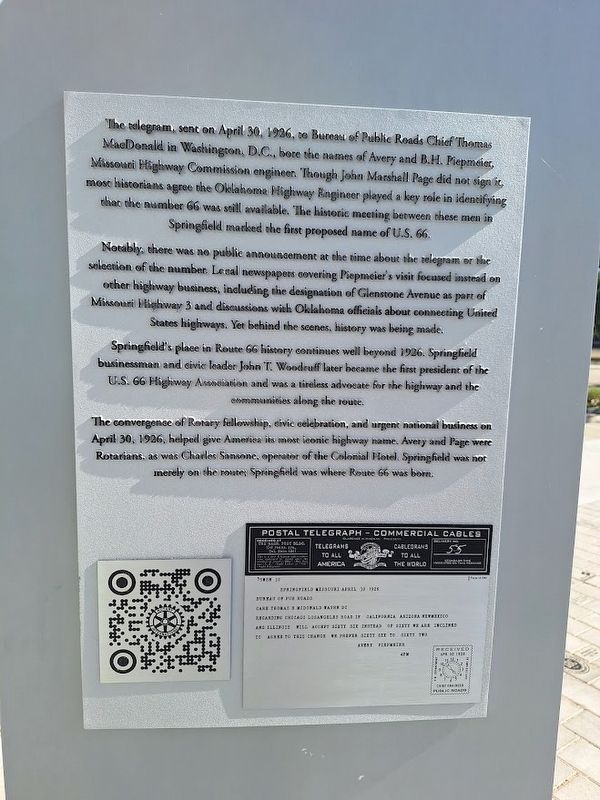
The exact location of the meeting is unknown, but the crucial telegram proposing '66' was sent from the Postal Telegraph office inside the Colonial Hotel at this location.
The telegram, sent on April 30, 1926, to Bureau of Public Roads Chief Thomas MacDonald in Washington, D.C., bore the names of Avery and B.H. Piepmeier, Missouri Highway Commission engineer. Though John Marshall Page did not sign it, most historians agree the Oklahoma Highway Engineer played a key role in identifying that the number 66 was still available. The historic meeting between these men in Springfield marked the first proposed name of U.S. 66.
Notably, there was no public announcement at the time about the telegram or the selection of the number. Local newspapers covering Piepmeier's visit focused instead on other highway business, including the designation of Glenstone Avenue as part of Missouri Highway 3 and discussions with Oklahoma officials about connecting United States highways. Yet behind the scenes, history was being made.
Springfield's place in Route 66 history continues well beyond 1926. Springfield businessman
Photographed by Jason Voigt, September 23, 2026
3. Rotary, Springfield, and the Birth of Route 66 Marker
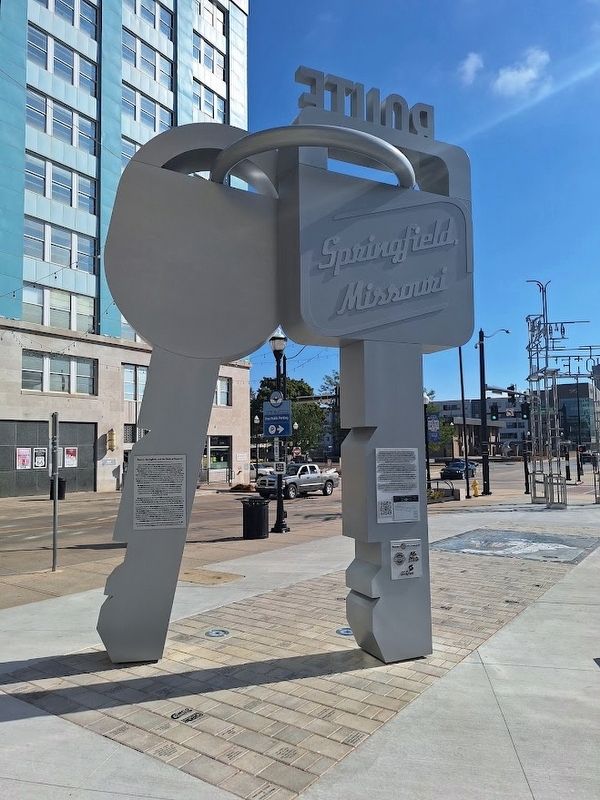
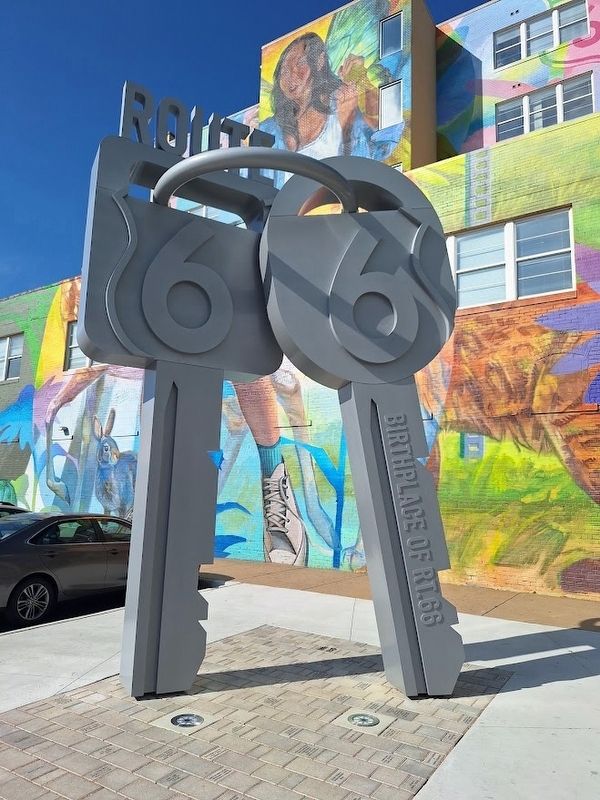
Markers are behind the Route 66 car keys sculpture
The convergence of Rotary fellowship, civic celebration, and urgent national business on April 30, 1926, helped give America its most iconic highway name. Avery and Page were Rotarians, as was Charles Sansone, sponsor of the Colonial Hotel. Springfield was not merely on the route; Springfield was where Route 66 was born.
Topics and series. This historical marker is listed in this topic list: Roads & Vehicles. In addition, it is included in the U.S. Route 66 series list. A significant historical date for this entry is April 30, 1926.
Location. 37° 12.531′ N, 93° 17.418′ W. Marker is in Springfield, Missouri, in Greene County. It is in Downtown Springfield. It is at the intersection of Park Central East and Jefferson Avenue, on the right when traveling east on Park Central East. Marker is located at Birthplace Plaza. Touch for map. Marker is at or near this postal address: 325 Park Central E, Springfield MO 65806, United States of America. Touch for directions.

Regionally,
Photographed by Jason Voigt, September 23, 2026
4. Rotary, Springfield, and the Birth of Route 66 Marker
Other nearby markers. At least 8 other markers are within walking distance of this marker: The Colonial Hotel (a few steps from this marker); Gillioz Theater (a few steps from this marker); John T. Woodruff (within shouting distance of this marker); Netter-Ullman Building (within shouting distance of this marker); Jewell Theater (within shouting distance of this marker); First Store in Greene County (about 400 feet away, measured in a direct line); Lynching in America / The Lynchings of Horace B. Duncan, Fred Coker and William Allen (about 500 feet away); Battle of Springfield (about 500 feet away). Touch for a list and map of all markers in Springfield.
Also see . . . Birthplace Plaza. Birthplace Plaza was built in time to celebrate the centennial anniversary of Route 66. It sits on where the Colonial Hotel once was. Link is the QR code on the marker. (Submitted on September 24, 2026, by Jason Voigt of Glen Carbon, Illinois.)
Credits. This page was last revised on September 24, 2026. It was originally submitted on September 24, 2026, by Jason Voigt of Glen Carbon, Illinois. This page has been viewed 4 times since then. Photos: 1, 2, 3, 4. submitted on September 24, 2026, by Jason Voigt of Glen Carbon, Illinois.
