Swindon, England, United Kingdom — Northwestern Europe (the British Isles)
GWR Park
| — | The Works Heritage Trail | — |
Photographed by Ray Gurganus, May 24, 2026
1. GWR Park Marker
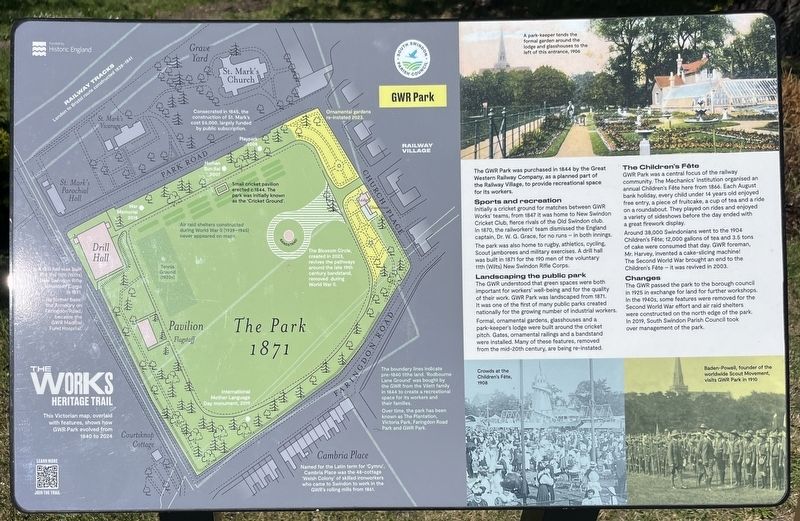
Sports and recreation
Initially a cricket ground for matches between GWR Works' teams, from 1847 it was home to New Swindon Cricket Club, fierce rivals of the Old Swindon club. In 1870, the railworkers' team dismissed the England captain, Dr. W. G. Grace, for no runs in both innings.
The park was also home to rugby, athletics, cycling, Scout jamborees and military exercises. A drill hall was built in 1871 for the 190 men of the voluntary 11th (Wilts) New Swindon Rifle Corps.
Landscaping the public park
The GWR understood that green spaces were both important for workers' well-being and for the quality of their work. GWR Park was landscaped from 1871. It was one of the first of many public parks created nationally for the growing number of industrial workers.
Formal, ornamental gardens, glasshouses and a park-keeper's lodge were built around the cricket pitch. Gates, ornamental railings and a bandstand were installed. Many of these features, removed
this page online
The Children's Fête
GWR Park was a central focus of the railway community. The Mechanics' Institution organised an annual Children's Fête here from 1866. Each August bank holiday, every child under 14 years old enjoyed free entry, a piece of fruitcake, a cup of tea and a ride on a roundabout. They played on rides and enjoyed a variety of sideshows before the day ended with a great firework display.
Around 38,000 Swindonians went to the 1904 Children's Fête; 12,000 gallons of tea and 3.5 tons of cake were consumed that day. GWR foreman, Mr. Harvey, invented a cake-slicing machine! The Second World War brought an end to the Children's Fête - it was revived in 2003.
Changes
The GWR passed the park to the borough council in 1925 in exchange for land for further workshops. In the 1940s, some features were removed for the Second World War effort and air raid shelters were constructed on the north edge of the park. In 2019, South Swindon Parish Council took over management of the park.
Erected by South Swindon Parish Council.
Topics. This historical marker is listed in these topic lists: Parks & Recreational Areas • Railroads & Streetcars. A significant historical year for this entry is 1844.
Location. 51° 33.63′ N, 1° 47.601′ W. Marker is in Swindon, England. It is on Church Place, on the right when traveling south. The marker is just beyond the entrance gate on the eastern side of the park. Touch for map. Marker is in this post office area: Swindon, England SN1 5ED, United Kingdom. Touch for directions.

Regionally, it is on the Atlantic Ocean, in the North Atlantic Region, in Europe, in Atlantic Europe, on one of the British Isles, in the Western World, and in the Anglosphere. Historically, it finds itself in what was once the Roman Empire.
Other nearby markers. At least 5 other markers are within 23 kilometers of this marker, measured as the crow flies: The Railway Church (about 90 meters away, measured in a direct line); College Street School (approx. 0.7 kilometers away); Silbury Hill (approx. 16.7 kilometers away); Welcome to the Avebury World Heritage Site (approx. 16.8 kilometers away); Ram Inn (approx. 21.2 kilometers away).
Credits. This page was last revised on September 25, 2026. It was originally submitted on September 24, 2026, by Ray Gurganus of Washington, District of Columbia. This page has been viewed 5 times since then. Photo 1. submitted on September 24, 2026, by Ray Gurganus of Washington, District of Columbia. • Andrew Ruppenstein was the editor who published this page.
