St Katharine's & Wapping in Tower Hamlets in Greater London, England, United Kingdom — Northwestern Europe (the British Isles)
A Walled City
| — | London Wall | — |
Photographed by Ian Lefkowitz, September 11, 2026
1. A Walled City Marker
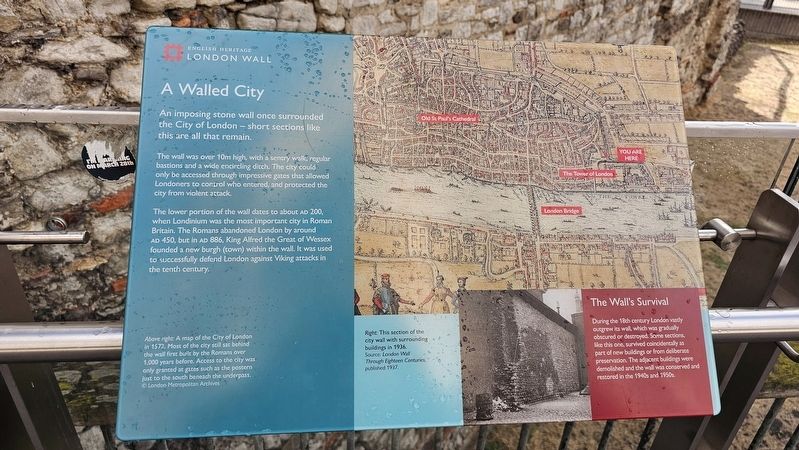
An imposing stone wall once surrounded the City of London — short sections like this are all that remain.
The wall was over 10m high, with a sentry walk, regular bastions and a wide encircling ditch. The city could only be accessed through impressive gates that allowed Londoners to control who entered, and protected the city from violent attack.
The lower portion of the wall dates to about AD 200, when Londinium was the most important city in Roman Britain. The Romans abandoned London by around AD 450, but in AD 886, King Alfred the Great of Wessex founded a new burgh (town) within the wall. It was used to successfully defend London against Viking attacks in the tenth century.
The Wall’s Survival
During the 18th century London vastly outgrew its wall, which was gradually obscured or destroyed. Some sections, like this one, survived coincidentally as part of new buildings or from deliberate preservation. The adjacent buildings were demolished and the wall was conserved and restored in the 1940s and 1950s.
(Captions)
Above right: A map of the City of London in 1572. Most of the city still sat behind the wall first built by the Romans over 1,000 years before. Access to the city was only granted at gates such as the postern just to the south beneath the underpass. © London Metropolitan Archives
Right: This section of the city wall with surrounding buildings in 1936. Source: London Wall Through Eighteen Centuries, published 1937.
Erected by English
this page online
Topics. This historical marker is listed in these topic lists: Anthropology & Archaeology • Forts and Castles. A significant historical year for this entry is 886 CE.
Location. 51° 30.601′ N, 0° 4.563′ W. Marker is in Tower Hamlets, England, in Greater London. It is in St Katharine's & Wapping. It can be reached from Tower Hill east of Trinity Square, on the left when traveling east. Touch for map. Marker is at or near this postal address: 40 Tower Hill, Tower Hamlets, England EC3N 2LY, United Kingdom. Touch for directions.

Regionally, this marker is in London and in the Greater South East. Globally, it is on the Atlantic Ocean, in the North Atlantic Region, in Europe, in Atlantic Europe, on one of the British Isles, in the Western World, and in the Anglosphere. Historically, it finds itself in what was once the Roman Empire.
Other nearby markers. At least 8 other markers are within walking distance of this marker: Tower Hill, City Wall (a few steps from this marker); The Pool of London (within shouting distance of this marker); Tower Hill Passageway: Yeoman Warders (within shouting distance of this marker);
Photographed by Ian Lefkowitz, September 11, 2026
2. A Walled City Marker
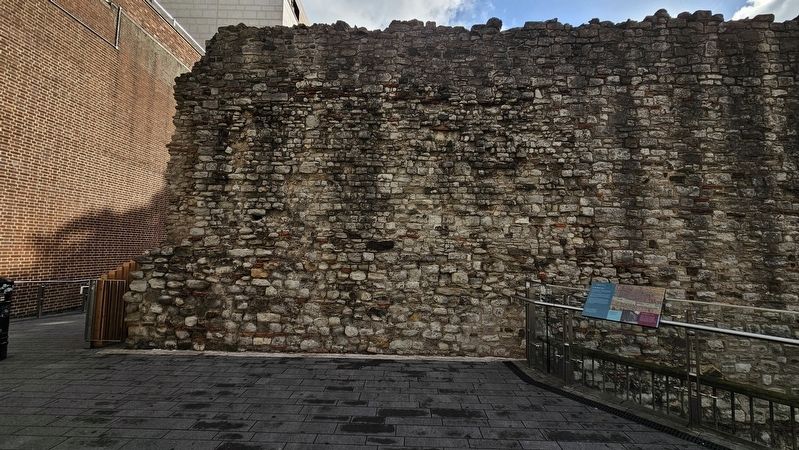
The marker is located in front of a section of London's wall, within Wakefield Gardens.
Another marker is no longer nearby. London Wall (was a few steps from this marker but has been replaced with another marker now near it).
Also see . . . London Wall (English Heritage).
Immediately north of the Tower of London, right in the heart of Tower Hill, stands one of the most substantial and impressive surviving sections of the London Wall. Built around AD 200, the Roman wall not only provided defence and security to the citizens of London, but also represented the status of the city itself.(Submitted on September 24, 2026, by Ian Lefkowitz of New York, New York.)
Photographed by Ian Lefkowitz, September 11, 2026
3. A Walled City Marker
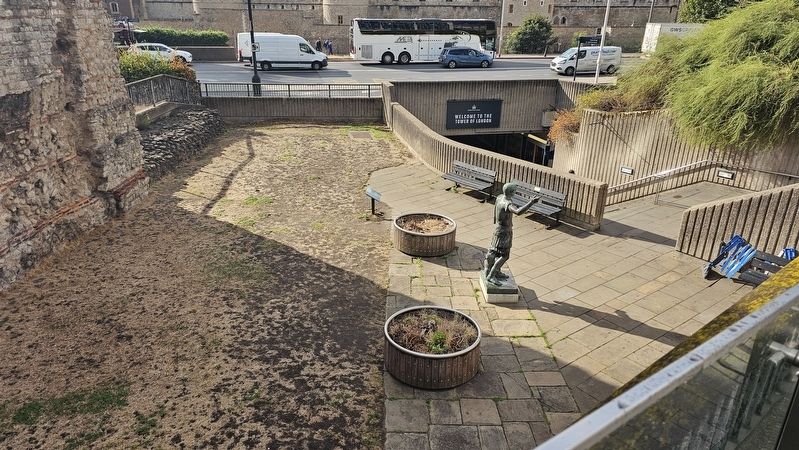
Looking from the marker towards the wall, the statue of Emperor Trajan, and the Tower of London.
Credits. This page was last revised on September 25, 2026. It was originally submitted on September 24, 2026, by Ian Lefkowitz of New York, New York. This page has been viewed 11 times since then. Photos: 1, 2, 3. submitted on September 24, 2026, by Ian Lefkowitz of New York, New York. • Andrew Ruppenstein was the editor who published this page.
