Central in Cape Town in Cape Town Metropolitan, Western Cape, South Africa — Southern Africa
‘Race Classification Board’
Photographed by Shaw Zavoshy, August 24, 2026
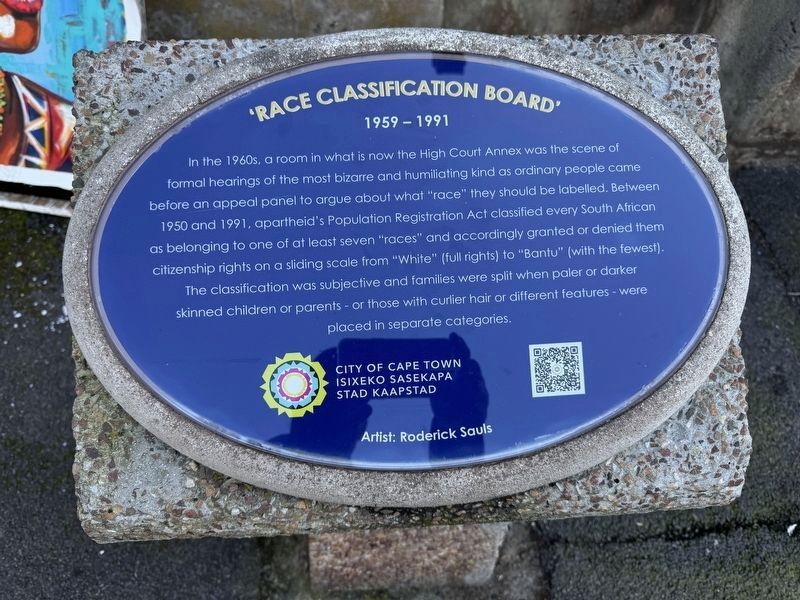
1. ‘Race Classification Board’ Marker
’Race Classification Board’
1959-1991
In the 1960s, a room in what is now the High Court Annex was the scene of formal hearings of the most bizarre and humiliating kind as ordinary people came before an appeal panel to argue about what "race" they should be labelled. Between 1950 and 1991, apartheid's Population Registration Act classified every South African as belonging to one of at least seven "races" and accordingly granted or denied them citizenship rights on a sliding scale from "White" (full rights) to "Bantu" (with the fewest). The classification was subjective and families were split when paler or darker skinned children or parents - or those with curlier hair or different features - were placed in separate categories.
Erected 2025 by City of Cape Town.
Topics. This historical marker is listed in this topic list: Civil Rights. A significant historical date for this entry is June 28, 1991.
Location. 33° 55.548′ S, 18° 25.044′ E. Marker is in Cape Town, Western Cape, in Cape Town Metropolitan. It is in Central. It is on Queen Victoria Street south of Wale Street, on the left when traveling north. Touch for map. Marker
this page online

Regionally, it is in Africa, Sub-Saharan Africa, Southern Africa, the South Atlantic Region, and the Anglosphere. Historically, it finds itself in what was once a British colony.
Also see . . .
1. Race Classification Board Memorial restored (City of Cape Town, 17 July 2025). Press release:
The City’s Community, Arts and Culture Development Department has completed the restoration of the Race Classification Board Memorial outside the High Court Annex building with the original artist, Dr Roderick Sauls. The memorial was originally installed in 2007 as part of the Sunday Times Heritage Project.(Submitted on September 25, 2026.)
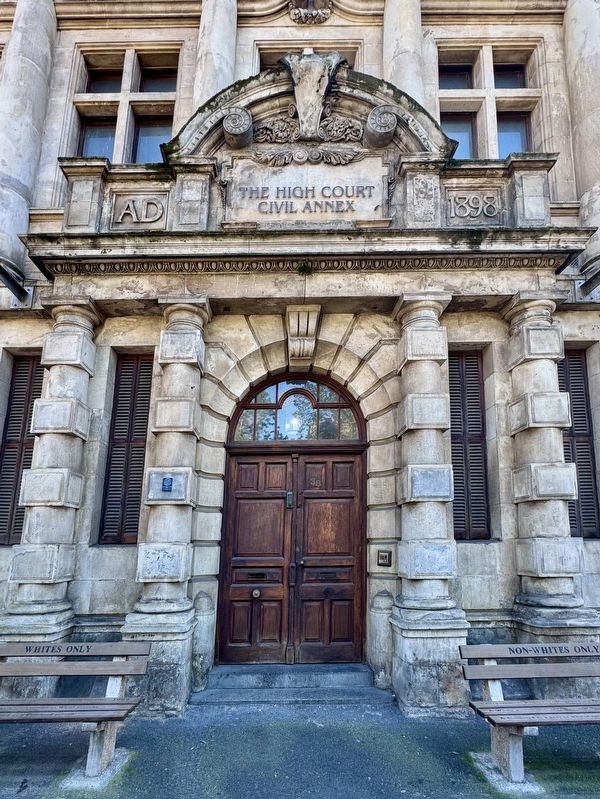
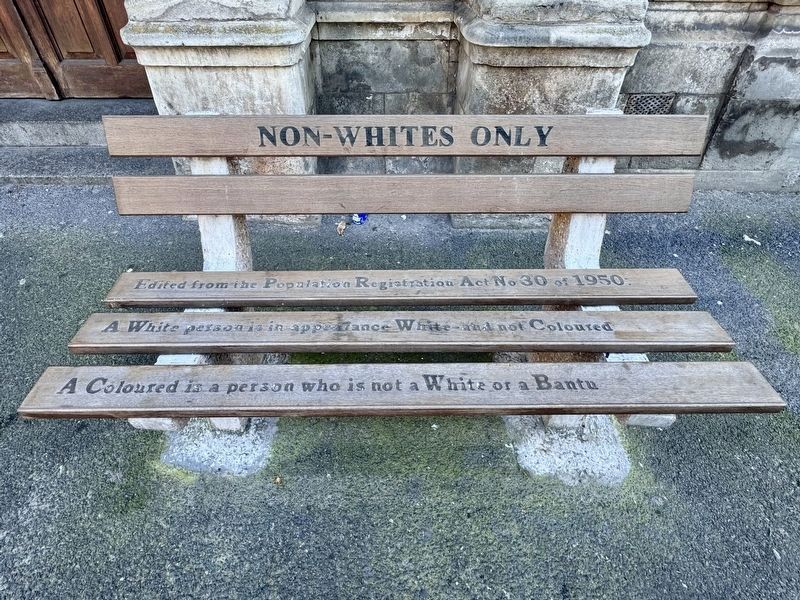
The two benches mimic apartheid-era public benches inscribed ‘Whites Only’ and ‘Non-Whites Only’, but also include text from the notorious Population Registration Act which defined the characteristic of different racial groups, often in arbitrary and humiliating ways.
‘We had this and other laws which segregated society and I felt that art would play a meaningful role in engaging with people, to communicate,and to bring people together. One can imagine what happened inside this building in the late 50s, where people were reclassified. For me, we didn’t understand at that particular time what the system meant and what the system did to us and what it did to our human spirituality. It’s taking me back 20 years. It is about memory, it’s a lot about memory and bringing those memories back,’ said the artist, Dr Roderick Sauls.Photographed by Shaw Zavoshy, August 24, 20262. High Court Civil Annex EntranceThe marker is just out of camera view, on the left
2. Apartheid (Wikipedia). Introduction:
Apartheid (transl. "separateness", lit. 'aparthood') was a system of institutionalised racial segregation that existed in South Africa and South West Africa (now Namibia) from 1948 to 1994. It was characterised by an authoritarian political culture based on baasskap (lit. 'boss-ship' or 'boss-hood'), which ensured that South Africa was dominated politically, socially, and economically by the nation's minority white population. Under this minoritarian system, white citizens held the highest status, followed by Indians, Coloureds and black Africans, in that order.(Submitted on September 25, 2026.)
Additional keywords. apartheid
Photographed by Shaw Zavoshy, August 24, 2026
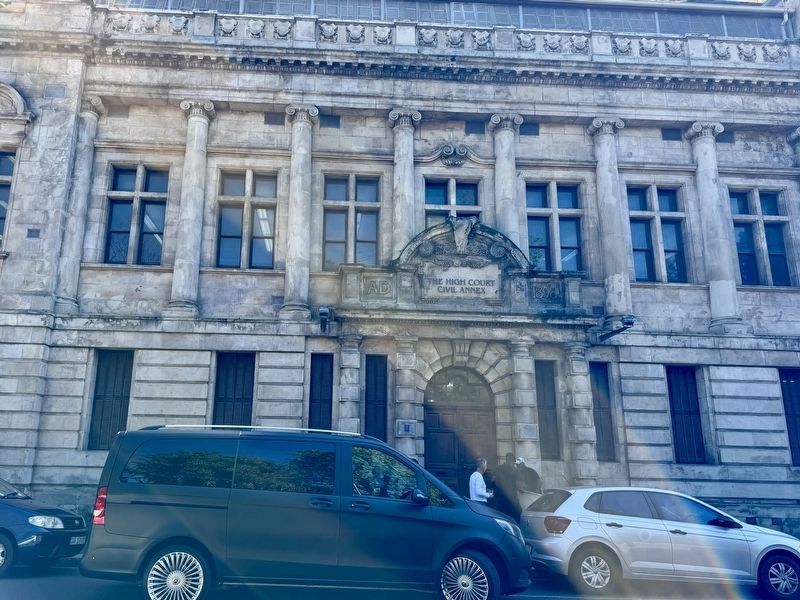
3. High Court Civil Annex
Photographed by Shaw Zavoshy, August 24, 2026
4. ‘Non-Whites’ Bench (at right of entrance)
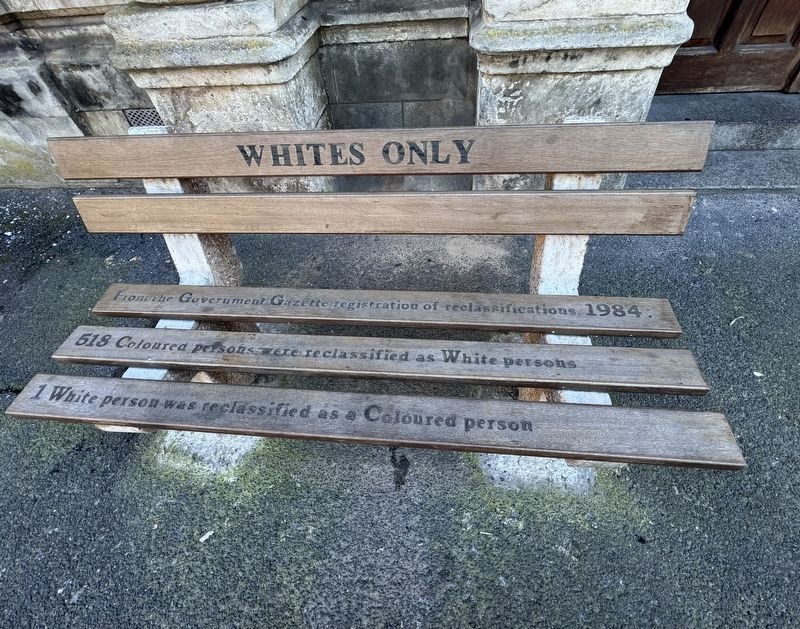
Photographed by Shaw Zavoshy, August 24, 2026
5. ‘Whites’ Bench (at left of the entrance)
Credits. This page was last revised on September 25, 2026. It was originally submitted on September 25, 2026, by Andrew Ruppenstein of Lamorinda, California. This page has been viewed 19 times since then. Photos: 1, 2, 3, 4, 5. submitted on September 25, 2026, by Andrew Ruppenstein of Lamorinda, California.
