Near Diamond in Newton County, Missouri — The American Midwest (Upper Plains)
From Pebbles to Paintings
George Washington Carver National Monument
| — | National Park Service, U.S. Department of the Interior | — |
Photographed by Jason Voigt, September 19, 2026
1. From Pebbles to Paintings Marker
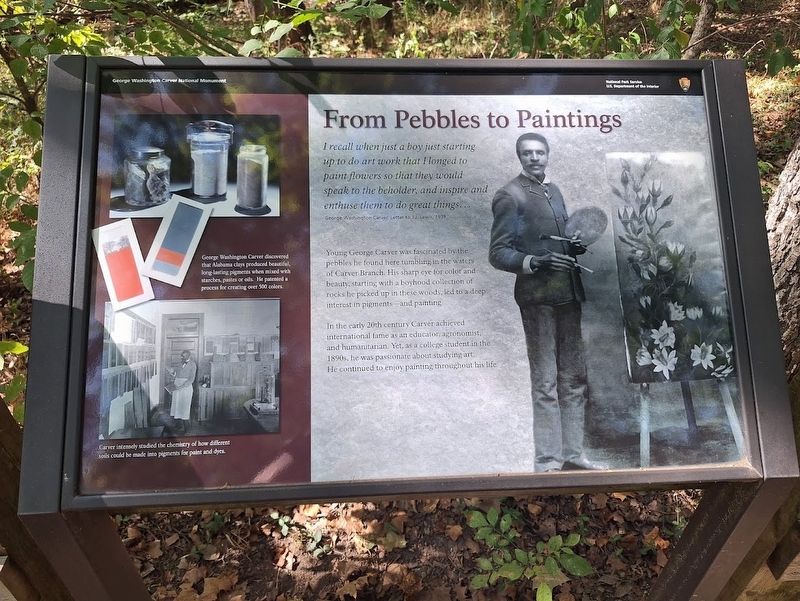
I recall when just a boy just starting up to do art work that I longed to paint flowers so that they would speak to the beholder, and inspire and enthuse them to do great things…
George Washington Carver, Letter to J.J. Lewis, 1939
Young George Carver was fascinated by the pebbles he found here tumbling in the waters of Carver Branch. His sharp eye for color and beauty, starting with a boyhood collection of rocks he picked up in these woods, led to a deep interest in pigments - and painting.
In the early 20th century Carver achieved international fame as an educator, agronomist, and humanitarian. Yet, as a college student in the 1890s, he was passionate about studying art. He continued to enjoy painting throughout his life.
Photo captions:
·George Washington Carver discovered that Alabama clays produced beautiful, long-lasting pigments when mixed with starches, pastes or oils. He patented a process for creating over 500 colors.
·Carver intensely studied the chemistry of how different soils could be made into pigments for paint and dyes.
Erected by National Park Service.
Topics and series. This
this page online
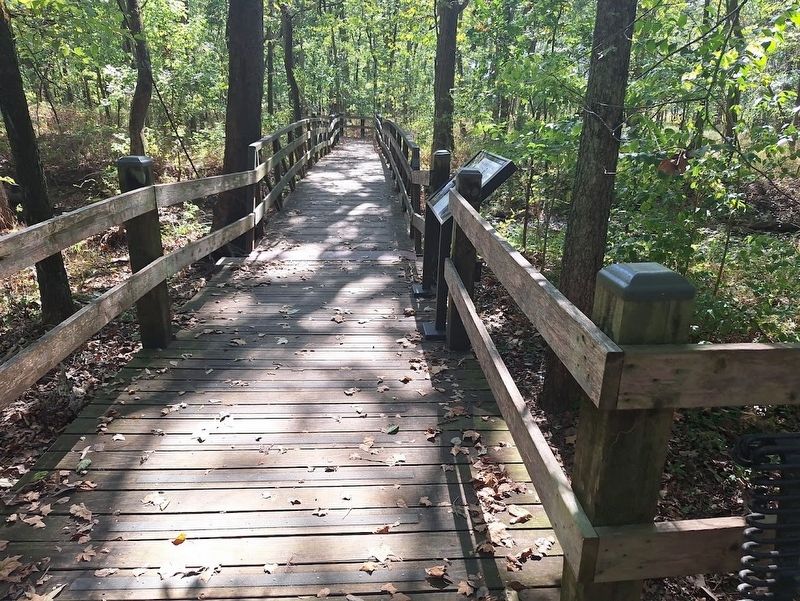
Location. 36° 59.282′ N, 94° 21.385′ W. Marker is near Diamond, Missouri, in Newton County. It can be reached from Carver Road. Marker is on Carver Trail, on the grounds of George Washington Carver National Monument. Touch for map. Marker is at or near this postal address: 5646 Carver Road, Diamond MO 64840, United States of America. Touch for directions.

Regionally, this marker is in Southwest Missouri. It is also in the American Ozarks, in the Lewis & Clark Corridor, and in the Corn Belt. Globally, it is in North America, the Western Hemisphere, the Western World, and the Anglosphere. Historically, it finds itself in what was once the territory of the Mississippian Culture, the Louisiana Purchase, and the Antebellum South.
Other nearby markers. At least 8 other markers are within walking distance of this marker: The Persimmon Tree (about 300 feet away, measured in a direct line);
Photographed by Jason Voigt, September 19, 2026
2. From Pebbles to Paintings Marker
Another marker is no longer nearby. Williams' Spring (was about 400 feet away but has been replaced with another marker now near it).
Also see . . .
1. George Washington Carver National Memorial (National Park Service). (Submitted on September 25, 2026, by Jason Voigt of Glen Carbon, Illinois.)
2. George Washington Carver National Monument on Wikipedia. (Submitted on September 25, 2026, by Jason Voigt of Glen Carbon, Illinois.)
Credits. This page was last revised on September 25, 2026. It was originally submitted on September 25, 2026, by Jason Voigt of Glen Carbon, Illinois. This page has been viewed 2 times since then. Photos: 1, 2. submitted on September 25, 2026, by Jason Voigt of Glen Carbon, Illinois.
