Bulla in Hume, Victoria, Australia — Oceania
Roses
| — | Alister Clark Memorial Rose Garden | — |
Photographed by Dean Barton-Ancliffe, August 27, 2026
1. Roses Marker
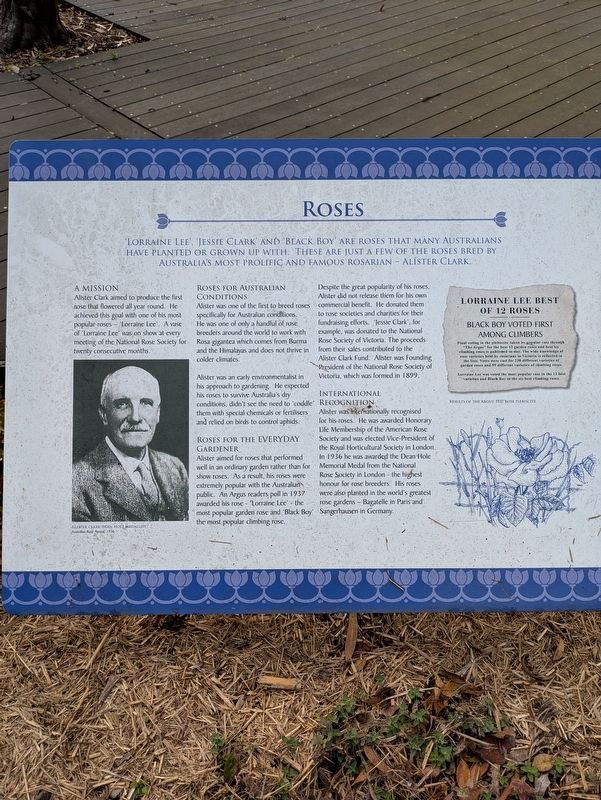
A Mission
Alister Clark aimed to produce the first rose that flowered all year round. He achieved this goal with one of his most popular roses - Lorraine Lee'. A vase of 'Lorraine Lee' was on show at every meeting of the National Rose Society for twenty consecutive months.
Roses for Australian Conditions
Alister was one of the first to breed roses specifically for Australian conditions. He was one of only a handful of rose breeders around the world to work with Rosa gigantea which comes from Burma and the Himalayas and does not thrive in colder climates.
Alister was an early environmentalist in his approach to gardening. He expected his roses to survive Australia's dry conditions. He didn't see the need to 'coddle' them with special chemicals or fertilisers and relied on birds to control aphids.
Roses for the Everyday Gardener
Alister aimed for roses that performed well in an ordinary garden rather
this page online
Despite the great popularity of his roses, Alister did not release them for his own commercial benefit. He donated them to rose societies and charities for their fundraising efforts. 'Jessie Clark', for example, was donated to the National Rose Society of Victoria. The proceeds from their sales contributed to the Alister Clark Fund. Alister was Founding President of the National Rose Society of Victoria, which was formed in 1899.
International Recognition
Alister was Internationally recognised for his roses. He was awarded Honorary Life Membership of the American Rose Society and was elected Vice-President of the Royal Horticultural Society in London. In 1936 he was awarded the Dean Hole Memorial Medal from the National Rose Society in London - the highest honour for rose breeders. His roses were also planted in the world's greatest rose gardens - Bagatelle in Paris and Sangerhausen in Germany.
Erected by Hume
Photographed by Dean Barton-Ancliffe, August 27, 2026
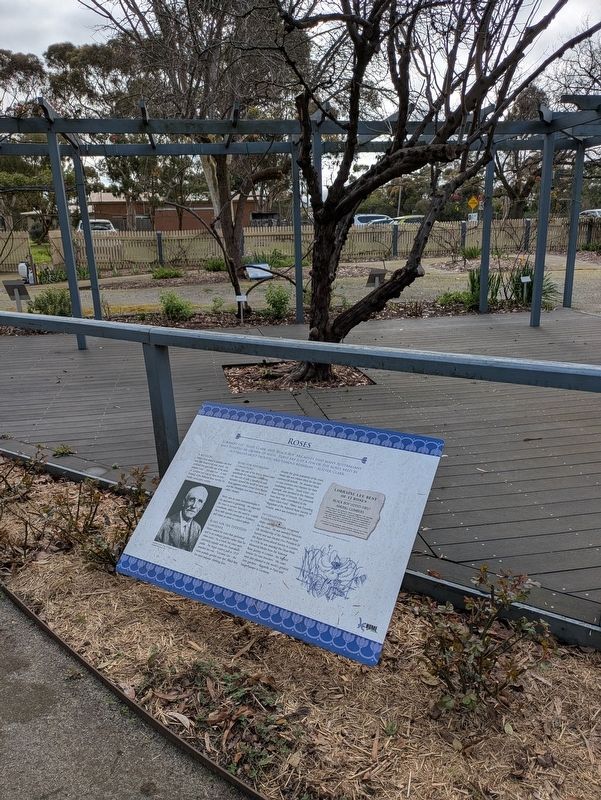
2. Roses Marker in the Rose Garden
Topics. This historical marker is listed in these topic lists: Charity & Public Work • Horticulture & Forestry • Parks & Recreational Areas. A significant historical year for this entry is 1899.
Location. 37° 38.197′ S, 144° 48.246′ E. Marker is in Bulla, Victoria, in Hume. It can be reached from Green Street 0.1 kilometers north of Bulla Road (Victoria Route C743). Touch for map. Marker is at or near this postal address: 1 Green Street, Bulla VIC 3428, Australia. Touch for directions.

Regionally, it is in Oceania, in Australasia, in the Pacific Ocean, in South Pacific, on the Pacific Rim, in the Western World, and in the Anglosphere. Historically, it finds itself in what was once a British colony.
Other nearby markers. At least 8 other markers are within walking distance of this marker: Nancy Hayward (here, next to this marker); Mrs Maud Alston (here, next to this marker); Editor Stewart (a few steps from this marker); Countess of Stradbroke (a few steps from this marker); Mrs Hugh Dettman (a few steps from this marker); Daffodils (a few steps from this marker); Lorraine Lee (a few steps from this marker); Peggy Bell (a few steps from this marker). Touch for a list and map of all markers in Bulla.
Also see . . . Alister Clark (1864–1949). Australian Dictionary of Biography
Clark was best known as a rosarian. He was a foundation member of the National Rose Society of Victoria in 1900 and served as its president. He put great effort and skill into developing new varieties, and his 'Lorraine Lee', 'Black Boy', 'Sunny South', 'Nancy Hayward' and many others were grown throughout Australia; they were highly regarded in the United States of America. He supplied his new varieties without charge to State rose societies for propagation and sale. He won many awards but his greatest triumph was the 1936 Dean Hole Memorial Medal of the National Rose Society (England). His rose garden survives at Glenara and a selection of his roses grows in a memorial garden in Blessington Street, St Kilda.(Submitted on September 25, 2026, by Dean Barton-Ancliffe of Rowville, Victoria.)
Clark contributed also to the development of new species of daffodils. In 1948 he received the Peter Barr Memorial Cup from the Royal Horticultural Society (England), of which he was a fellow, and vice-president in 1944-48. He believed his pink daffodil to be the world's first.
Credits. This page was last revised on September 29, 2026. It was originally submitted on September 25, 2026, by Dean Barton-Ancliffe of Rowville, Victoria. This page has been viewed 5 times since then. Photos: 1, 2. submitted on September 25, 2026, by Dean Barton-Ancliffe of Rowville, Victoria. • Andrew Ruppenstein was the editor who published this page.
