Bulla in Hume, Victoria, Australia — Oceania
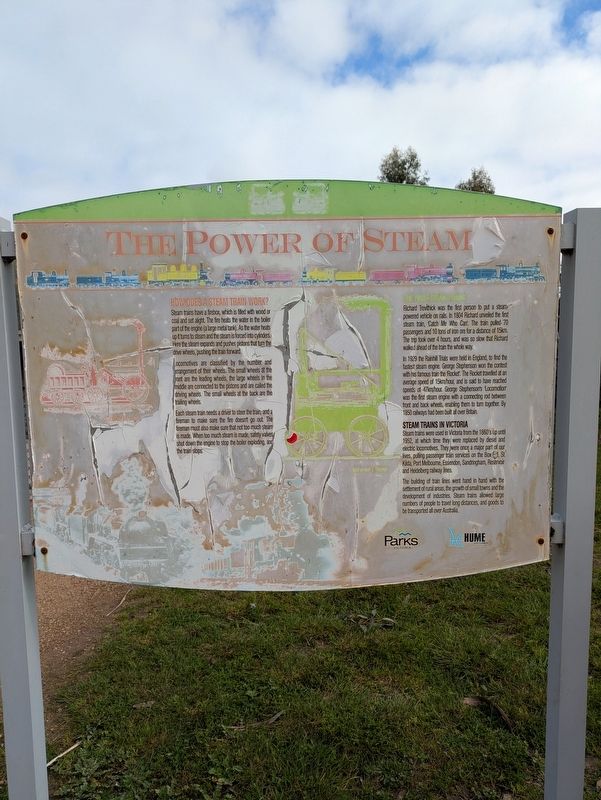
The Power of Steam
Photographed by Dean Barton-Ancliffe, August 27, 2026
1. The Power of Steam Marker
How does a Steam Train Work?
Steam trains have a firebox, which is filled with wood or coal and set alight. The fire heats the water in the boiler part of the engine (a large metal tank). As the water heats up it turns to steam and the steam is forced into cylinders. Here the steam expands and pushes pistons that turn the drive wheels, pushing the train forward.
Locomotives are classified by the number and arrangement of their wheels. The small wheels at the front are the leading wheels, the large wheels in the middle are connected to the pistons and are called the driving wheels. The small wheels at the back are the trailing wheels.
Each steam train needs a driver to steer the train, and a fireman to make sure the fire doesn't go out. The fireman must also make sure that not too much steam is made. When too much steam is made, safety valves shut down the engine to stop the boiler exploding, and the train stops.
The First Steam Trains
Richard Trevithick was the first person to put a steam-powered vehicle on rails. In 1804 Richard unveiled the first steam train, 'Catch Me Who Can'. The train pulled 70 passengers
this page online
In 1929 the Rainhill Trials were held in England, to find the fastest steam engine. George Stephenson won the contest with his famous train the 'Rocket'. The Rocket travelled at an average speed of 15km/hour, and is said to have reached speeds of 47km/hour. George Stephenson's 'Locomotion' was the first steam engine with a connecting rod between front and back wheels, enabling them to turn together. By 1850 railways had been built all over Britain.
Steam Trains in Victoria
Steam trains were used in Victoria from the 1860's up until 1952, at which time they were replaced by diesel and electric locomotives. They were once a major part of our lives, pulling passenger train services on the Box, St Kilda, Port Melbourne, Essendon, Sandringham, Reservoir and Heidelberg railway lines.
The building of train lines went hand in hand with the settlement of rural areas, the growth of small towns and the development of industries. Steam trains allowed large numbers of people to travel long distances,
Photographed by Dean Barton-Ancliffe, August 27, 2026
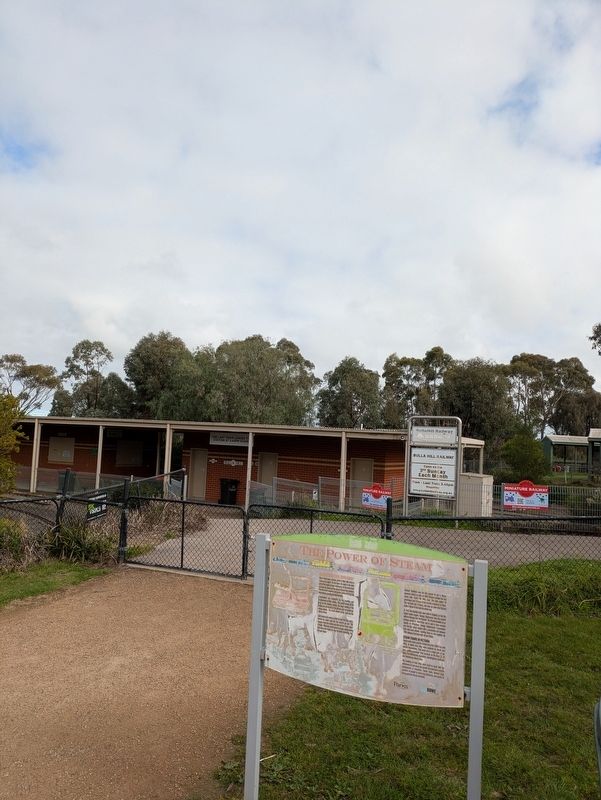
2. The Power of Steam Marker outside the Bulla Hill Miniature Railway
Erected by Parks Victoria and Hume City Council.
Topics. This historical marker is listed in these topic lists: Colonial Era • Railroads & Streetcars. A significant historical year for this entry is 1804.
Location. 37° 38.053′ S, 144° 48.293′ E. Marker is in Bulla, Victoria, in Hume. It is on Green Street 0.1 kilometers north of Cahill Street, on the left when traveling north. Touch for map. Marker is at or near this postal address: 15 Green Street, Bulla VIC 3428, Australia. Touch for directions.

Regionally, it is in Oceania, in Australasia, in the Pacific Ocean, in South Pacific, on the Pacific Rim, in the Western World, and in the Anglosphere. Historically, it finds itself in what was once a British colony.
Other nearby markers. At least 8 other markers are within walking distance of this marker: Lost and Unconfirmed Roses (approx. 0.3 kilometers away); Mrs Harold Brookes (approx. 0.3 kilometers away); Daffodils (approx. 0.3 kilometers away); Lorraine Lee (approx. 0.3 kilometers away); Nancy Hayward (approx. 0.3 kilometers away); Mrs Maud Alston (approx. 0.3 kilometers away); Roses (approx. 0.3 kilometers away); Mrs Hugh Dettman (approx. 0.3 kilometers away). Touch for a list and map of all markers in Bulla.
Also see . . . Heritage railways. Travel Victoria
A number of heritage railways and tramways have been established throughout Victoria along closed lines to preserve rail history and to operate as tourist attractions. Some also feature museums where the public can rediscover the history of rail transport.(Submitted on September 26, 2026, by Dean Barton-Ancliffe of Rowville, Victoria.)
(Site gives links to 13 Heritage Railways and displays in Victoria)
Credits. This page was last revised on October 5, 2026. It was originally submitted on September 26, 2026, by Dean Barton-Ancliffe of Rowville, Victoria. This page has been viewed 6 times since then. Photos: 1, 2. submitted on September 26, 2026, by Dean Barton-Ancliffe of Rowville, Victoria. • Andrew Ruppenstein was the editor who published this page.
