Keilor in Brimbank, Victoria, Australia — Oceania
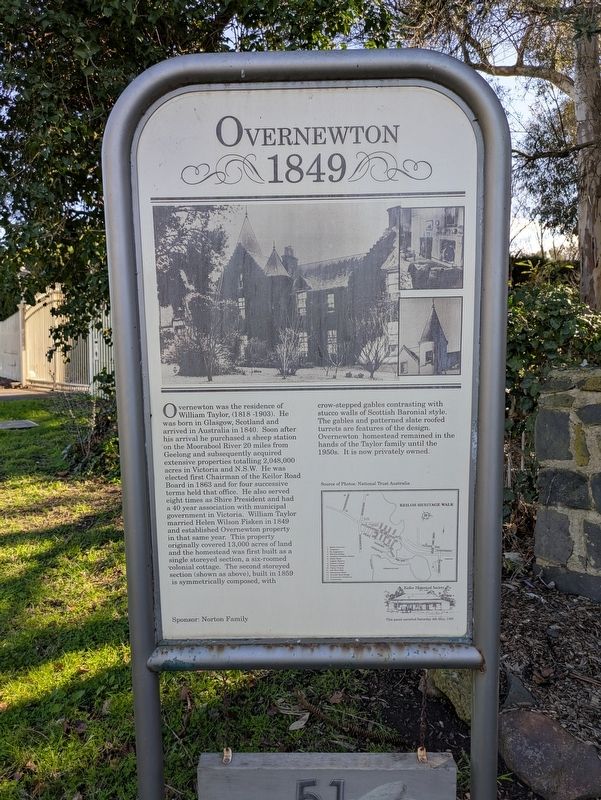
Overnewton
1849
| — | Keilor Heritage Walk | — |
Photographed by Dean Barton-Ancliffe, August 27, 2026
1. Overnewton Marker
this page online
Erected 1991 by Keilor Historical Society. (Marker Number 15.)
Topics. This historical marker is listed in these topic lists: Architecture • Colonial Era • Settlements & Settlers. A significant historical year for this entry is 1849.
Location. 37° 42.332′ S, 144° 49.272′ E. Marker is in Keilor, Victoria, in Brimbank. It is on Overnewton Close 0.1 kilometers south of Overnewton Road, on the right when traveling south. Touch for map. Marker is at or near this postal address: 33 Overnewton Close, Keilor VIC 3036, Australia. Touch for directions.

Regionally, it is in Oceania, in Australasia, in the Pacific Ocean, in South Pacific, on the Pacific Rim, in the Western World, and in the Anglosphere. Historically, it finds itself in what was once a British colony.
Other nearby markers. At least 8 other markers are within 8 kilometers of this marker, measured as the crow flies: Keilor Hotel (approx. 2.1 kilometers away); Old Iron Bridge (approx. 2.4 kilometers away); St Augustine’s (approx. 3.1 kilometers away); Keilor Cemetery (approx. 3.7 kilometers away); Bulla War Memorial (approx. 7.8 kilometers away);
Photographed by Dean Barton-Ancliffe, August 27, 2026
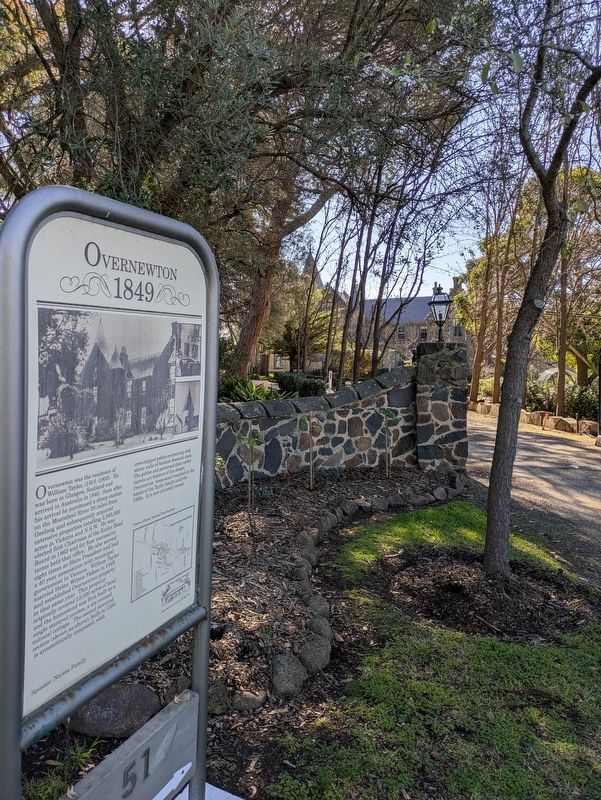
2. Overnewton Marker in front of Overnewton
Also see . . . Overnewton. Victorian Heritage Database
Overnewton, located in Keilor, comprises the original homestead built in 1849 with substantial additions made in 1859, and associated outbuildings and structures including the butchery and dairy, gazebo, generator shed, machine shed, dry stone wall, domed cistern and an outbuilding believed to be the former men's quarters.(Submitted on September 26, 2026, by Dean Barton-Ancliffe of Rowville, Victoria.)
William Taylor, a squatter who arrived in Victoria from Glasgow, Scotland in 1840, built the original six-room cottage in what was once the centre of a large pastoral estate. Extensive additions were made to the single storey bluestone house when Taylor made Overnewton his permanent home in 1859. During this time, the Overnewton Gatehouse (H1947) was constructed.
The style of the house following the 1859 additions is a distinctive form of the Scottish Baronial. Characteristic of the Scottish Baronial style are the steeply-pitched slate-clad roofs, bartizan towers with candle snuffer roofs and fish scale slates, gabled dormer windows, and bluestone crow-stepped parapeted gables. The bluestone rubble walls are rendered with "harling", a 15mm thick roughcast mix of gravel, clay and lime, giving an idiosyncratic yellow colour to the walls. The Taylor family crest, a mailed arm, fist and dagger and the motto "Semper Fidelis", is located above the master bedroom window.
The billiard room is reputed to have been prefabricated in Scotland and erected on site in 1859. It is a simple gabled structure constructed, like the rest of the house, of bluestone. The interior wainscotting, panelling and high vaulted ceiling are oak. On the east wall at cornice level are portrait friezes of famous persons including Robert Burns, George Washington, James Watt, Sir Joshua Reynolds, William Shakespeare, Sir Walter Scott and James Cook. A floral design separates each portrait. Leading off from the billiard room in the north-west corner is a semi-circular washroom with ornate marble basin.
Credits. This page was last revised on September 29, 2026. It was originally submitted on September 26, 2026, by Dean Barton-Ancliffe of Rowville, Victoria. This page has been viewed 9 times since then. Photos: 1, 2. submitted on September 26, 2026, by Dean Barton-Ancliffe of Rowville, Victoria. • Andrew Ruppenstein was the editor who published this page.
