Ambridge in Beaver County, Pennsylvania — The American Northeast (Mid-Atlantic)
Greenhouse and Bakery
Photographed by Mike Wintermantel, September 20, 2022
1. Greenhouse and Bakery Marker
Economy's Greenhouses
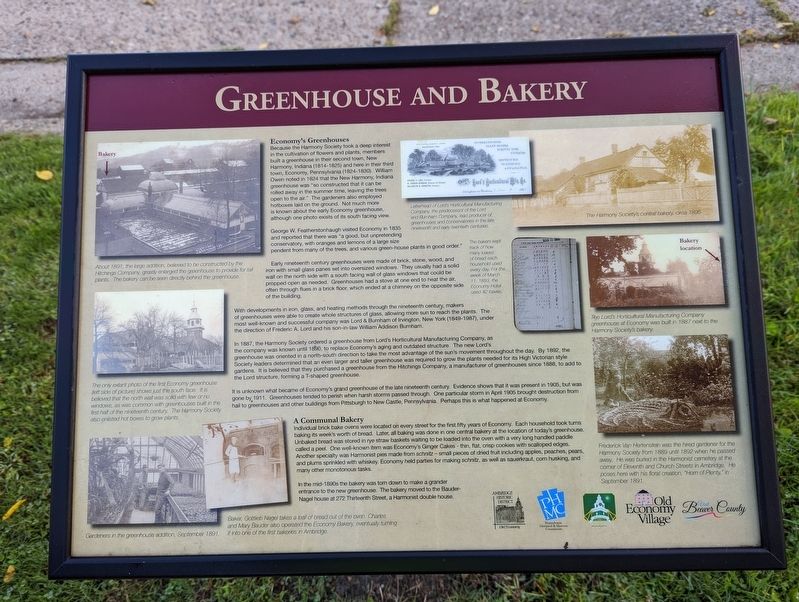
Because the Harmony Society took a deep interest in the cultivation of flowers and plants, members built a greenhouse in their second town, New Harmony, Indiana (1814-1825) and here their third town, Economy, Pennsylvania (1824-1830). William Owen noted in 1824 that the New Harmony, Indiana greenhouse was "so constructed that it can be rolled away in the summer time, leaving the trees open to the air." The gardeners also employed hotboxes laid on the ground. Not much more is known about the early Economy greenhouse, although one photo exists of its south facing view.
George W. Featherstonhaugh visited Economy in 1835 and reported that there was "a good, but unpretending conservatory, with oranges and lemons of a large size pendent from many of the trees, and various green-house plants in good order."
Early nineteenth century greenhouses were made of brick, stone, wood, and iron with small glass panes set into oversized windows. They usually had a solid wall on the north side with a south facing wall of glass windows that could be propped open as needed. Greenhouses had a stove at one end to
this page online
With developments in iron, glass, and heating methods through the nineteenth century, makers of greenhouses were able to create whole structures of glass, allowing more sun to reach the plants. The most well-known and successful company was Lord & Burnham of Irvington, New York (1849-1987), under the direction of Frederic A. Lord and his son-in-law William Addison Burnham.
In 1887, the Harmony Society ordered a greenhouse from Lord's Horticultural Manufacturing Company, as the company was known until 1890, to replace Economy's aging and outdated structure. The new Lord's greenhouse was oriented in a north-south direction to take the most advantage of the sun's movement throughout the day. By 1892, the Society leaders determined that they purchased a greenhouse from the Hitchings Company, a manufacturer of greenhouses since 1888, to add to the Lord structure, forming a T-shaped greenhouse.
It is unknown what became of Economy's grand greenhouse of the late nineteenth century. Evidence shows that it was present in
Photographed by Mike Wintermantel, September 20, 2022
2. Greenhouse and Bakery Marker
A Communal Bakery
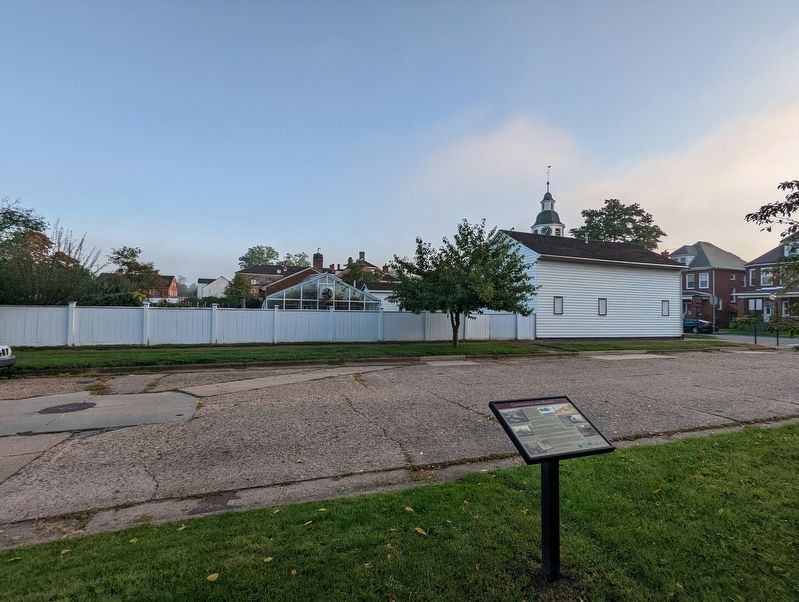
Individual brick bake ovens were located on every street for the first fifty years of Economy. Each household took turns baking its week's worth of bread. Later, all baking was done in one central bakery at the location of today's greenhouse. Unbaked bread was stored in rye straw baskets waiting to be loaded into the oven with a very long handled paddle called a peel. One well-known item was Economy's Ginger Cakes - thin, flat, crisp cookies with scalloped edges. Another specialty was Harmonist pies made from schnitz - small pieces of dried fruit including apples, peaches, pears, and plums sprinkled with whiskey. Economy held parties for making schnitz, as well as sauerkraut, corn husking, and many other monontonous tasks.
In the mid-1890s the bakery was torn down to make a grander entrance to the new greenhouse. The bakery moved to the Bauder-Nagel house at 272 Thirteenth Street, a Harmonist double house.
Erected by Ambridge Historic District, Pennsylvania Historical and Museum Commission, Ambridge Rotary Club, Old Economy Village.
Topics and series. This historical marker is listed in these topic lists: Environment • Food & Drink • Notable Buildings. In addition, it is included in the Communal and Utopian Societies, and the Rotary International series lists. A significant historical month for this entry is April 1905.
Location. 40° 35.736′ N, 80° 13.944′ W. Marker is in Ambridge, Pennsylvania, in Beaver County. It is at the intersection of 13th Street and Church Street, on the right when traveling east on 13th Street. Touch for map. Marker is in this post office area: Ambridge PA 15003, United States of America. Touch for directions.

Regionally, this marker is in Greater Pittsburgh. It is also in the American Northeast, in the Mid-Atlantic, and in the Ohio River Valley. Globally, it is in North America, the Western Hemisphere, the Western World, and the Anglosphere. Historically, it finds itself in what was once the Haudenosaunee (Iroquois) Confederacy and also one of the original Thirteen Colonies.
Other nearby markers. At least 8 other markers are within walking distance of this marker: Old Economy (a few steps from this marker); The Harmonist Wool Block (within shouting distance of this marker); Carriage House and Summer Kitchen (within shouting distance of this marker); Harmony Society Church (within shouting distance of this marker); Harmonist Church / St. John's Lutheran Church (within shouting distance of this marker); Old Economy Memorial (about 500 feet away, measured in a direct line); Economy Hotel (about 600 feet away); Water Pump, Bank, Restaurant, Croatian Club (about 700 feet away). Touch for a list and map of all markers in Ambridge.
Credits. This page was last revised on September 28, 2026. It was originally submitted on September 20, 2022, by Mike Wintermantel of Pittsburgh, Pennsylvania. This page has been viewed 514 times since then and 27 times this year. Last updated on September 26, 2026, by Trudi Jacobson of Slingerlands, New York. Photos: 1, 2. submitted on September 20, 2022, by Mike Wintermantel of Pittsburgh, Pennsylvania. • Devry Becker Jones was the editor who published this page.
