Varna near Dayton in Columbia County, Washington — The American West (Northwest)
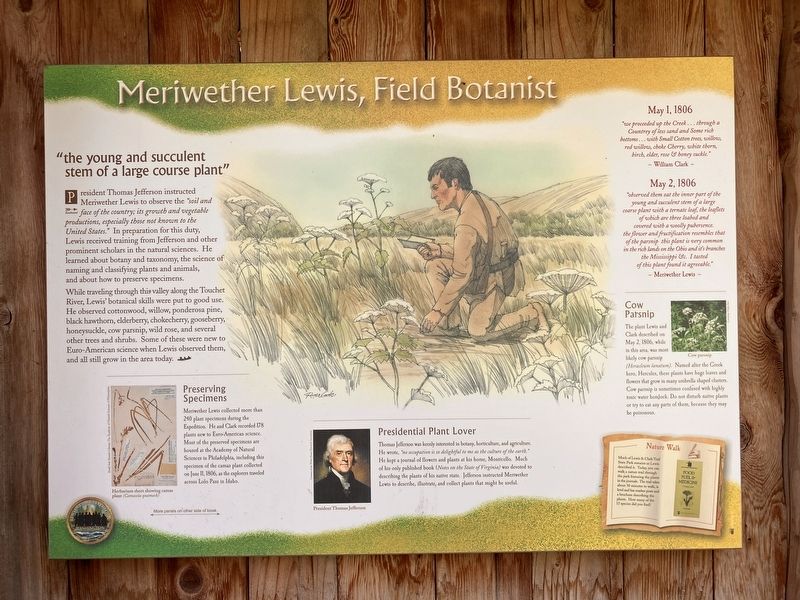
Meriwether Lewis, Field Botanist
Photographed by Barry Swackhamer, June 14, 2026
1. Meriwether Lewis, Field Botanist Marker
Caption: (lower left), Herbarium sheet showing camas plant ( Canasta quamaqsh)
"the young and succulent stem of a large course plant"
President Thomas Jefferson instructed Meriwether Lewis to observe the "soil and face of the country; its growth and vegetable productions, especially those not known to the United States." In preparation for this duty, Lewis received training from Jefferson and other prominent scholars in the natural sciences. He learned about botany and taxonomy. the science of naming and classifying plants and animals and about how to preserve specimens.
While traveling through this valley along the Touchet River, Lewis' botanical skills were put to good use. He observed cottonwood, willow, ponderosa pine, black hawthorn, cow parsnip, wild rose, and several other trees and shrubs. Some of these were new Euro-American sconce when Lewis observed them, and all still grow in the area today.
Preserving Specimens
Meriwether Lewis collected more than 240 plant specimens during the Expedition. He and Clark recored 178 plants new to Euro-American science. Most of the preserved specimens are housed at the Academy of Natural Sciences in Philadelphia, including specimens of the camas
this page online
Presidential Plant Lover
Thomas Jefferson was keenly interested in botany, horticulture and agriculture. He wrote "no occupation is so delightful to me as the culture of the earth." He kept a journal of flowers and plants at his home, Monticello. Much of his only published book (Notes on the State of Virginia) was devoted to describing the plants of his native state. Jefferson instructed Meriwether Lewis to describe, illustrate, and collect plants that might be useful.
"we proceeded up the Creek ...through a Countrey of less sand and Some rich bottoms ...with Small Cotton trees, willows, red willows, choke Cherry, white thorn, birch, elder, rose & honey suckle."
William Clark
May 2, 1806
:observed them eat the inner part of the young and succulent stem of a large coarse plant with a ternate leaf, the leaflets of which are three loabed and covered with a wooly pubersence, the flower and fructification resembles that of the parsnip this plant is very common in the rich lands on the Ohio and it's branches the Mississippi &c I tasted of this plant found it agreeable."
Photographed by Barry Swackhamer, June 14, 2026
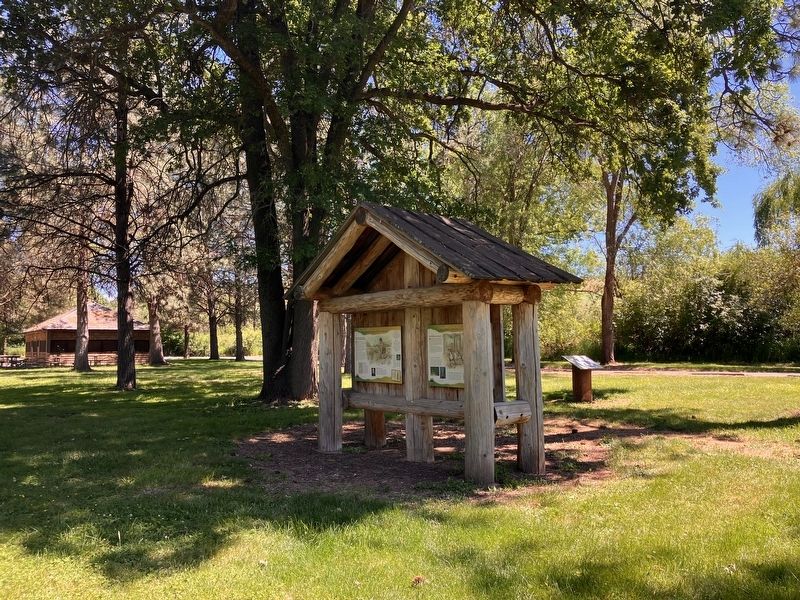
2. Meriwether Lewis, Field Botanist Marker
Meriwether Lewis
Cow Parsnip
This plant Lewis and Clark described on May 2, `1805, while in this area, was most likely cow parsnip (Heracleum lanatum) , Named after the Greek hero, Hercules, this plants have huge leaves and flowers that grow in many umbrella shaped cluster. Cow parsnip is sometimes confused with highly toxic water hemlock. Do not disturb native plants or try to eat any parts of them, because they may be poisonous.
Erected by Washington Lewis & Clark Expedition Bicentennial Commission.
Topics and series. This historical marker is listed in these topic lists: Exploration • Science & Medicine. In addition, it is included in the Lewis & Clark Expedition series list. A significant historical date for this entry is May 2, 1806.
Location. 46° 17.216′ N, 118° 4.403′ W. Marker is near Dayton, Washington, in Columbia County. It is in Varna. It is on U.S. 12 near Timpey Road, on the right when traveling east. Touch for map. Marker is in this post office area: Dayton WA 99328, United States of America. Touch for directions.

Regionally, this marker is in the Palouse. It is also in the American Mountain West and in the Lewis & Clark Corridor. Globally, it is in North America, on the Pacific Rim, in the Western Hemisphere, in the Western World, and in the Anglosphere.
Other nearby markers. At least 8 other markers are within 5 miles of this marker, measured as the crow flies: "a pleasant looking Country" (here, next to this marker); Lewis and Clark National Historic Trail (a few steps from this marker); Snake River Passage & Columbia Plains Crossing (a few steps from this marker); Cayuse, Umatilla, and Walla Walla Homeland (a few steps from this marker); On The Lewis and Clark Trail (about 300 feet away, measured in a direct line); "Good things from the Garden, (approx. 3.8 miles away); The Giant on the Hill (approx. 3.8 miles away); Dodge Quarantine Cabin (approx. 4.9 miles away). Touch for a list and map of all markers in Dayton.
Credits. This page was last revised on September 26, 2026. It was originally submitted on September 26, 2026, by Barry Swackhamer of Brentwood, California. This page has been viewed 7 times since then. Photos: 1, 2. submitted on September 26, 2026, by Barry Swackhamer of Brentwood, California.
