Keilor in Brimbank, Victoria, Australia — Oceania
Keilor Hotel
1849
| — | Keilor Heritage Walk | — |
Photographed by Dean Barton-Ancliffe, August 27, 2026
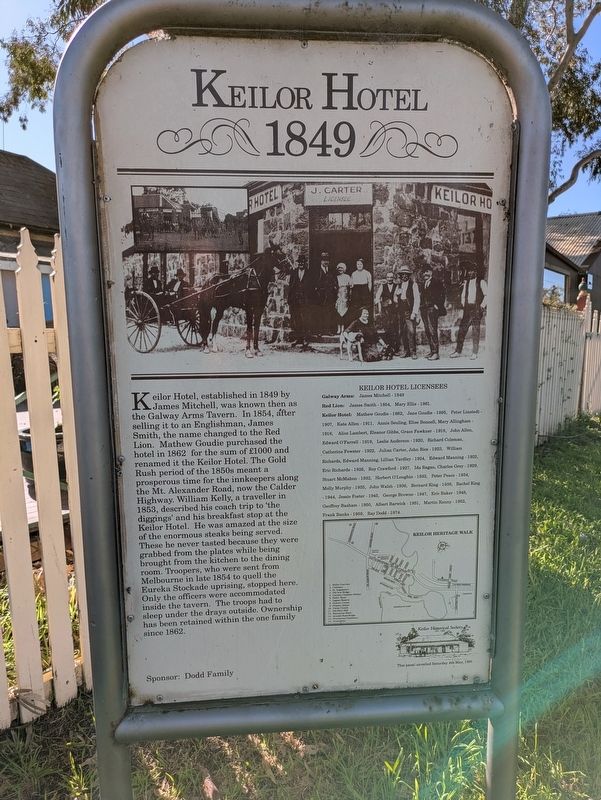
1. Keilor Hotel Marker
Keilor Hotel Licensees
Galway Arms: James Mitchell - 1849
Red Lion: James Smith - 1854, Mary Ellis - 1861.
Keilor Hotel: Mathew Goudie
this page online
Erected 1991 by Keilor Historical Society. (Marker Number 6.)
Topics. This historical marker is listed in these topic lists: Colonial Era • Industry & Commerce. A significant historical year for this entry is 1849.
Location. 37° 43.197′ S, 144° 50.205′ E. Marker is in Keilor, Victoria, in Brimbank. It is at the intersection of Old Calder Highway and Hunter
Photographed by Dean Barton-Ancliffe, August 27, 2026
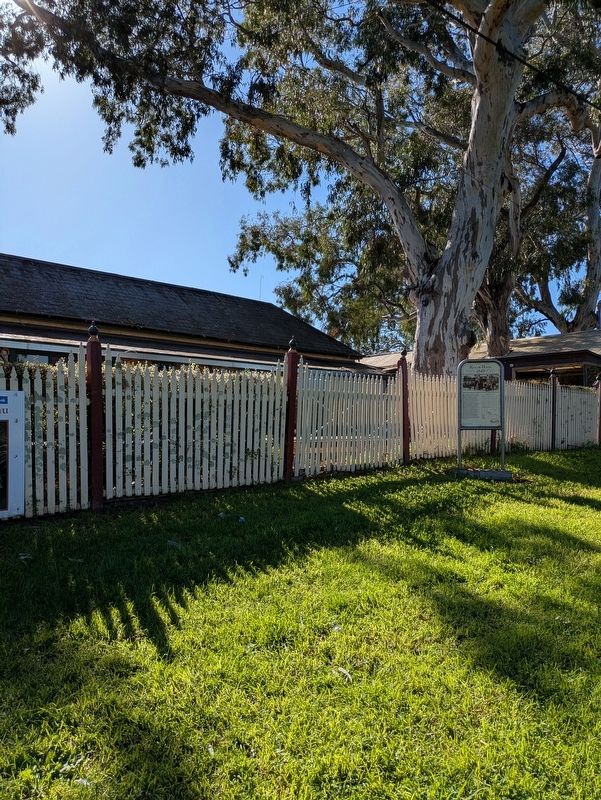
2. Keilor Hotel Marker beside the side fence

Regionally, it is in Oceania, in Australasia, in the Pacific Ocean, in South Pacific, on the Pacific Rim, in the Western World, and in the Anglosphere. Historically, it finds itself in what was once a British colony.
Other nearby markers. At least 8 other markers are within 10 kilometers of this marker, measured as the crow flies: Old Iron Bridge (approx. 0.3 kilometers away); St Augustine’s (approx. one kilometer away); Keilor Cemetery (approx. 1.6 kilometers away); Overnewton (approx. 2.1 kilometers away); Woodlands Historic Park (approx. 9.2 kilometers away); Hume and Hovell - 100 Year Memorial Marker (approx. 9.3 kilometers away); Bulla War Memorial (approx. 9.7 kilometers away); Former Bulla Shire Hall (approx. 9.7 kilometers away). Touch for a list and map of all markers in Keilor.
Also see . . . Keilor Hotel. Wikipedia
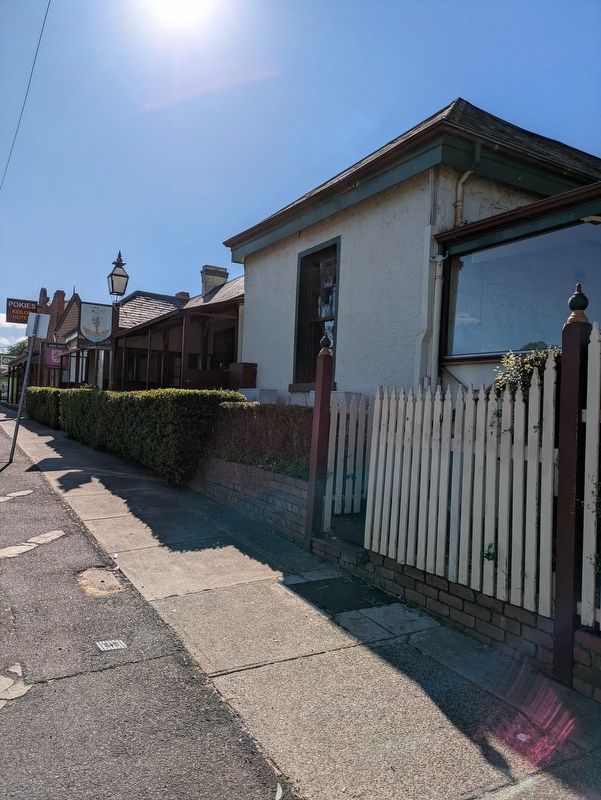
The Keilor Hotel is an Old Colonial Georgian-style single storey bluestone building with a slate(Submitted on September 27, 2026, by Dean Barton-Ancliffe of Rowville, Victoria.)roof and two projecting hipped bays on either side of a recessed verandah. The bluestone walls were subsequently rendered and the hotel has retained its original form and, as of 2022, was still in operation.Photographed by Dean Barton-Ancliffe, August 27, 20263. Keilor Hotel
The hotel, believed to have been constructed in 1848, is located on the main road to Macedon, now called the Old Calder Highway, a site chosen so as to attract passing trade, and was an important stopping place for travellers enroute to squatting runs to the north and west of Melbourne, and later to the Central Victorian goldfields. In 1854, Cobb & Co began running their coaches to the goldfields of Castlemaine and Bendigo, with Keilor as their first main stop. Their practice was to arrange the journey in stretches of approximately sixteen kilometres (ten miles) each, and to change horses at the end of each stretch. The Keilor Hotel was approximately that distance from the Melbourne town centre, and was therefore became a regular coach stop.
Called the Galway Arms Tavern in 1853, and then the Red Lion, the name of the pub was changed to the Keilor Hotel in 1862 when Mathew Goudie bought the hotel for £1,000; and it has been retained in the Dodd and Goudie families since 1862 – and as of November 2020, the hotel was owned by Ray Dodd. The pub claims to be Australia's oldest family-owned hotel.
Credits. This page was last revised on September 28, 2026. It was originally submitted on September 27, 2026, by Dean Barton-Ancliffe of Rowville, Victoria. This page has been viewed 14 times since then. Photos: 1, 2, 3. submitted on September 27, 2026, by Dean Barton-Ancliffe of Rowville, Victoria. • Andrew Ruppenstein was the editor who published this page.
