Keilor Park in Brimbank, Victoria, Australia — Oceania
St Augustine’s
1863
| — | Keilor Heritage Walk | — |
Photographed by Dean Barton-Ancliffe, August 27, 2026
1. St Augustines Marker
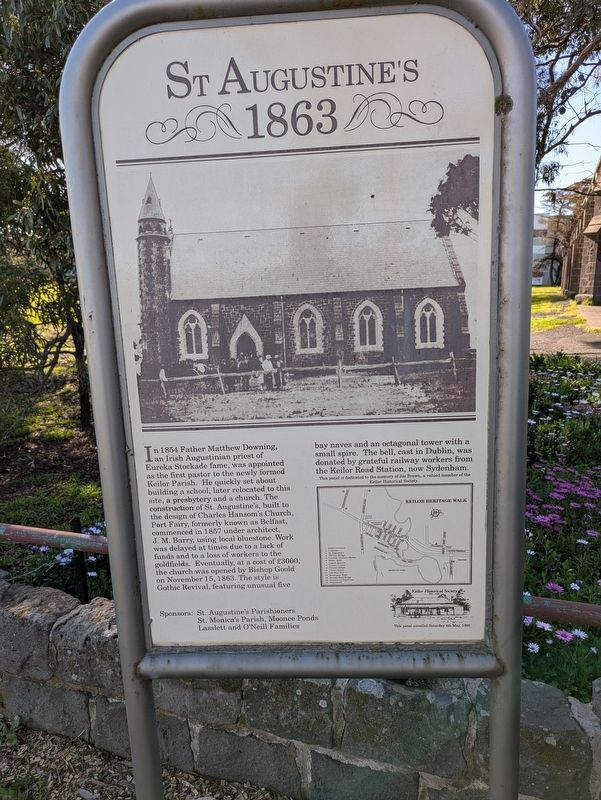
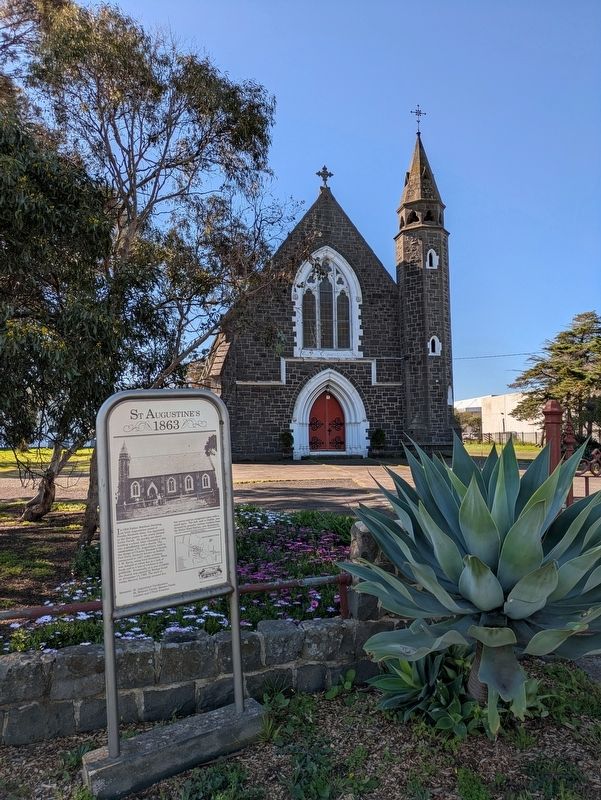
In 1854 Father Matthew Downing, an Irish Augustinian priest of Eureka Stockade fame, was appointed as the first pastor to the newly formed Keilor Parish. He quickly set about building a school, later relocated to this site, a presbytery and a church. The construction of St. Augustine's, built to the design of Charles Hansom's Church, Port Fairy, formerly known as Belfast, commenced in 1857 under architect, J. M. Barry, using local bluestone. Work was delayed at times due to a lack of funds and to a loss of workers to the goldfields. Eventually, at a cost of £3000, the church was opened by Bishop Goold on November 15, 1863. The style is Gothic Revival, featuring unusual five bay naves and an octagonal tower with a small spire. The bell, cast in Dublin, was donated by grateful railway workers from the Keilor Road Station, now Sydenham.
Erected 1991 by Keilor Historical Society. (Marker Number 3.)
Topics. This historical marker is listed in these topic lists: Architecture • Colonial Era • Education • Religion & Religious Structures. A significant historical date for this entry is November 15, 1863.
Location. 37° 43.452′ S, 144° 50.799′ E.
this page online

Regionally, it is in Oceania, in Australasia, in the Pacific Ocean, in South Pacific, on the Pacific Rim, in the Western World, and in the Anglosphere. Historically, it finds itself in what was once a British colony.
Other nearby markers. At least 8 other markers are within 11 kilometers of this marker, measured as the crow flies: Keilor Cemetery (approx. 0.6 kilometers away); Old Iron Bridge (approx. 0.7 kilometers away); Keilor Hotel (approx. one kilometer away); Overnewton (approx. 3.1 kilometers away); Anders Mauritz Hansen (approx. 9.4 kilometers away); Woodlands Historic Park (approx. 9.7 kilometers away); Hume and Hovell - 100 Year Memorial Marker (approx. 9.8 kilometers away); Bulla War Memorial (approx. 10.4 kilometers away).
Also see . . . St. Augustine's (Catholic) Church-Keilor. Victorian Heritage Database
St.(Submitted on September 27, 2026, by Dean Barton-Ancliffe of Rowville, Victoria.)Augustine's Keilor is of regional architectural and historical significance as an unusual and early example of an English Gothic church, executed in local materials and occupying the high point of the locality. It is expressive of the growth occurring in the colony at the time of the gold rushes, and the development of the early rural farming community with strong Irish Catholic links in Keilor. The building is, according to the Australian Heritage Commission, 'a handsome bluestone church of c.1858 with an octagonal bell-tower in the manner of the English architect Charles Hansom and probably built to his design under the supervision of the local architect J.M. Barry. A blind cement panel in the chancel arch results from the removal of an earlier timber chancel .'Photographed by Dean Barton-Ancliffe, August 27, 20262. St Augustines Marker and the Church
Credits. This page was last revised on September 28, 2026. It was originally submitted on September 27, 2026, by Dean Barton-Ancliffe of Rowville, Victoria. This page has been viewed 3 times since then. Photos: 1, 2. submitted on September 27, 2026, by Dean Barton-Ancliffe of Rowville, Victoria. • Andrew Ruppenstein was the editor who published this page.
