Newport in Newport County, Rhode Island — The American Northeast (New England)
Touro Park
Walk Newport's History
| — | Newport Historical Society | — |
Photographed by Devry Becker Jones, September 18, 2026
1. Touro Park Marker
The Newport Historical Society invites you to Walk Newport's History and discover our city's rich past by exploring its historic buildings and landscape. This self-guided walking tour—with signs scattered throughout Newport's historic neighborhoods—celebrates the many voices and stories that make up our community's history. It is important to acknowledge that Newport is built on the ancestral lands of Native American nations who welcomed the first European settlers to Rhode Island. Furthermore, this State's wealth and development were historically dependent on the unwilling labor of people of African and Native descent, who played an integral role in building this state.
Made possible the Rhode Island Commerce & the Pomeroy Foundation
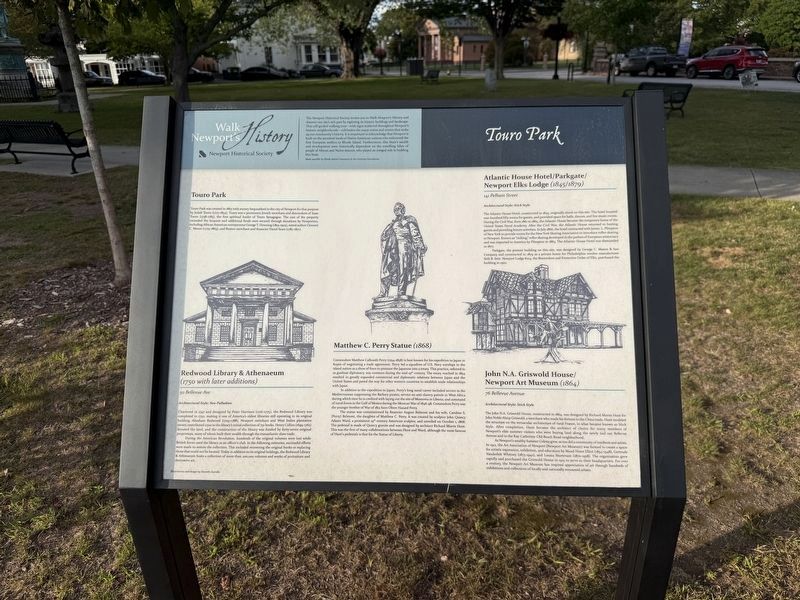
Touro Park
Touro Park was created in 1865 with money bequeathed to the city of Newport for that purpose by Judah Touro (1775-1854). Touro was a prominent Jewish merchant and descendant of Isaac Touro (1738-1783), the first spiritual leader of Touro Synagogue. The cost of the property exceeded the bequest and additional funds were secured through donations by Newporters, including African
this page online
Redwood Library & Athenaeum (1750 with later additions)
50 Bellevue Ave
Architectural Style: Neo-Palladian
Chartered in 1747 and designed by Peter Harrison (1716-1775), the Redwood Library was completed in 1750, making it one of America's oldest libraries still operating in its original building. Abraham Redwood (1709-1788), Newport merchant and West Indies plantation owner, contributed £500 to the library's initial collection of 751 books. Henry Collins (1699-1765) donated the land, and the construction of the library was funded by forty-seven original proprietors, many of whom built their wealth through the transatlantic slave trade.
During the American Revolution, hundreds of the original volumes were lost while British forces used the library as an officer's club. In the following centuries, successful efforts were made to restore the collection. This included recovering the original books or replacing those that could not be located. Today in addition to its original
Matthew C. Perry Statue (1868)
Commodore Matthew Calbraith Perry is best known for his expedition to Japan in hopes of negotiating a trade agreement. Perry led a squadron of U.S. Navy warships to the island nation as a show of force to pressure the Japanese into a treaty. This practice, referred to as gunboat diplomacy, was common during the mid-19th century. The treaty reached in 1854 resulted in greatly expanded commercial and diplomatic relations between Japan and the United States and paved the way for other western countries to establish trade relationships with Japan.
In addition to the expedition to Japan, Perry's long naval career included service in the Mediterranean suppressing the Barbary pirates; service on anti-slavery patrols in West Africa during which time he is credited with laying out of the site of Monrovia in Liberia; and command of naval forces in the Gulf of Mexico during the Mexican War of 1846-48. Commodore Perry was the younger brother of War of 1812 hero Oliver Hazard Perry.
The statue was commissioned by financier August Belmont and his wife, Caroline S. (Perry) Belmont, the daughter of Matthew C. Perry. It was created by sculptor John Quincy Adams Ward, a prominent 19th century American sculptor, and unveiled on October 1, 1868. The pedestal is made of Quincy granite and was designed by architect Richard Morris Hunt. This was the first of many collaborations between Hunt and Ward, although the most famous of Hunt's pedestals is that for the Statue of Liberty.
Atlantic House Hotel/Parkgate/Newport Elks Lodge (1845/1879)
141 Pelham Street
Architectural Style: Stick Style
The Atlantic House Hotel, constructed in 1845, originally stood on this site. The hotel boasted one-hundred fifty rooms for guests, and provided space for balls, dances, and live music events. During the Civil War, from 1861 to 1865, the Atlantic House became the temporary home of the United States Naval Academy. After the Civil War, the Atlantic House returned to hosting guests and providing leisure activities. In July 1866, the hotel contracted with James L. Plimpton of New York to provide rooms for the New York Skating Association to introduce roller skating to Newport. Known as "rinking," roller skating developed in the parlors of European aristocracy and was imported to America by Plimpton in 1863. The Atlantic House Hotel was dismantled in 1877.
Parkgate, the present building on this site, was designed by George C. Mason & Son Company and constructed in 1879 as a private home for Philadelphia woolen manufacturer Seth B. Stitt. Newport Lodge #104, the Benevolent and Protective Order of Elks, purchased the building in 1920.
John N.A. Griswold House/Newport Art Museum (1865)
76 Bellevue Avenue
Architectural Style: Stick Style
The John N.A. Griswold House, constructed in 1864, was designed by Richard Morris Hunt for John Noble Alsop Griswold, a merchant who made his fortune in the China trade. Hunt modeled the structure on the vernacular architecture of rural France, in what became known as Stick Style. After completion, Hunt became the architect of choice for many members of Newport's elite summer visitors who were buying land along the newly laid out Bellevue Avenue and in the Kay-Catherine-Old Beach Road neighborhood.
As Newport's wealthy Summer Colony grew, so too did a community of intellects and artists. In 1912, the Art Association of Newport (Newport Art Museum) was formed to create a space for artistic expression, exhibition, and education by Maud Howe Elliott (1854-1948), Gertrude Vanderbilt Whitney (1875-1942), and Louisa Sturtevant (1870-1958). The organization grew rapidly and purchased the Griswold House in 1915 to serve as their headquarters. For over a century, the Newport Art Museum has inspired appreciation of art through hundreds of exhibitions and collections of locally and nationally renowned artists.
Erected by Newport Historical Society, made possible the Rhode Island Commerce & the William G. Pomeroy Foundation.
Topics and series. This historical marker is listed in these topic lists: Architecture • Arts, Letters, Music • Fraternal or Sororal Organizations • Parks & Recreational Areas. In addition, it is included in the William G. Pomeroy Foundation series list. A significant historical month for this entry is July 1866.
Location. 41° 29.119′ N, 71° 18.542′ W. Marker is in Newport, Rhode Island, in Newport County. It is on Pelham Street. Touch for map. Marker is at or near this postal address: 139 Pelham St, Newport RI 02840, United States of America. Touch for directions.

Regionally, this marker is on Narragansett Bay and in Newport and Aquidneck Island. It is also in the American Northeast, in New England, and on the Eastern Seaboard. Globally, it is in the North Atlantic Region, North America, the Western Hemisphere, the Western World, and the Anglosphere. Historically, it finds itself in what was once one of the original Thirteen Colonies.
Other nearby markers. At least 8 other markers are within walking distance of this marker: The League of American Wheelmen (within shouting distance of this marker); The 2012 Shimoda Tomodachi Declaration (within shouting distance of this marker); Matthew Perry Monument (within shouting distance of this marker); a different marker also named Touro Park (within shouting distance of this marker); Redwood Library (about 400 feet away, measured in a direct line); Bellevue Avenue (about 400 feet away); Christopher Columbus (about 600 feet away); Serenity Inn Newport (about 700 feet away). Touch for a list and map of all markers in Newport.
Other markers no longer nearby. Touro Park (has been replaced with this marker); a different marker also named Touro Park (was within shouting distance of this marker but has been replaced with another marker now near it); Bellevue Ave. at John St. (was about 500 feet away but has been replaced with another marker now near it).
Additional keywords. human trafficking
Credits. This page was last revised on September 27, 2026. It was originally submitted on September 27, 2026, by Devry Becker Jones of Washington, District of Columbia. This page has been viewed 4 times since then. Photos: 1, 2. submitted on September 27, 2026, by Devry Becker Jones of Washington, District of Columbia.
