
Greenville in Greenville County, South Carolina — The American South (South Atlantic)
Historic Plants Garden
The Children's Garden
| — | History Garden | — |
Photographed by Brian Scott, April 30, 2010
1. Historic Plants Garden Marker
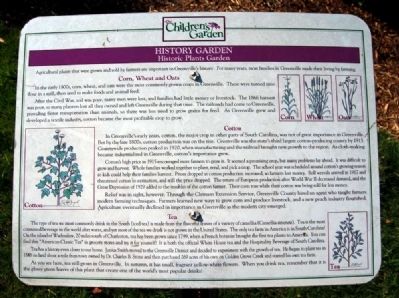
Agricultural plants that were grown and sold by farmers are important to Greenville's history. For many years, most families in Greenville made their living by farming.
After the Civil War, soil was poor, many men were lost, and families had little money or livestock. The 1866 harvest was poor, so many planters lost all they owned and left Greenville during that time. The railroads had come to Greenville, providing faster transportation than animals, so there was less need to grow grains for feed. As Greenville grew and developed a textile industry, cotton became the most profitable crop to grow.
this page online
Cotton's high price in 1915 encouraged more farmers to grow. It seemed a promising crop, but many problems lay ahead. It was difficult to grow and harvest. Whole families worked together to plant, tent, and pick up a crop. The school year was scheduled around cotton's growing season as kids could help their families harvest. Prices dropped as cotton production increased, so farmers lost money. Boll weevils arrived in 1917 and threatened cotton to extinction, ans still the price dropped. The return of European production after World War II decreased demand, and the Great Depression of 1929 added to the troubles of the cotton farmer. Their costs rose while their cotton was being sold for less money.
Relief was in sight, however. Through the Clemson Extension Service, Greenville County hired an agent who taught farmers modern farming techniques. Farmers learned new ways to grow corn and produce livestock, and a new peach industry flourished. Agriculture eventually declined in importance in Greenville as
Photographed by Brian Scott, April 30, 2010
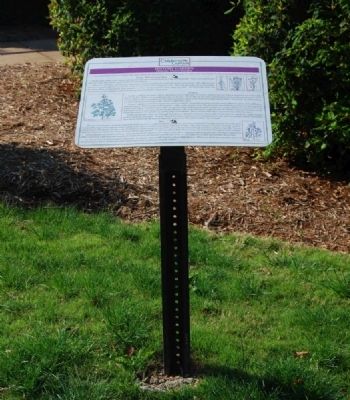
2. Historic Plants Garden Marker
Tea has a history even closer to home. Junius Smith moved to the Greenville District and decided to experiment with the growth of tea. He began to plant tea in 1848 on land about a mile from town owned by Dr. Charles B. Stone and then purchased 269 acres of his own on Golden Grove Creek and started his own tea farm.
As you see here, teal still grows in Greenville. In autumn, it has small, fragrant yellow-white flowers. When you drink tea, remember that it is the
Photographed by Brian Scott, April 30, 2010
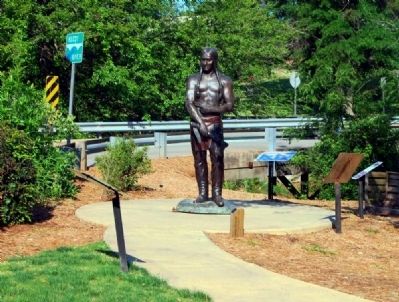
3. Historic Garden Markers -
Cherokee Indian
Donated by Phil and Sharon Carlton
Cherokee Indian
Donated by Phil and Sharon Carlton
Erected by City of Greenville Parks and Recreation.
Topics. This historical marker is listed in these topic lists: Agriculture • Natural Resources. A significant historical year for this entry is 1866.
Location. 34° 50.95′ N, 82° 24.25′ W. Marker is in Greenville, South Carolina, in Greenville County. It can be reached from Reedy View Drive. Marker is located on the grounds of the Children's Garden at Linky Stone Park. Touch for map. Marker is at or near this postal address: 24 Reedy View Drive, Greenville SC 29601, United States of America. Touch for directions.

Regionally, this marker is in Upstate. It is also in the American South, specifically in the Deep South, in Appalachia, and specifically in Southern Appalachia. Globally, it is in North America, the Western Hemisphere, the Western World, and the Anglosphere. Historically, it finds itself in what was once the original Cherokee Nation, the territory of the Mississippian Culture, one of the original Thirteen Colonies, one of the Confederate States of America, and the Antebellum South.
Other nearby markers. At least 10 other markers are within walking distance of this marker: Historic River Cane (here, next to this marker); History of the Reedy River (here, next to this marker); Linky Stone Park (here, next to this marker); The Geologic History of Greenville (within shouting distance of this marker); Huguenot Mill Office (about 700 feet away, measured in a direct line); Prospect Hill / McBee Homestead (approx. 0.2 miles away); Votes for Women (approx. 0.2 miles away); Carolina Supply Company (approx. 0.2 miles away); Downtown Baptist Church (approx. 0.2 miles away); Prospect Hill Park Monument (approx. 0.2 miles away). Touch for a list and map of all markers in Greenville.
Credits. This page was last revised on November 16, 2020. It was originally submitted on May 28, 2010, by Brian Scott of Anderson, South Carolina. This page has been viewed 980 times since then and 28 times this year. Photos: 1, 2, 3. submitted on May 28, 2010, by Brian Scott of Anderson, South Carolina.
