Jackson in Hinds County, Mississippi — The American South (East South Central)
Jackson Civil Rights Lawyers
| — | Mississippi Freedom Trail | — |
Photographed by Mark Hilton, September 27, 2026
1. Jackson Civil Rights Lawyers Marker
Someone has wrapped and tied a telephone wire around the marker.
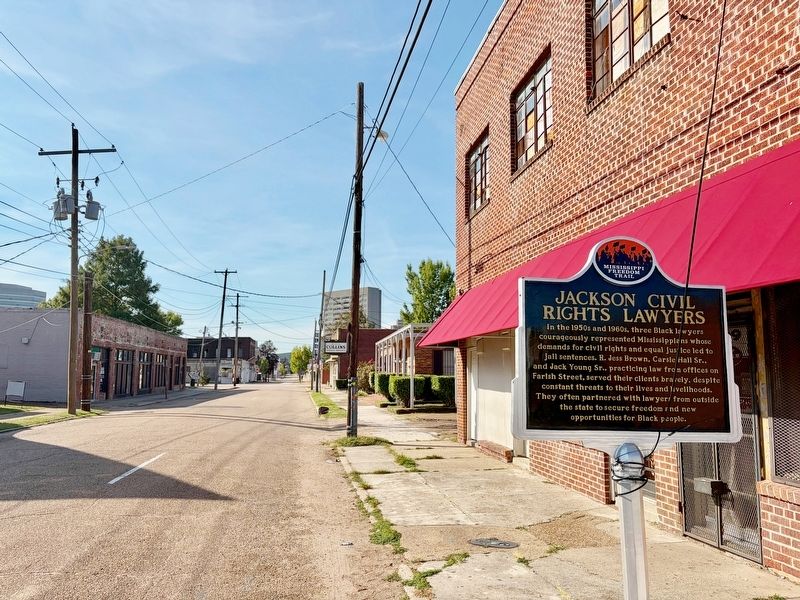
North Farish Street is a one-way street northbound.
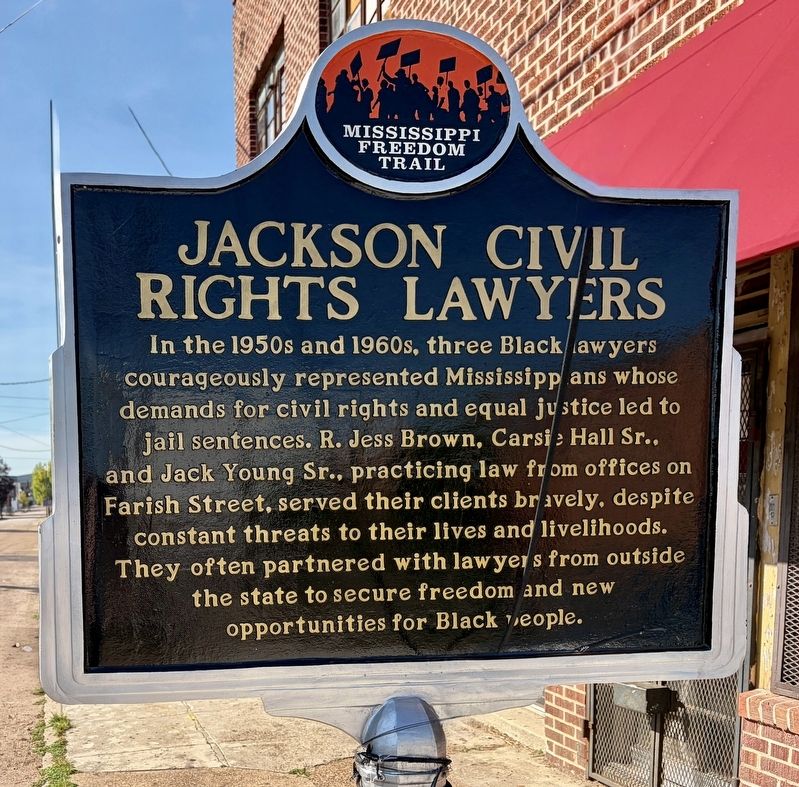
In the 1950s and 1960s, three Black lawyers courageously represented Mississippians whose demands for civil rights and equal justice led to jail sentences. R. Jess Brown, Carsie Hall Sr., and Jack Young Sr., practicing law from offices on Farish Street, served their clients bravely, despite constant threats to their lives and livelihoods. They often partnered with lawyers from outside the state to secure freedom and new opportunities for Black people.
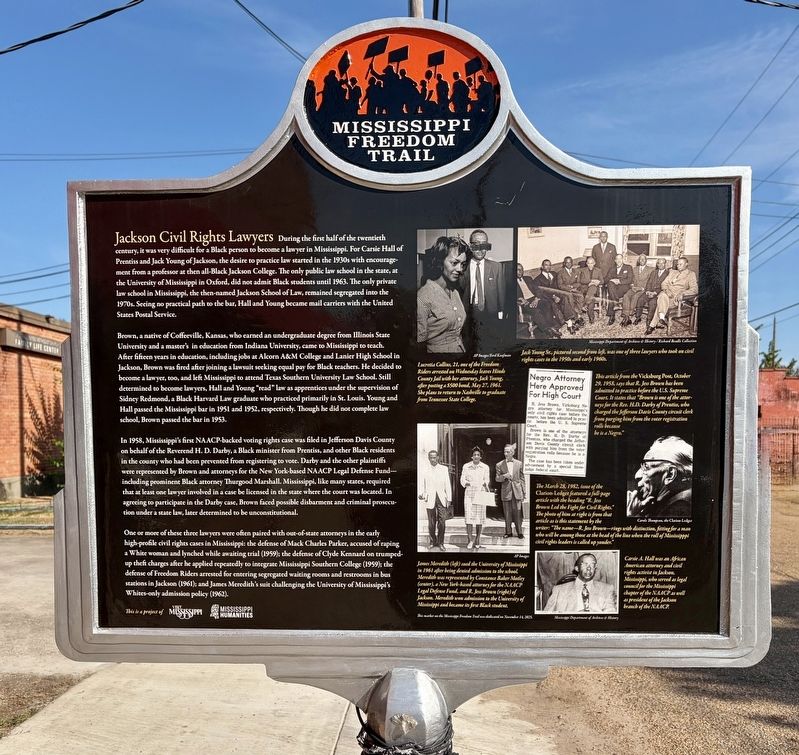
Jackson Civil Rights Lawyers During the first half of the twentieth century, it was very difficult for a Black person to become a lawyer in Mississippi. For Carsie Hall of Prentiss and Jack Young of Jackson, the desire to practice law started in the 1930s with encouragement from a professor at then all-Black Jackson College. The only public law school in the state, at the University of Mississippi in Oxford, did not admit Black students until 1963. The only private law school in Mississippi, the then-named Jackson School of Law, remained segregated into the 1970s. Seeing no practical path to the bar, Hall and Young became mail carriers with the United States
this page online
Brown, a native of Coffeeville, Kansas, who earned an undergraduate degree from Illinois State University and a master's in education from Indiana University, came to Mississippi to teach. After fifteen years in education, including jobs at Alcorn A&M College and Lanier High School in Jackson, Brown was fired after joining a lawsuit seeking equal pay for Black teachers. He decided to become a lawyer, too, and left Mississippi to attend Texas Southern University Law School. Still determined to become lawyers, Hall and Young "read" law as apprentices under the supervision of Sidney Redmond, a Black Harvard Law graduate who practiced primarily in St. Louis. Young and Hall passed the Mississippi bar in 1951 and 1952, respectively. Though he did not complete law school, Brown passed the bar in 1953.
In 1958, Mississippi's first NAACP-backed voting rights case was filed in Jefferson Davis County on behalf of the Reverend H. D. Darby, a Black minister from Prentiss, and other Black residents in the county who had been prevented from registering to vote. Darby and the other plaintiffs were represented by Brown and attorneys
Photographed by Mark Hilton, September 27, 2026
2. Jackson Civil Rights Lawyers Marker
One or more of these three lawyers were often paired with out-of-state attorneys in the early high-profile civil rights cases in Mississippi: the defense of Mack Charles Parker, accused of raping a White woman and lynched while awaiting trial (1959); the defense of Clyde Kennard on trumped-up theft charges after he applied repeatedly to integrate Mississippi Southern College (1959); the defense of Freedom Riders arrested for entering segregated waiting rooms and restrooms in bus stations in Jackson (1961); and James Meredith's suit challenging the University of Mississippi's Whites-only admission policy (1962).
Erected 2025 by Visit Mississippi, the Mississippi Humanities Council.
Topics and series. This historical marker
Photographed by Mark Hilton, September 27, 2026
3. Jackson Civil Rights Lawyers Marker
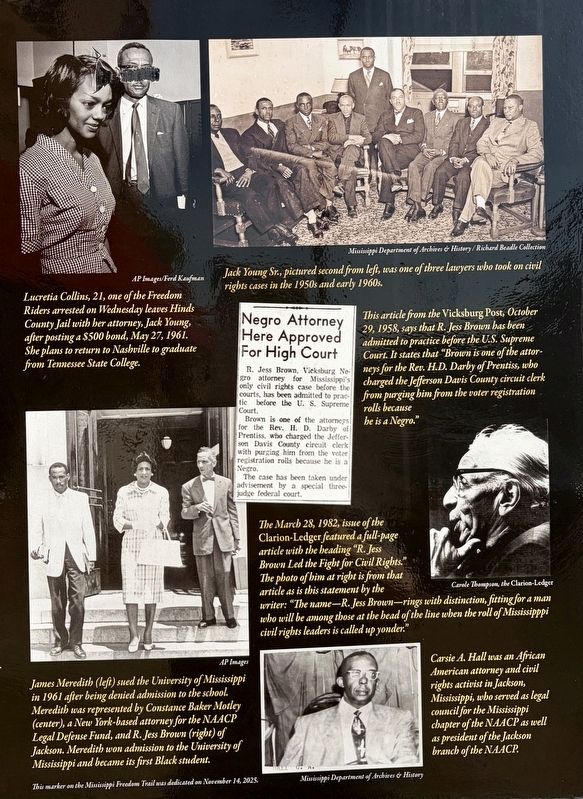
Close-up of photos & captions.
Location. 32° 18.309′ N, 90° 11.319′ W. Marker is in Jackson, Mississippi, in Hinds County. It is on North Farish Street north of Hobson Street, on the left when traveling north. Touch for map. Marker is at or near this postal address: 509 N Farish St, Jackson MS 39202, United States of America. Touch for directions.

Regionally, this marker is in Natchez Trace Corridor. It is also in the American South and specifically in the Deep South. Globally, it is in North America, a Gulf of Mexico state, the Western Hemisphere, the Western World, and the Anglosphere. Historically, it finds itself in what was once the territory of the Mississippian Culture, one of the Confederate States of America, and the Antebellum South.
Other nearby markers. At least 8 other markers are within walking distance of this marker: The Alamo Theatre (about 400 feet away, measured in a direct line); Trumpet Records (about 600 feet away); Smith Robertson School
Photographed by Mark Hilton, September 27, 2026
4. Jackson Civil Rights Lawyers Marker looking south.
This is a one-way street heading north.
Also see . . . 'Jackson Civil Rights Lawyers' Freedom Trail Marker unveiled on Farish Street,. (Submitted on September 28, 2026, by Mark Hilton of Montgomery, Alabama.)
Credits. This page was last revised on September 28, 2026. It was originally submitted on September 28, 2026, by Mark Hilton of Montgomery, Alabama. This page has been viewed 10 times since then. Photos: 1, 2, 3, 4. submitted on September 28, 2026, by Mark Hilton of Montgomery, Alabama.
