Wales Township in Goodells in St. Clair County, Michigan — The American Midwest (Great Lakes)
The County Farm
Photographed by Joel Seewald, September 26, 2026
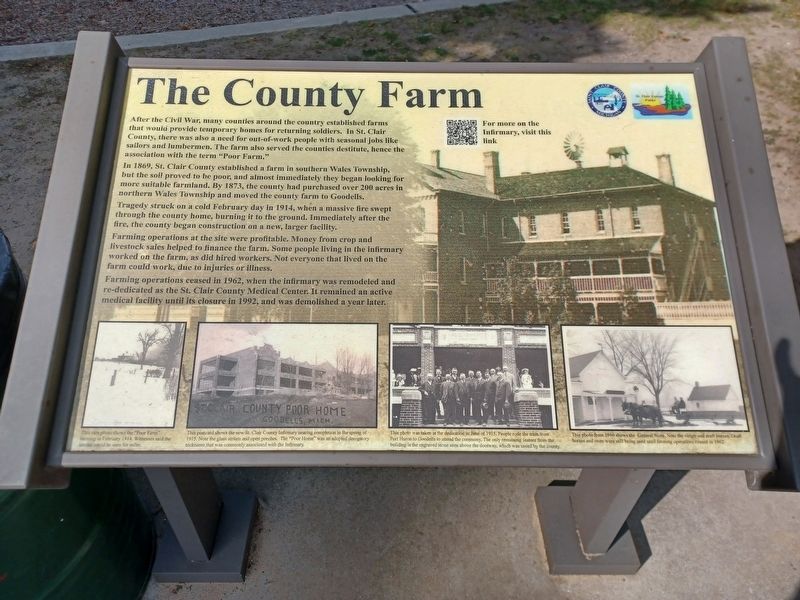
1. The County Farm Marker
After the Civil War, many counties around the country established farms that would provide temporary homes for returning soldiers. In St. Clair County, there was also a need for out-of-work people with seasonal jobs like sailors and lumbermen. The farm also served the counties destitute, hence the association with the term "Poor Farm."
In 1869, St. Clair County established a farm in southern Wales Township, but the soil proved to be poor, and almost immediately they began looking for more suitable farmland. By 1873, the county had purchased over 200 acres in northern Wales Township and moved the county farm to Goodells.
Tragedy struck on a cold February day in 1914, when a massive fire swept through the county home, burning it to the ground. Immediately after the fire, the county began construction on a new, larger facility.
Farming operations at the site were profitable. Money from crop and livestock sales helped to finance the farm. Some people living in the infirmary worked on the farm, as did hired workers. Not everyone lived on the farm could work, due to injuries or illness.
Farming operations ceased
this page online
Erected by St. Clair County, Michigan and St. Clair County Parks.
Topics. This historical marker is listed in this topic list: Agriculture. A significant historical year for this entry is 1869.
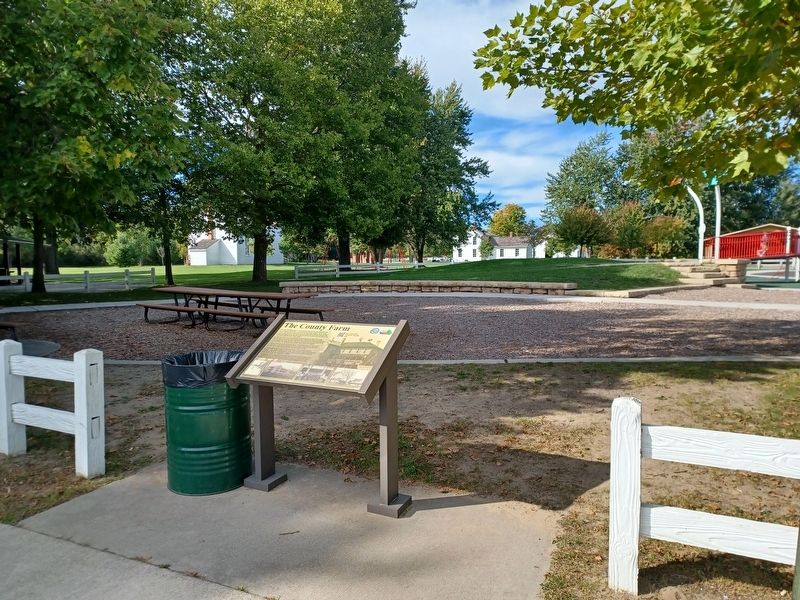
Location. 42° 59.04′ N, 82° 39.513′ W. Marker is in Goodells, Michigan, in St. Clair County. It is in Wales Township. It can be reached from County Park Drive 0.4 miles east of Goodells Road, on the left when traveling east. Marker is at the northwest corner of the Farm Museum parking lot next to the playground. Touch for map. Marker is at or near this postal address: 8310 County Park Dr, Goodells MI 48027, United States of America. Touch for directions.

Regionally, this marker is in Southeast Michigan and in one of the Lake Huron Shore counties. It is also in the American Midwest. Globally, it is in North America, on the Great Lakes, in the Western Hemisphere, in the Western World, and in the Anglosphere. Historically, it finds itself
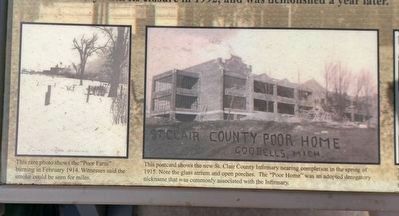
2. The County Farm Marker - left images
Left image caption: This rare photo shows the "Poor Farm" burning in February 1914. Witnesses said the smoke could be seen for miles.
Right image caption: This postcard shows the new St. Clair County Infirmary nearing completion in the spring of 1915. Note the glass atrium and open porches. The "Poor Home" was an adopted derogatory nickname that was commonly associated with the Infirmary.
Right image caption: This postcard shows the new St. Clair County Infirmary nearing completion in the spring of 1915. Note the glass atrium and open porches. The "Poor Home" was an adopted derogatory nickname that was commonly associated with the Infirmary.
Other nearby markers. At least 8 other markers are within 11 miles of this marker, measured as the crow flies: Columbus Bible Church (about 400 feet away, measured in a direct line); Mudge Log Cabin (about 400 feet away); Lynn Township School (about 500 feet away); Wales Township Hall (approx. 3.1 miles away); Our Lady of Mount Carmel Parish / John F. Farrell (approx. 5.4 miles away); "The Thing" (approx. 8.1 miles away); Shiloh Baptist Church (approx. 10½ miles away); C. H. Wills & Company (approx. 10.8 miles away). Touch for a list and map of all markers in Goodells.
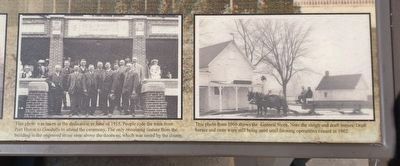
3. The County Farm Marker - right images
Left image caption: This photo was taken at the dedication in June of 1915. People rode the train from Port Huron to Goodells to attend the ceremony. The only remaining feature from the building is the engraved stone seen above the doorway, which was saved by the county.
Right image caption: This photo from 1960 shows the General Store. Note the sleigh and draft horses. Draft horses and oxen were still being used until farming operations ceased in 1962.
Right image caption: This photo from 1960 shows the General Store. Note the sleigh and draft horses. Draft horses and oxen were still being used until farming operations ceased in 1962.
Photographed by Joel Seewald, September 26, 2026
4. The County Farm Marker
Credits. This page was last revised on September 28, 2026. It was originally submitted on September 28, 2026, by Joel Seewald of Madison Heights, Michigan. This page has been viewed 5 times since then. Photos: 1, 2, 3, 4. submitted on September 28, 2026, by Joel Seewald of Madison Heights, Michigan.
