Tiverton in Newport County, Rhode Island — The American Northeast (New England)
Historic Town Farm/Asylum
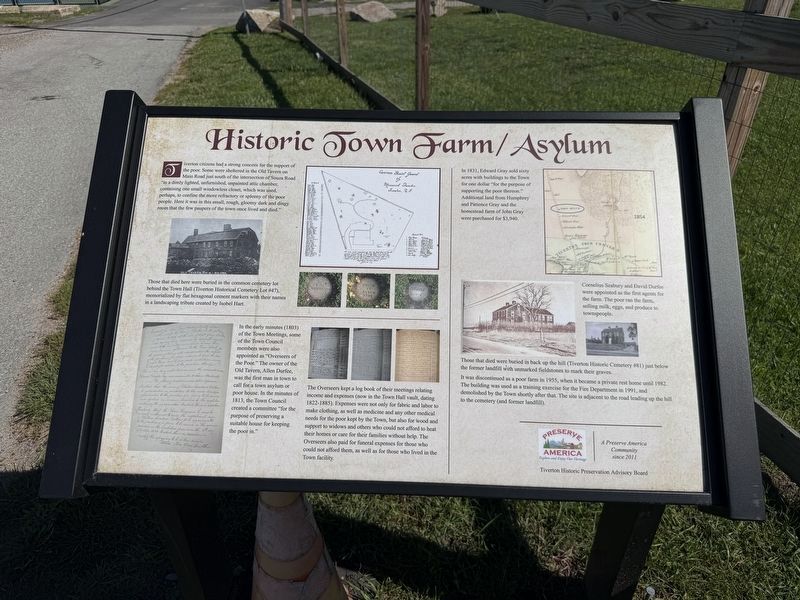
Tiverton citizens had a strong concern for the support of the poor. Some were sheltered in the Old Tavern on Main Road just south of the intersection of Souza Road "in a dimly lighted, unfurnished, unpainted attic chamber, containing one small windowless closet, which was used, perhaps, to confine the more refractory or spleeny of the poor people. Here it was in this small, rough, gloomy dark and dingy room that the few paupers of the town once lived and died."
Those that died here were buried in the common cemetery lot behind the Town Hall (Tiverton Historical Cemetery Lot #47), memorialized by flat hexagonal cement markers with their names in a landscaping tribute created by Isobel Hart.
In the early minutes (1803) of the Town Meetings, some of the Town Council members were also appointed as "Overseers of the Poor." The owner of the Old Tavern, Allen Durfee, was the first man in town to call for a town asylum or poor house. In the minutes of 1813, the Town Council created a committee "for the purpose of preserving a suitable house for keeping the poor in."
The Overseers kept a log book of their meetings relating
this page online
In 1831, Edward Gray sold sixty acres with buildings to the Town for one dollar "for the purpose of supporting the poor thereon." Additional land from Humphrey and Patience Gray and the homestead farm for John Gray were purchased for $3,940.
Cornelius Seabury and David Durfee were appointed as the first agents for the farm. The poor ran the farm, selling milk, eggs, and produce to townspeople.
Those that died were buried in back up the hill (Tiverton Historic Cemetery #81) just below the former landfill with unmarked fieldstones to mark their graves.
It was discontinued as a poor farm in 1955, when it became a private rest home until 1982. The building
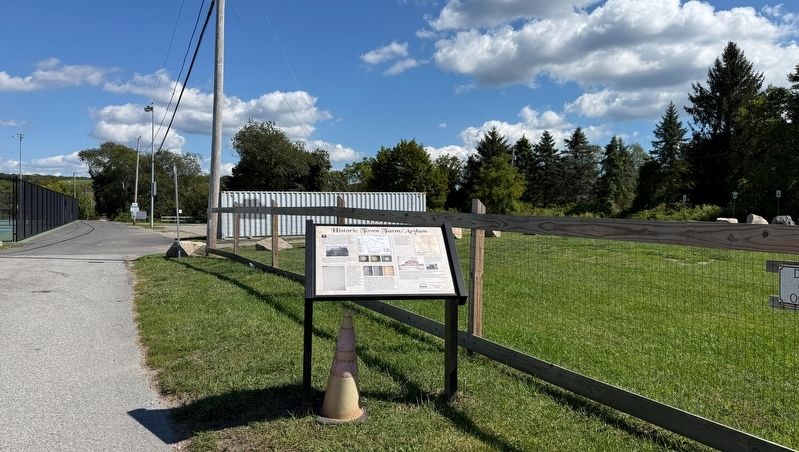
Erected by Tiverton Historic Preservation Advisory Board.
Topics. This historical marker is listed in these topic lists: Agriculture • Charity & Public Work • Government & Politics. A significant historical year for this entry is 1813.
Location. 41° 34.911′ N, 71° 11.515′ W. Marker is in Tiverton, Rhode Island, in Newport County. It is on Main Road (Rhode Island Route 77) south of Wampanoag Lane, on the right when traveling north. Touch for map. Marker is at or near this postal address: 3524 Main Rd, Tiverton RI 02878, United States of America. Touch for directions.

Regionally, this marker is on Narragansett Bay. It is also in the American Northeast, in New England, and on the Eastern Seaboard. Globally, it is in the North Atlantic Region, North America, the Western Hemisphere, the Western World, and the Anglosphere. Historically, it finds itself in what was once one of the original Thirteen Colonies.
Other nearby markers. At least 8 other markers are within 4 miles of this marker, measured as the crow flies: Historic Tiverton Four Corners (approx. ¾ mile away); Chace-Cory House (approx. 0.8 miles away); Weetamoo (approx. one mile away); Historic Bridgeport (approx. 2.6 miles away); Historic Nanaquaket (approx. 2.6 miles away); Holt’s Trail (approx. 3.1 miles away); Town of Tiverton, Rhode Island World War II Honor Roll (approx. 3.1 miles away); Fort Barton (approx. 3.1 miles away). Touch for a list and map of all markers in Tiverton.
Credits. This page was last revised on September 28, 2026. It was originally submitted on September 28, 2026, by Devry Becker Jones of Washington, District of Columbia. This page has been viewed 7 times since then. Photos: 1, 2. submitted on September 28, 2026, by Devry Becker Jones of Washington, District of Columbia.
