Near Castle Junction in Banff National Park, Alberta — Canada’s Prairie Region (North America)
Internment Camp
⎯⎯⎯
Camp d'internement
Photographed by Cosmos Mariner, July 4, 2022
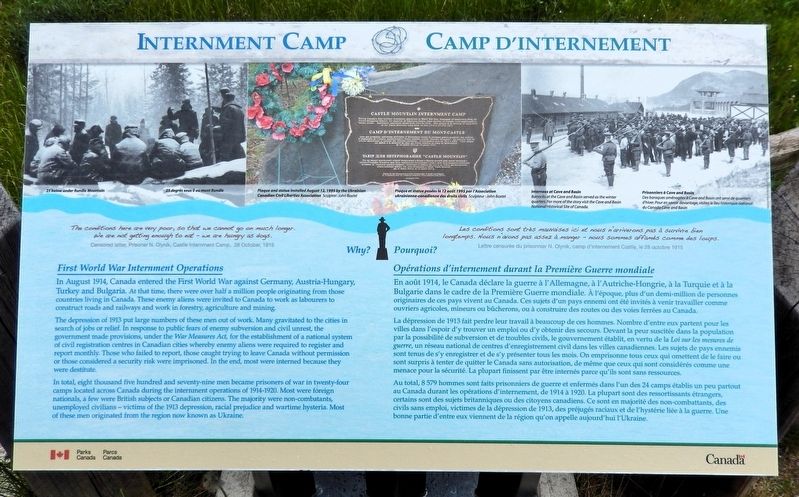
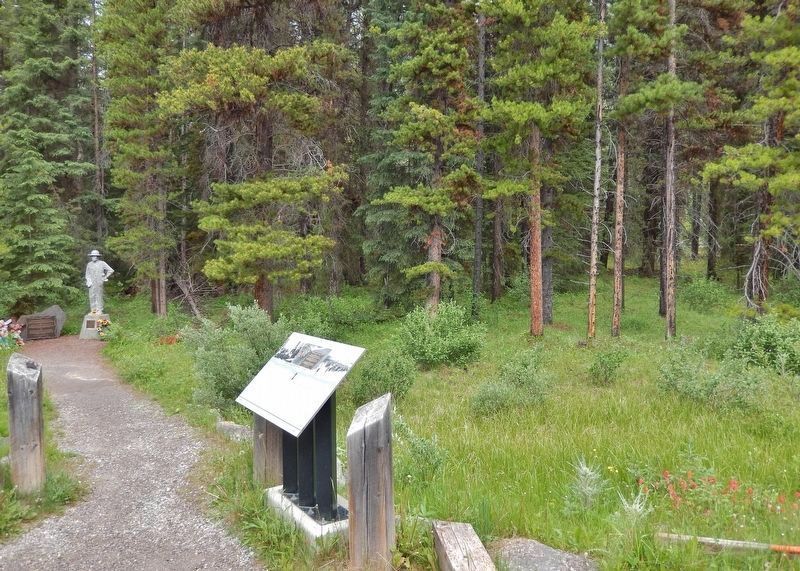
1. Internment Camp / Camp d'internement Marker

Censored letter, Prisoner N. Olynik, Castle Internment Camp, 28 October, 1915
First World War Internment Operations
In August 1914, Canada entered the First World War against Germany, Austria-Hungary, Turkey and Bulgaria. At that time, there were over half a million people originating from those countries living in Canada. These enemy aliens were invited to Canada to work as labourers to construct roads and railways and work in forestry, agriculture and mining.
The depression of 1913 put large numbers of these men out of work. Many gravitated to the cities in search of jobs or relief. In response to public fears of enemy subversion and civil unrest, the government made provisions, under the War Measures Act, for the establishment of a national system of civil registration centres in Canadian cities whereby enemy aliens were required to register and report monthly. Those who failed to report, those caught trying to leave Canada without permission or those considered a security risk were imprisoned.
this page online
In total, eight thousand five hundred and seventy-nine men became prisoners of war in twenty-four camps located across Canada during the internment operations of 1914-1920. Most were foreign nationals, a few were British subjects or Canadian citizens. The majority were non-combatants, unemployed civilians — victims of the 1913 depression, racial prejudice and wartime hysteria. Most of these men originated from the region now known as Ukraine.
Lettre censurée du prisonnier N. Olynik, camp d'internement Castle, le 28 octobre 1915
Opérations d'internement durant la Première Guerre mondiale
En août 1914, le Canada déclare la guerre à l'Allemagne, à l'Autriche-Hongrie, à la Turquie et à la Bulgarie dans le cadre de la Première Guerre mondiale. À l'époque, plus d'un demi-million de personnes originaires de ces pays vivent au Canada. Ces sujets d'un pays ennemi ont été invités à venir travailler comme ouvriers agricoles, mineurs
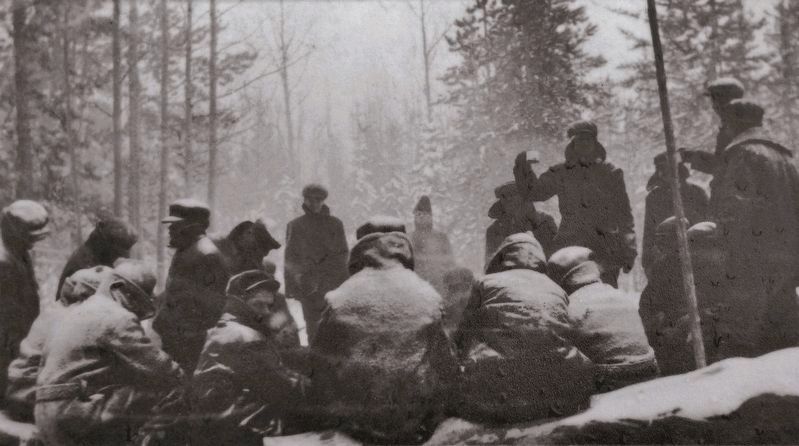
2. Marker detail: 25 below under Rundle Mountain /
25 degrés sous 0 au mont Rundle
25 degrés sous 0 au mont Rundle
La dépression de 1913 fait perdre leur travail à beaucoup de ces hommes. Nombre d'entre eux partent pour les villes dans l'espoir d'y trouver un emploi ou d'y obtenir des secours. Devant la peur suscitée dans la population par la possibilité de subversion et de troubles civils, le gouvernement établit, en vertu de la Loi sur les mesures de guerre, un réseau national de centres d'enregistrement civil dans les villes canadiennes. Les sujets de pays ennemis sont tenus de s'y enregistrer et de s'y présenter tous les mois. On emprisonne tous ceux qui omettent de le faire ou sont surpris à tenter de quitter le Canada sans autorisation, de même que ceux qui sont considérés comme une menace pour la sécurité. La plupart finissent par être internés parce qu'ils sont sans ressources.
Au total, 8 579 hommes sont faits prisonniers de guerre et enfermés dans l'un des 24 camps établis un peu partout au Canada durant les opérations d'internement, de 1914 à 1920. La plupart sont des ressortissants étrangers, certains sont des sujets britanniques ou des citoyens canadiens. Ce sont
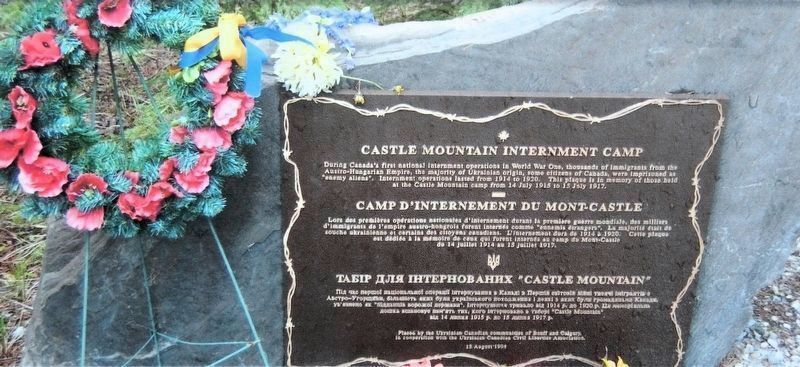
3. Marker detail: Castle Mountain Internment Camp
Erected by Parks Canada / Parcs Canada.
Topics. This historical marker is listed in these topic lists: Law Enforcement • War, World I. A significant historical month for this entry is August 1914.
Location. 51° 17.479′ N, 115° 58.051′ W. Marker is near Castle Junction, Alberta, in Banff National Park. It is on Bow Valley Parkway (Provincial Highway 1A) 4.3 kilometers west of Banff-Windermere Highway (Provincial Highway 93), on the right when traveling west. Touch for map. Marker is in this post office area: Castle Junction AB T0L 0B6, Canada. Touch for directions.

Regionally, this marker is in the Canadian Rockies. It is also in the Prairies. Globally, it is in North America, the Rocky Mountains, the Western Hemisphere, the Western World, and the Anglosphere. Historically, it finds itself in what was once a British colony and also Rupert’s Land.
Other nearby markers. At least 8 other
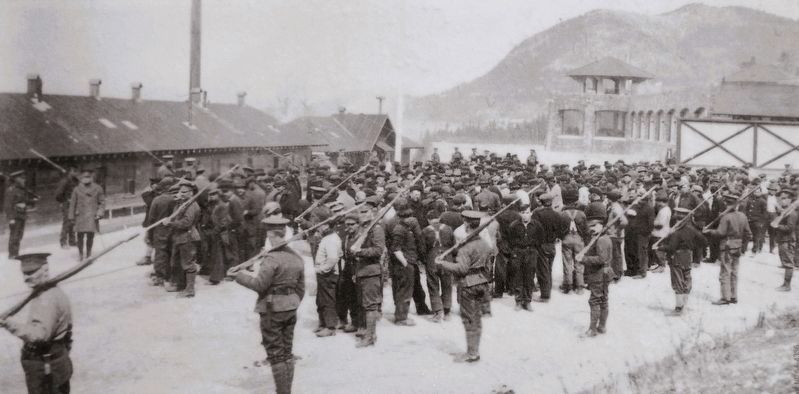
Glenbow Alberta Archives NC 54-4336
4. Marker detail: Internees at Cave and Basin /
Prisonniers à Cave and Basin
Prisonniers à Cave and Basin
Internees at Cave and Basin Barracks at the Cave and Basin served as the winter quarters. For more of the story visit the Cave and Basin National Historical Site of Canada. • • • Prisonniers à Cave and Basin Des baraques aménagées à Cave and Basin ont servi de quartiers d'hiver. Pour en savoir davantage, visitez le lieu historique national du Canada Cave and Basin
Related markers. Click here for a list of markers that are related to this marker. Castle Mountain Internment Camp
Also see . . . Castle Mountain Internment Camp (Wikipedia).
Excerpt: Designated enemy aliens under Canada's 1914 War Measures Act, some 8,579 enemy aliens were interned during World War I as prisoners of war. Ostensibly nationals of countries at war with Canada, the vast majority however were settler immigrants, primarily(Submitted on October 4, 2026, by Cosmos Mariner of Cape Canaveral, Florida.)of Ukrainian ethnic origin. The Castle Camp, which was built in 1915 at the base of Castle Mountain was a Canadian internment camp which held immigrant prisoners of Ukrainian, Austrian, Hungarian and German descent.Photographed by Cosmos Mariner, July 4, 20225. Internment Camp / Camp d'internement MarkerThe marker is among related markers and monuments in a pull-out on the north side of Bow Valley Parkway.
Despite their civilian status, a great many were sent to prisoner of war camps located in the Canadian hinterland, to be used as military conscript labour on government work projects. Of particular note was the use of forced labour in Canada's national parks, where they were introduced there as a matter of policy to improve existing facilities and increase accessibility by developing the park system's infrastructure. By 1915 several internment camps in and around the Rocky Mountains were in full operation, including a camp at the foot of Castle Mountain, the terminal point of the then uncompleted Banff-Laggan (Lake Louise) road. The Castle Mountain Internment Camp was the largest internment facility in the Canadian Rockies, housing several hundred prisoners at any one time. Established on July 13, 1915, a total of 660 enemy aliens were interned at the facility during its entire operation.
Credits. This page was last revised on October 4, 2026. It was originally submitted on September 30, 2026, by Cosmos Mariner of Cape Canaveral, Florida. This page has been viewed 12 times since then. Photos: 1, 2, 3, 4, 5. submitted on October 3, 2026, by Cosmos Mariner of Cape Canaveral, Florida.
