Daytona Beach in Volusia County, Florida — The American South (South Atlantic)
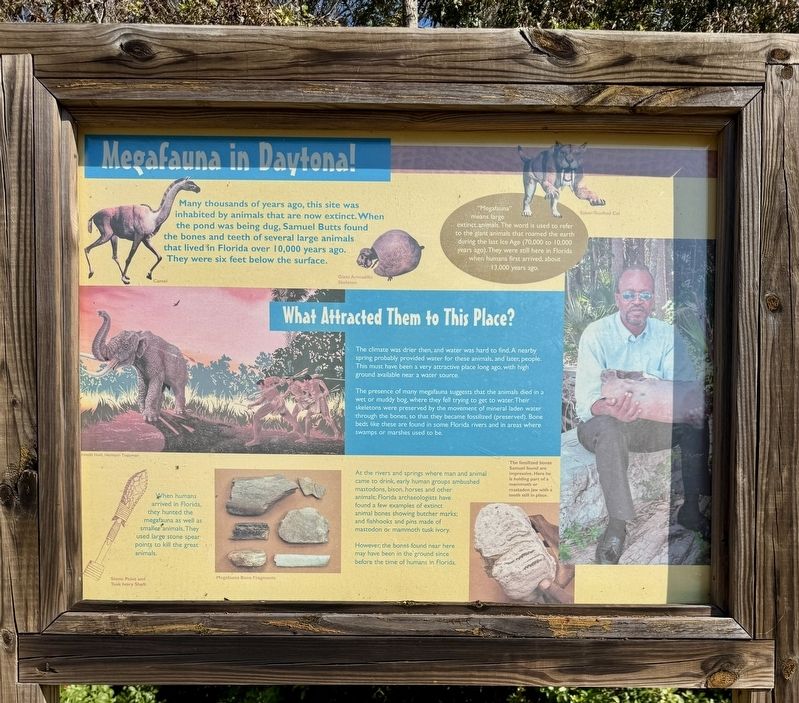
Megafauna in Daytona
750 Bellevue Avenue
Photographed by Stephen Thomas White, January 7, 2026
1. Magafauna in Daytona Marker
"Megafauna" means large extinct animals. The word is used to refer to the giant animals that roamed the earth during the last Ice Age (70,000 to 10,000 years ago). They were still here in Florida when humans first arrived, about 13,000 years ago.
What Attracted Them to This Place?
The climate was drier then, and water was hard to find. A nearby spring probably provided water for these animals, and later, people. This must have been a very attractive place long ago, with high ground available near a water source.
The presence of many megafauna suggests that the animals died in a wet or muddy bog, where they fell trying to get to water. Their skeletons were preserved by the movement of mineral laden water through the bones, so that they became fossilized (preserved). Bone beds like these are found in some Florida rivers and in areas where swamps or marshes used to be.
When humans arrived in Florida they hunted the megafauna as well as smaller animals. They used large stone spear points to kill the great animals.
At the rivers and springs where man and animal came to drink, early human groups ambushed mastodons,
this page online
However, the bones found near here may have been in the ground since before the time of humans in Florida.
(captions)
Camel
Saber-Toothed Cat
Giant Armadillo Skeleton
Mammoth Hunt; Herman Trappenian
Stone Point and Tusk Ivory Shaft
Magafauna Bones Fragments
The fossilized bones Samuel found are impressive. Here he is holding part of a mammoth or mastodon jaw with a tooth still in place.
Erected by City of Daytona Beach and the Department of State, Division of Historical Resources.
Topics. This historical marker is listed in these topic lists: Animals • Anthropology & Archaeology • Paleontology.
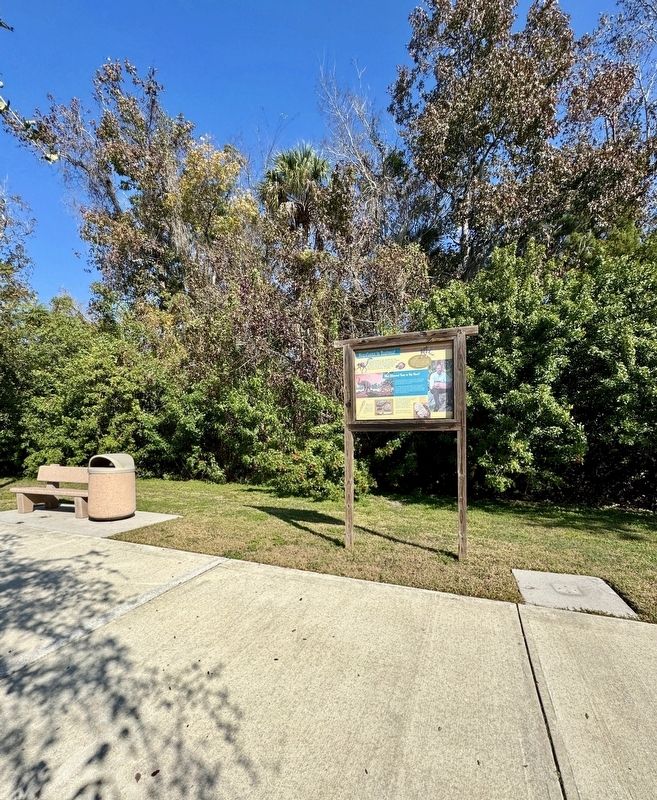
Location. 29° 11.655′ N, 81° 1.489′ W. Marker is in Daytona Beach, Florida, in Volusia County. It is at the intersection of Bellevue Avenue and Lockhart Street, on the left when traveling north on Bellevue Avenue. The marker is located at the Samuel Butts Youth
Photographed by Stephen Thomas White, January 7, 2026
2. Magafauna in Daytona Marker

Regionally, this marker is in First Coast. It is also in the American South and on the Eastern Seaboard. Globally, it is in the North Atlantic Region, North America, a Gulf of Mexico state, the Western Hemisphere, the Western World, and the Anglosphere. Historically, it finds itself in what was once New Spain, the territory of the Mississippian Culture, one of the Confederate States of America, and the Antebellum South.
Other nearby markers. At least 8 other markers are within walking distance of this marker: The General Store (about 400 feet away, measured in a direct line); Samuel Butts Youth Archaeological Park (about 700 feet away); Mount Bethel Baptist Institutional Church (approx. ¼ mile away); Historic Childhood Home of Dr. Howard Thurman (approx. 0.4 miles away); Howard Thurman Home (approx. 0.4 miles away); Masonic Lodge No. 36 (approx. 0.4 miles away); Mount Zion AME Church (approx. half a mile away); Daytona Times Building (approx. half a mile away). Touch for a list and map of all markers in Daytona Beach.
Also see . . . You Don’t Know Butts. (Submitted on October 1, 2026, by Stephen Thomas White of Norfolk, Virginia.)
Credits. This page was last revised on November 6, 2026. It was originally submitted on October 1, 2026, by Stephen Thomas White of Norfolk, Virginia. This page has been viewed 14 times since then. Photos: 1, 2. submitted on October 1, 2026, by Stephen Thomas White of Norfolk, Virginia. • Andrew Ruppenstein was the editor who published this page.
