Kyneton in Macedon Ranges Shire, Victoria, Australia — Oceania
WT Jones & Son Stonemason
| — | Discover Historic Kyneton | — |
Photographed by Dean Barton-Ancliffe, August 31, 2026
1. WT Jones & Son Stonemason Marker
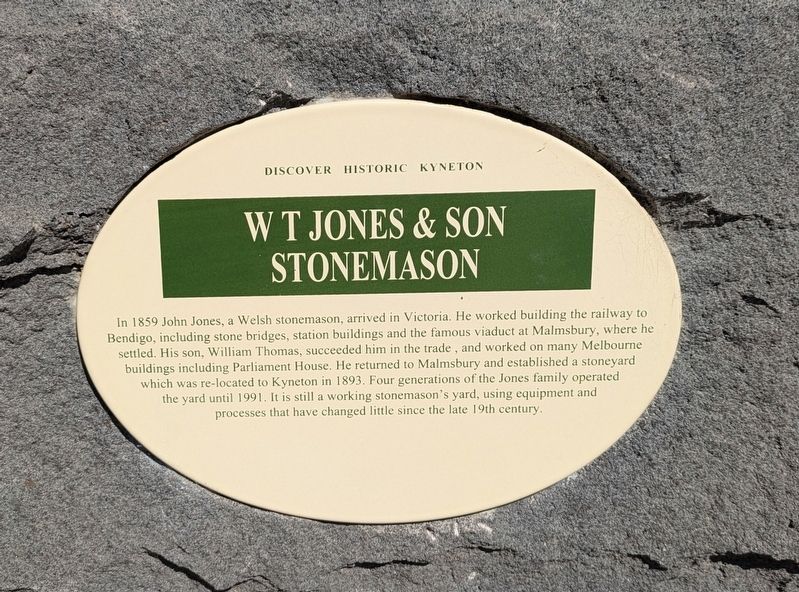
In 1859 John Jones, a Welsh stonemason, arrived in Victoria. He worked building the railway to Bendigo, including stone bridges, station buildings and the famous viaduct at Malmsbury, where he settled. His son, William Thomas, succeeded him in the trade, and worked on many Melbourne buildings including Parliament House. He returned to Malmsbury and established a stoneyard which was re-located to Kyneton in 1893. Four generations of the Jones family operated the yard until 1991. It is still a working stonemason's yard, using equipment and processes that have changed little since the late 19th century.
Topics. This historical marker is listed in these topic lists: Architecture • Bridges & Viaducts • Colonial Era • Industry & Commerce. A significant historical year for this entry is 1859.
Location. 37° 14.681′ S, 144° 27.155′ E. Marker is in Kyneton, Victoria, in Macedon Ranges Shire. It is on Piper Street 0.1 kilometers west of Mollison Street (Victoria Route C793), on the left when traveling west. Touch for map. Marker is at or near this postal address: 11 Piper Street, Kyneton VIC 3444, Australia. Touch for directions.

Regionally,
this page online
Other nearby markers. At least 8 other markers are within walking distance of this marker: G.W. Willis's Mill (within shouting distance of this marker); Willis Steam Mill (within shouting distance of this marker); Royal George Hotel (about 120 meters away, measured in a direct line); Kyneton Gasworks Community Park (about 180 meters away); Our Lady of the Rosary (about 240 meters away); 2009 Bushfires Memorial Mural Kyneton (approx. 0.3 kilometers away); Kyneton Court House (approx. 0.3 kilometers away); Kyneton Town Hall (approx. 0.3 kilometers away). Touch for a list and map of all markers in Kyneton.
Also see . . . Stonemasons Yard. Victorian Heritage Database
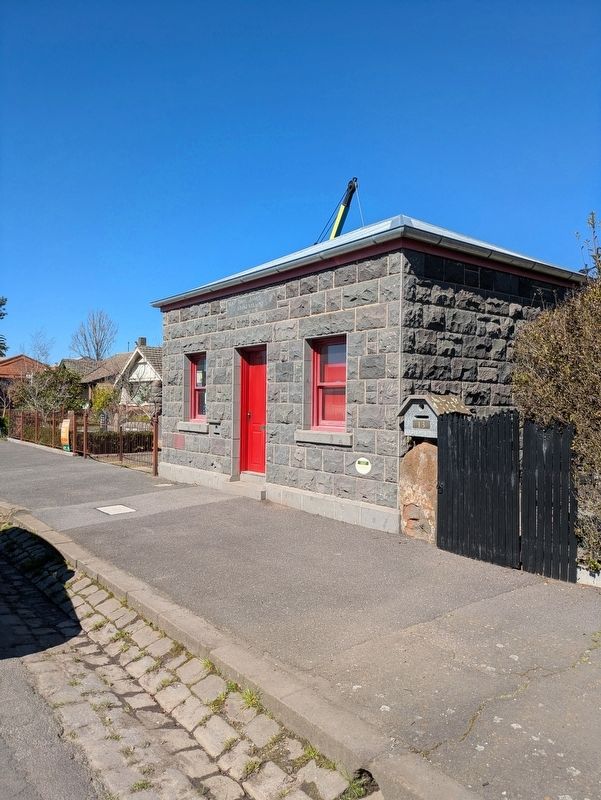
The Stonemasons Yard is situated in Piper Street within the township of Kyneton. Kyneton and the surrounding district has a rich array of stone buildings and stone rail infrastructure. The WT Jones stonemasons yard was originally established in Malmsbury(Submitted on October 2, 2026, by Dean Barton-Ancliffe of Rowville, Victoria.)and a second yard was established in Kyneton in the 1890's. During this time there was an abundance of loose bluestone and numerous small quarries established in the district, some of which supplied the masons yard with the local stone. An advertisement for the business dates back to 1898 and states: 'WT Jones Monumental and General Mason, Piper Street Kyneton and Mollison Street, Malmsbury'. The yard is currently operating under the same name of WT Jones and Sons Memorials.Photographed by Dean Barton-Ancliffe, August 31, 20262. WT Jones & Son Stonemason Marker at the bottom right of the Building
The building layout consists of an L-shaped configuration of office buildings, engraving area, sandblasting, bush hammer area, polishers shed, sawing and drilling area, early gang saw shed and engine room. The operations are mainly outdoors, or under the cover of open sheds which all face a central open yard. The Jenny Lind Polisher which dates 1893 from Scotland is still in use. A network of trolley lines throughout the site indicate the working layout of the yard. The gang saw shed retains an A-frame timber structure that was used to support two gang saws which no longer remain on site. Gang saw blades, rails for the gang saw trolley and related winch, and a deposit of steel shot waste all give further indication of the importance of gang saw operation in earlier phases of operations on the site.
The two cranes, known as 'Stiff Legged Dykes' were manufactured in Melbourne and are used for lifting and moving larger stones. The larger crane dates from c1897, marked HW Mould Clyde Forge, South Melbourne. The smaller crane was purchased in 1942 from W Ferris, Monumental Mason who was located in Fitzroy and is marked Drysdale & Fraser Melbourne. Both of these cranes are visually prominent on the site and have been located to facilitate movement of heavy materials on and off and transport between the processing areas. The processing areas within the sheds are set out to follow a linear sequence of stone preparation from raw material to finished monumental product. The L-shaped configuration of buildings facilitates movement of the stones by the cranes. Office buildings are closest to the street and most of the stone is stored in the open yard central to the L-shaped building layout.
Credits. This page was last revised on October 15, 2026. It was originally submitted on October 2, 2026, by Dean Barton-Ancliffe of Rowville, Victoria. This page has been viewed 25 times since then. Photos: 1, 2. submitted on October 2, 2026, by Dean Barton-Ancliffe of Rowville, Victoria. • Andrew Ruppenstein was the editor who published this page.
