Near Massive in Banff National Park, Alberta — Canada’s Prairie Region (North America)
Sawback
Photographed by Cosmos Mariner, July 4, 2022
1. Sawback Marker

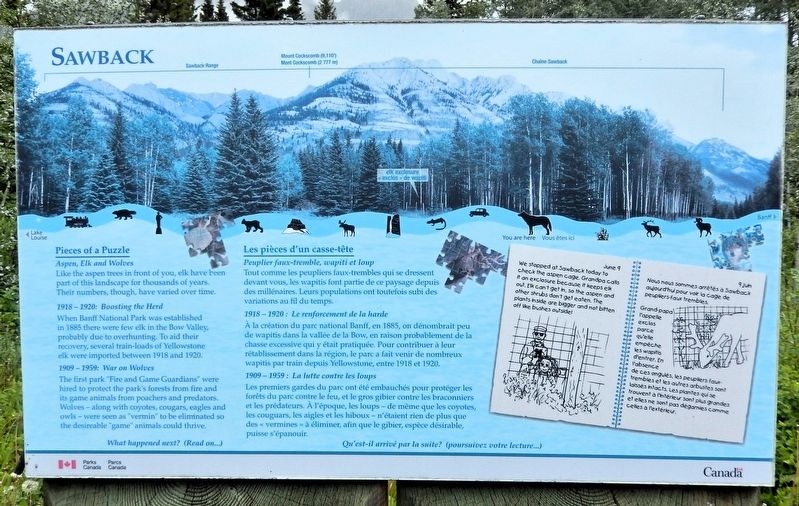
Pieces of a Puzzle
Aspen, Elk and Wolves
Like the aspen trees in front of you, elk have been part of this landscape for thousands of years. Their numbers, though, have varied over time.
1918 — 1920: Boosting the Herd
When Banff National Park was established in 1885 there were few elk in the Bow Valley, probably due to overhunting. To aid their recovery, several train-loads of Yellowstone elk were imported between 1918 and 1920.
1909 — 1959: War on Wolves
The first park “Fire and Game Guardians” were hired to protect the park's forests from fire and its game animals from poachers and predators. Wolves — along with coyotes, cougars, eagles and owls — were seen as “vermin” to be eliminated so the desirable “game” animals could thrive.
Les pièces d'un casse-tête
Peuplier faux-tremble, wapiti et loup
Tout comme les peupliers faux-trembles qui se dressent devant vous, les wapitis font partie de ce paysage depuis des millénaires. Leurs populations ont toutefois subi des variations au fil du temps.
1918 — 1920 : Le renforcement de la harde
À la création du parc national Banff, en 1885, on dénombrait peu de wapitis
this page online
1909 — 1959 : La lutte contre les loups
Les premiers gardes du parc ont été embauchés pour protéger les forêts du parc contre le feu, et le gros gibier contre les braconniers et les prédateurs. À l'époque, les loups — de même que les coyotes, les couguars, les aigles et les hiboux — n'étaient rien de plus que des « vermines » à éliminer, afin que le gibier, espèce désirable, puisse s'épanouir.
Erected by Parks Canada / Parcs Canada.
Topics. This historical marker is listed in these topic lists: Animals • Parks & Recreational Areas. A significant historical year for this entry is 1885.
Location. 51° 12.991′ N, 115° 46.078′ W. Marker is near Massive, Alberta, in Banff National Park. It is on Bow Valley Parkway (Provincial Highway 1A) 12.6 kilometers east of Banff-Windermere Highway (Provincial Highway 93), on the left when traveling east. The marker is beside a pull-out on the north side of Bow
Photographed by Cosmos Mariner, July 4, 2022
2. Sawback Marker
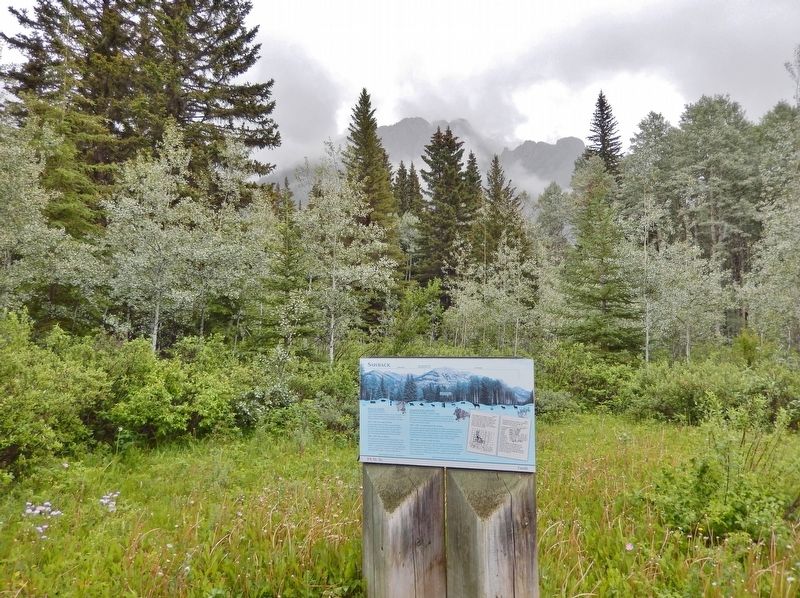
Looking north from Bow Valley Parkway. The Sawback Range is in the background.

Regionally, this marker is in the Canadian Rockies. It is also in the Prairies. Globally, it is in North America, the Rocky Mountains, the Western Hemisphere, the Western World, and the Anglosphere. Historically, it finds itself in what was once a British colony and also Rupert’s Land.
Other nearby markers. At least 8 other markers are within 14 kilometers of this marker, measured as the crow flies: The Bigger Picture / La situation dans son ensemble (here, next to this marker); Past Visitors / Visiteurs du passé (approx. 1.3 kilometers away); Era of the Automobile / L'ère de l'automobile (approx. 1.3 kilometers away); Prescribed Burn / Brûlage dirigé (approx. 3.4 kilometers away); Flames of Life / Flammes de la vie (approx. 3.4 kilometers away); Pilot Pond / Étang Pilot (approx. 3.5 kilometers away); The Cave and Basin (approx. 13.5 kilometers away); An Architectural Landmark (approx. 13.9 kilometers away). Touch for a list and map of all markers in Massive.
Also see . . . Elk in Banff National Park (Parks Canada).
Excerpt: Elk are a vital part of Banff's ecology - they are the main herbivore, or plant eater, in the park and in turn a major food source for predators such as wolves. Elk have always been part of the natural ecology of the park but probably in fewer numbers than we see today. When Banff National Park was created in 1885, only a few elk were seen in the Bow Valley. By 1906, numbers of elk were so low they seemed to have disappeared. But ten years later, elk populations were up naturally, as well as with additional help from the introduction of 235 elk from Yellowstone National Park in Wyoming in 1918-20. Today, elk are the most numerous large animal with close to 350 found in the park; over 200 of them live in the lower Bow Valley close to the town of Banff.(Submitted on October 5, 2026, by Cosmos Mariner of Cape Canaveral, Florida.)
Credits. This page was last revised on October 5, 2026. It was originally submitted on October 3, 2026, by Cosmos Mariner of Cape Canaveral, Florida. This page has been viewed 8 times since then. Photos: 1, 2. submitted on October 5, 2026, by Cosmos Mariner of Cape Canaveral, Florida.
