Near Sawback in Banff National Park, Alberta — Canada’s Prairie Region (North America)
Flames of Life
Picture a Patchwork Quilt
⎯⎯⎯
Flammes de la vie
Comme une mosaïque
Photographed by Cosmos Mariner, July 4, 2022
1. Flames of Life / Flammes de la vie Marker

Picture a Patchwork Quilt
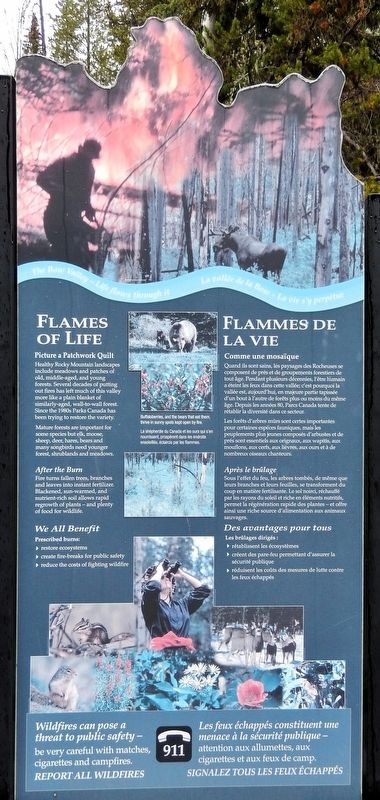
Healthy Rocky Mountain landscapes include meadows and patches of old, middle-aged, and young forests. Several decades of putting out fires has left much of this valley more like a plain blanket of similarly-aged, wall-to-wall forest. Since the 1980s Parks Canada has been trying to restore the variety.
Mature forests are important for some species but elk, moose, sheep, deer, hares, bears and many songbirds need younger forest, shrublands and meadows.
After the Burn
Fire turns fallen trees, branches and leaves into instant fertilizer. Blackened, sun-warmed, and nutrient-rich soil allows rapid regrowth of plants — and plenty of food for wildlife.
We All Benefit
Prescribed burns:
► restore ecosystems
► create fire-breaks for public safety
► reduce the costs of fighting wildfire
Wildfires can pose a threat to public safety —
be very careful with matches, cigarettes and campfires.
Report All Wildfires
Comme une mosaïque
Quand ils sont sains, les paysages des Rocheuses se composent de près et de groupements forestiers de tout âge. Pendant plusieurs décennies, l'être humain à éteint les feux dans cette vallée; c'est pourquoi la vallée est, aujourd'hui, en majeure partie tapissée d'un bout à l'autre de forêts plus ou moins du même âge. Depuis les années 80, Parcs Canada tente de rétablir la diversité dans ce secteur.
Les forêts d'arbres mûrs sont certes importantes pour certaines espèces fauniques, mais les peuplements plus jeunes composés d'arbustes et de prés sont essentiels aux orignaux, aux wapitis, aux mouflons, aux cerfs, aux lièvres, aux ours et à de nombreux oiseaux chanteurs.
Après le brûlage
Sous l'effet du feu, les arbres tombés, de même que leurs branches et leurs feuilles, se transforment du coup en matière fertilisante. Le sol noirci, réchauffé
this page online
Des avantages pour tous
Les brûlages dirigés :
► rétablissent les écosystèmes
► créent des pare-feu permettant d'assurer la sécurité publique
► réduisent les coûts des mesures de lutte contre les feux échappés
Les feux échappés constituent une menace a la sécurité public —
attention aux allumettes, aux cigarettes et aux feux de camp.
Signalez tous les feux échappés
Erected by Parks Canada / Parcs Canada.
Topics. This historical marker is listed in these topic lists: Animals • Horticulture & Forestry • Parks & Recreational Areas. A significant historical year for this entry is 1980.
Location. 51° 11.575′ N, 115° 44.23′ W. Marker is near Sawback, Alberta, in Banff National Park. It is on Bow Valley Parkway (Provincial Highway 1A) 16 kilometers east of Banff-Windermere Highway (Provincial Highway 93), on the left when traveling east. The marker is beside a pull-out on the north side of Bow Valley Parkway. Touch for map. Marker is in this post
Photographed by Cosmos Mariner, July 4, 2022
2. Flames of Life / Flammes de la vie Marker
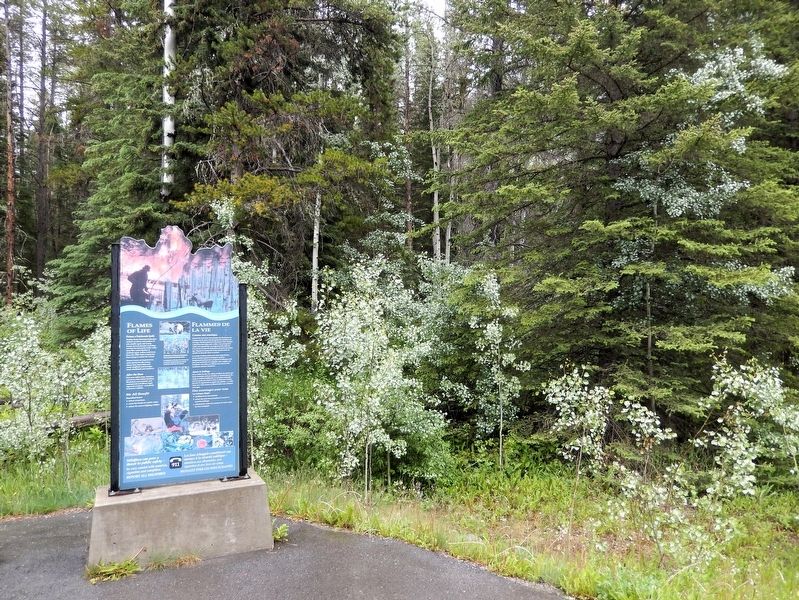
Looking north from Bow Valley Parkway.

Regionally, this marker is in the Canadian Rockies. It is also in the Prairies. Globally, it is in North America, the Rocky Mountains, the Western Hemisphere, the Western World, and the Anglosphere. Historically, it finds itself in what was once a British colony and also Rupert’s Land.
Other nearby markers. At least 8 other markers are within 11 kilometers of this marker, measured as the crow flies: Prescribed Burn / Brûlage dirigé (here, next to this marker); The Bigger Picture / La situation dans son ensemble (approx. 3.4 kilometers away); Sawback (approx. 3.4 kilometers away); Past Visitors / Visiteurs du passé (approx. 4.7 kilometers away); Era of the Automobile / L'ère de l'automobile (approx. 4.7 kilometers away); Pilot Pond / Étang Pilot (approx. 6.8 kilometers away); The Cave and Basin (approx. 10.7 kilometers away); An Architectural Landmark (approx. 11.3 kilometers away).
Related markers. Click here for a list of markers that are related to this marker.
Also see . . . Wildfire in the Bow Valley (AlbertaViews.ca).
(By Adrienne Mason July 1, 2026) Excerpt: Since the 1980s, Parks Canada has been a leader in reintroducing fire and in acknowledging that fires are necessary—and inevitable. It’s a challenging choreography, since what can renew can also destroy. In addition to letting some wildfires safely burn and lighting others purposely to reduce fuels and break up similarly aged stands of densely packed trees, Parks Canada has been actively mitigating wildfire risk around the built environment. They have created fire breaks, thinned and limbed trees, and removed deadfall and woody debris.(Submitted on October 7, 2026, by Cosmos Mariner of Cape Canaveral, Florida.)
The resounding message to be learned in Banff from understanding the history and role of fire on the landscape, and from the analysis that has come out of Jasper, is that the world of today isn’t the world of a century ago — or even 20 years ago. Wildfire suppression has only made our forests more combustible. Now, with the climate warming and becoming less predictable, fire seasons are longer and fires are more intense and harder to control. The risk to Banff is urgent.
Fire historian Stephen Pyne has coined a term for our era: the Pyrocene. “We’ve made an alliance with fire,” he writes. “It took us to the top of the food chain and now threatens to unhinge the planet.”
Credits. This page was last revised on October 7, 2026. It was originally submitted on October 3, 2026, by Cosmos Mariner of Cape Canaveral, Florida. This page has been viewed 10 times since then. Photos: 1, 2. submitted on October 6, 2026, by Cosmos Mariner of Cape Canaveral, Florida.
