Decatur in Benton County, Arkansas — The American South (West South Central)
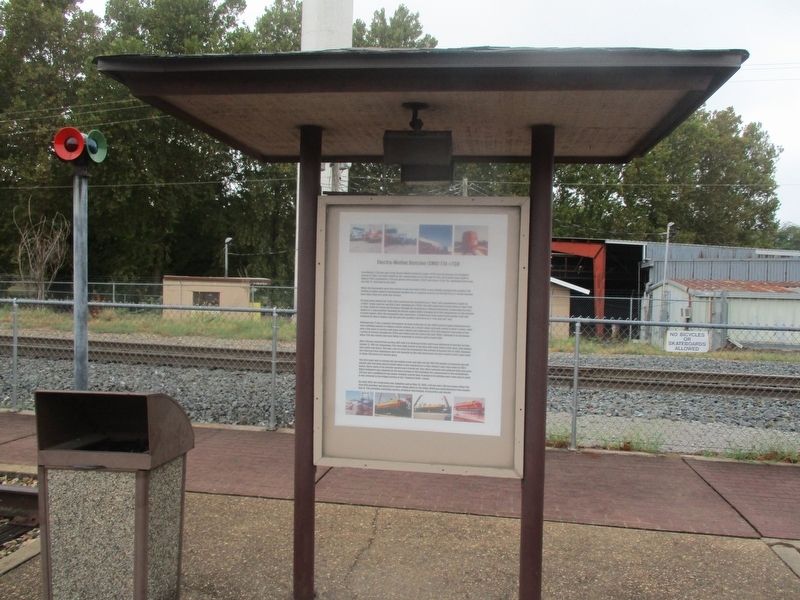
Electro-Motive Division (EMD) F7A #73D
Photographed by Marc Hayot, October 2, 2026
1. Kansas City Southern Railway Locomotive Marker
When the locomotive went into service in the last half of 1950, it was initially assigned the number 73d. Having an alpha-numeric designation number was a common practice on the KCS for its F-series locomotives when they first went into service.
At some point during the 1970s, KCS converted the locomotive to a "slug" and renumbered it again as #4060 (some sources say that it was renumbered #2040). The KCS converted at least three of their F7As to slugs, likely for better performance through the mountains of western Arkansas. Converting the locomotive to a slug involved removing the diesel engine while retaining all of the components for the electric traction motors. After the locomotive was converted, it would have been paired with another unit that retained its diesel engine,
this page online
After 73D was retired from service, KCS sold it to Peterson Farms and it was delivered to Decatur on September 17, 1991 for restoration. The rusty hulk arrived in Decatur with many holes in the nose, side panels, door wells and doors. This was a far cry from the locomotive that arrived in Kansas City in 1950, however the Peterson Farm employees were not daunted by the task ahead and set out to work in their spare time to bring 73D back to its former glory.
The first tasks was to remove the top engine cover and take out the 180,200 pounds of concrete and old wheels that had
Photographed by Marc Hayot, October 2, 2026
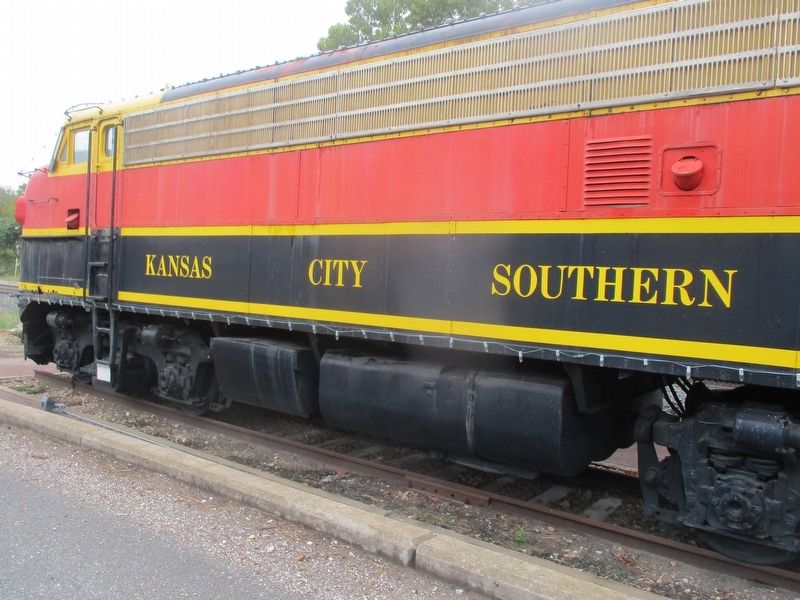
2. Kansas City Southern Railway Locomotive
By early 1993, the restoration was complete and on May 25, 1993, a 65-ton and a 90-ton cranes lifted 73D from KCS mainline and placed on a short siding where it sits today. KCSW was instrumental in the completion of 73D providing switching service, technical information, accessories and decals.
Erected 2012.
Topics. This historical marker is listed in these topic lists: Industry & Commerce • Railroads & Streetcars • Roads & Vehicles. A significant historical month for this entry is August 1950.
Location. 36° 20.074′ N, 94° 27.688′ W. Marker is in Decatur, Arkansas, in Benton County. It is on South Main Street (Arkansas Route 59), on the left when traveling east. The marker is located on the grounds of the Decatur Museum. Touch for map. Marker is at or near this postal address: 249 S Main Street, Decatur AR 72722, United States of America. Touch for directions.

Regionally, this marker is in Northwest Arkansas, on the Ozark Plateau, in the Cherokee Heritage Region, and in Osage Territory. It is also in the American South, specifically in the Upper South, and in the Ozarks. Globally, it is in North America, the Western Hemisphere, the Western World, and the Anglosphere. Historically, it finds itself in what was once the territory of the Mississippian Culture, the Louisiana Purchase, one of the Confederate States of America, and the Antebellum South.
Other nearby markers. At least 8 other markers are within 6 miles of this marker, measured as the crow flies: Kansas City Southern Caboose #385 (here, next to this marker); Mitchell House (approx. 4.7 miles away); Mitchell-Ward House (approx. 4.7 miles away); Carpenter Building (approx. 4.8 miles away); Carl and Evans House (approx. 4.8 miles away); Georgia Cemetery (approx. 5.4 miles away); Camp Jackson / Confederate Dead (approx. 5.4 miles away); Gentry Grand Army of the Republic Monument (approx. 5.9 miles away).
More about this marker. The marker is located in between the museum and the locomotive and caboose. It is on the front side of a marker containing the Electro-Motive Division (EMD) F7A #73D and the Kansas City Southern Caboose #385 which is on the reverse side.
Regarding Electro-Motive Division (EMD) F7A #73D. Locomotive #73D was part of the Electro-Motive Division's order #6142 that the Kansas City Southern placed in 1950. Although it is not known when 73D was retired, but most likely it remained in service until around 1980. After 73D was retired from service, KCS sold it to Peterson Farms and it was delivered to Decatur on September 17, 1991 for restoration.
Also see . . .
1. Kansas City Southern Railway Locomotive #73D and Caboose #385. This is the National Historic Register application for both Locomotive #73D and Caboose #385 which is also located on the premise.
Kansas City Southern Railway Locomotive #73D is a diesel-powered EMD F7A freight locomotive built by the Electro-Motive Division of General Motors in August 1950. It was operated by the Kansas City Southern until it was purchased by Peterson Farms and brought to Decatur in 1991.(Submitted on October 3, 2026, by Marc Hayot of Siloam Springs, Arkansas.)
2. Decatur icons get rubbed down and waxed. This is an article from the Westside Eagle-Observer from 2019 where the locomotive and caboose were refurbished.
After nearly 25 years since being hoisted into place by a pair of heavy-lift cranes, Decatur's iconic EMD F7A locomotive and its companion bay window caboose #385 finally received a much-needed face-lift.(Submitted on October 3, 2026, by Marc Hayot of Siloam Springs, Arkansas.)
Additional keywords. Transportation, Engineering, Kansas City Southern Railway
Credits. This page was last revised on October 5, 2026. It was originally submitted on October 3, 2026, by Marc Hayot of Siloam Springs, Arkansas. This page has been viewed 8 times since then. Photos: 1, 2. submitted on October 3, 2026, by Marc Hayot of Siloam Springs, Arkansas. • Andrew Ruppenstein was the editor who published this page.
